

5 Best Stainless Steel Moka Pots for Home Brewing
Table of Contents
- Why Stainless Steel Moka Pots Beat Aluminum in 2026
- Quick Comparison: Top 5 Stainless Steel Moka Pots
- 1. Fiamma & Ferro Linea Suprema 12-Cup Induction Moka Pot
- 2. Cuisinox Roma: The Classic 18/10 Stainless Steel Pick
- 3. Alessi Pulcina: Design-Forward Brewing for Small Kitchens
- 4. Giannini Giannina: The Italian Heritage Option for Induction Cooktops
- 5. Bialetti Venus: The Accessible Entry Point to Stainless Steel
- Stainless Steel vs Aluminum Moka Pot: Which Material Wins?
- Frequently Asked Questions
Last Updated: September 12, 2026
Why Stainless Steel Moka Pots Beat Aluminum in 2026
Stainless steel moka pots have become the default choice for home brewers who want a stovetop espresso maker that lasts, works on induction, and never leaves a metallic aftertaste in the cup. Aluminum still has loyalists, but the material argument has shifted.
The core reason is material stability. Aluminum is reactive: it pits, oxidizes, and can transfer flavor into acidic coffee over years of use. Stainless steel resists that. Grades like 18/10 and 304 stainless steel offer strong corrosion resistance, hold up to daily washing, and won't react with coffee oils the way bare aluminum can.
There's a practical angle too. Induction cooktops are now common in American kitchens, and aluminum moka pots simply don't work on them without a steel plate adapter. A stainless steel body with a magnetic base works directly.
At fiammaferro.com, we build our moka pots from 304 stainless steel with no aluminum, no plastic, and no paint in the brew path, because material purity is the whole point of upgrading. Below, we compare five stainless steel moka pots for home brewing, break down how we tested them, and explain what actually separates a good one from a great one.
Quick Comparison: Top 5 Stainless Steel Moka Pots
Here's the short version before the detail. Every pot below is stainless steel, induction compatible, and built for daily home use, but they differ sharply in capacity, finish, and who they suit.
| Moka Pot | Capacity | Material | Best For |
|---|---|---|---|
| Fiamma & Ferro Linea Suprema | 12-cup / 600 ml | 304 stainless, copper PVD finish | Induction owners wanting premium build |
| Cuisinox Roma | 6-cup | 18/10 stainless steel | Classic single-household brewing |
| Alessi Pulcina | 3-6 cup | Stainless steel | Small kitchens, design-first buyers |
| Giannini Giannina | 3-6 cup | Stainless steel | Induction cooktops, heritage buyers |
| Bialetti Venus | 2-10 cup | Stainless steel | First-time stainless buyers |
How We Tested These Moka Pots
We evaluated each pot on five criteria: heat distribution across the base, handle ergonomics during a full brew, gasket seal quality, how easily the filter basket and upper chamber cleaned up, and whether the safety release valve performed consistently under pressure. We also checked induction compatibility directly on a magnetic base test and brewed multiple batches at a medium-fine grind to compare extraction evenness.

Capacity claims were verified against actual yield, not marketing copy. A "6-cup" moka pot rarely fills six American mugs; it produces roughly six small espresso-style servings of about 1 to 1.5 ounces each.
1. Fiamma & Ferro Linea Suprema 12-Cup Induction Moka Pot
Our top pick is the Fiamma & Ferro Linea Suprema, a 20 oz / 600 ml (12-cup) induction moka pot built from 304 stainless steel with a copper PVD mirror finish. It's the most complete package here: no aluminum, no plastic, and no paint in contact with your coffee, plus a design that looks intentional on a counter rather than purely utilitarian.
What separates it in practice is the finish and the accessories. The copper PVD coating resists the dulling that plain brushed steel develops, and each pot ships with a protective canvas bag, full-color brew and care guides, and access to OEM replacement parts, including the silicone gasket. That last point matters more than most buyers realize: gaskets are the first component to wear out, and a pot with no replacement parts path becomes disposable.
Pros:
- 304 stainless steel, induction compatible
- No aluminum, plastic, or paint in the brew path
- Copper PVD finish holds its appearance
- OEM replacement gaskets and parts available
Cons:
- 12-cup capacity is more than a single daily drinker needs
- Premium price at $169.99
2. Cuisinox Roma: The Classic 18/10 Stainless Steel Pick
The Cuisinox Roma is the traditionalist's answer: a straightforward 18/10 stainless steel stovetop espresso maker with a clean, rounded silhouette and a 6-cup capacity. There's no finish gimmick here, just solid steel and a familiar shape.
It brews evenly and cleans up easily, and the 18/10 grade gives it good corrosion resistance for daily use. Where it falls short is capacity flexibility and accessories. You get the pot, and that's largely it. If you want a brew guide, a storage bag, or a documented replacement-parts channel, you won't find them in the box.
Pros:
- Reliable 18/10 stainless steel construction
- Simple, classic design
- Easy to hand wash
Cons:
- Limited capacity options
- No bundled accessories or brew guidance
- Handle can get warm on longer brews
3. Alessi Pulcina: Design-Forward Brewing for Small Kitchens
The Alessi Pulcina is the one you buy partly for how it looks. Its sculpted body and distinctive spout make it a genuine design object, and the smaller capacities suit tight kitchens and single servings.
The trade-off is practical. The Pulcina's shape, while striking, makes the upper chamber slightly harder to scrub than a straight-sided pot, and the smaller sizes mean you're brewing one or two servings at a time. For someone who values aesthetics as much as output, that's a fair exchange. For a household brewing for four, it isn't.
Pros:
- Distinctive, award-winning design
- Compact footprint for small kitchens
- Good heat distribution on the base
Cons:
- Awkward interior geometry to clean
- Small capacities only
- Design premium reflected in price
4. Giannini Giannina: The Italian Heritage Option for Induction Cooktops
Giannini has been making stovetop coffee makers in Italy for generations, and the Giannina carries that heritage with a stainless steel body designed to work on induction. The build quality is solid, and the brand's long history gives buyers confidence in the design.
The catch is availability and support. Giannini's distribution is thinner than the big names, so replacement gaskets and parts can be harder to source, and documentation is often Italian-first. If you're comfortable tracking down parts yourself, it's a rewarding pot. If you want a frictionless ownership experience, look elsewhere.
Pros:
- Long Italian manufacturing heritage
- Induction-ready stainless steel
- Solid, traditional build
Cons:
- Parts and gaskets harder to source
- Documentation not always English-first
- Limited retail presence
5. Bialetti Venus: The Accessible Entry Point to Stainless Steel
The Bialetti Venus is the easiest recommendation for a first stainless steel moka pot. It's widely available, comes in a broad range of capacities from 2-cup up to 10-cup, and its stainless steel body works on induction. The name recognition helps too: Bialetti is synonymous with the moka pot in most people's minds.
The compromise is in the details. The Venus is a mass-market product, so the finish is functional rather than refined, and the included documentation is minimal. It's a good pot to learn on. It's not the one you'll pass down.
Pros:
- Wide capacity range
- Easy to find in stores and online
- Induction compatible stainless steel
Cons:
- Functional rather than premium finish
- Minimal included guidance
- Gasket wear is a known long-term maintenance point
Stainless Steel vs Aluminum Moka Pot: Which Material Wins?
Stainless steel wins for most home brewers today, primarily because of induction compatibility, corrosion resistance, and flavor neutrality. Aluminum conducts heat faster and costs less, but it reacts with acidic coffee over time and won't work on induction without an adapter plate.
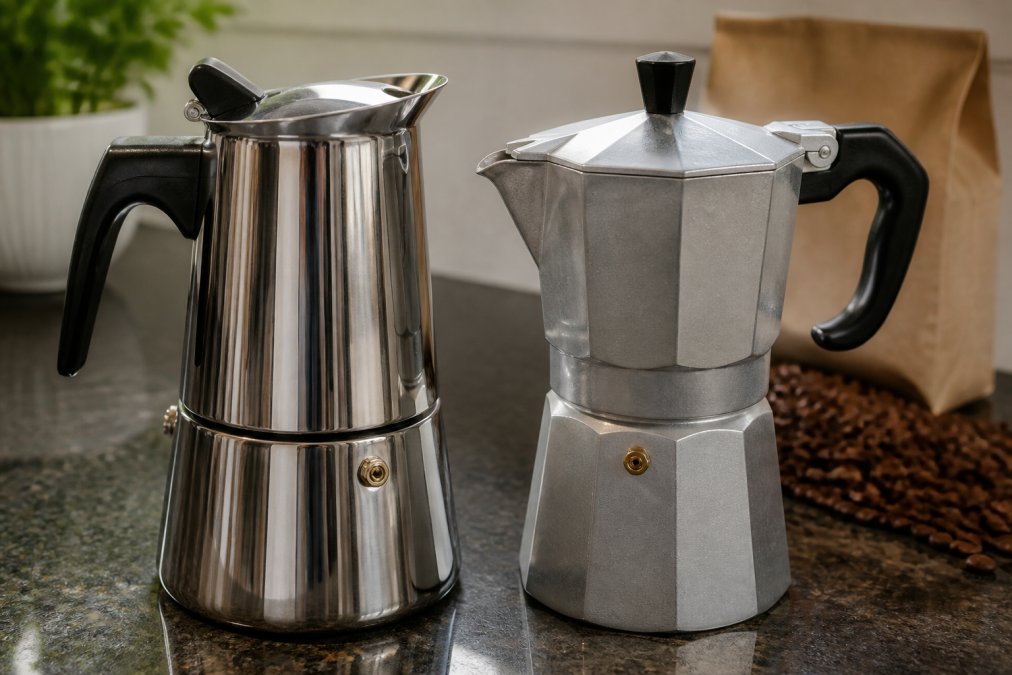
Here's the nuance most comparisons skip. Aluminum's thermal conductivity is roughly four to five times that of stainless steel, which is why an aluminum pot on a gas burner reaches brewing temperature noticeably faster (engineeringtoolbox.com). Stainless steel heats more slowly but spreads heat more evenly across the base, and that evenness tends to produce more consistent extraction across the filter basket. For grind consistency and even coffee extraction, that evenness matters more than raw speed.
That thermal difference changes how you should brew, not just how fast. Because stainless steel ramps up slowly, a common pattern is that the first water pushed through the puck is cooler than the target brew temperature, which can leave the cup tasting flat or sour. Most practitioners find that preheating the lower chamber with hot, not boiling, water before assembly closes that gap and stabilizes the extraction window. On aluminum, the same trick is less necessary and can even overshoot.
Grind size for stainless steel specifically. Grind size controls resistance in the filter basket. Too fine and you risk a choked brew and pressure buildup; too coarse and water races through with weak extraction. Medium-fine, roughly the texture of table salt, coarser than espresso, finer than drip, is the reliable zone for most moka pots. On stainless steel, because heat arrives more gradually, you can usually go one notch finer than you would on aluminum without stalling the brew, which is a small but real advantage for anyone chasing a fuller-bodied cup.
Water chemistry matters more than most owners assume. Hard water leaves calcium and magnesium scale that insulates the base, slows heat transfer, and eventually clogs the filter and safety valve. If your tap water leaves spots on glassware, it will scale a moka pot. Two practical responses: brew with filtered or softened water, and descale on a schedule rather than waiting for visible buildup. A common approach is a 1:1 white vinegar and water soak for 30 minutes, followed by a full water-only brew cycle to rinse. Stainless steel tolerates this well; bare aluminum does not, which is another reason the material argument tilts toward steel.
Environmental impact. Stainless steel is among the most recycled materials in the world and holds its value as scrap, and a well-maintained steel pot can realistically serve a household for a decade or more with only gasket swaps (the EPA). Aluminum is also recyclable, but the lower upfront cost and shorter typical service life push more pots into the waste stream. For buyers who want one pot for ten years rather than three, stainless is the lower-impact choice.
Frequently Asked Questions
Why choose stainless steel over aluminum for a moka pot?
Stainless steel moka pots resist corrosion and oxidization, so they hold up to daily use without pitting or reacting to acidic coffee oils. Aluminum is lighter and heats faster, but it can develop a metallic aftertaste over time and cannot go in a dishwasher. Stainless steel also works on induction cooktops, which aluminum does not unless it has a special base. For buyers who want a pot that lasts for years and keeps flavor clean, stainless steel is the safer long-term pick.
Are stainless steel moka pots induction compatible?
Not all of them. Induction compatibility depends on whether the base contains a magnetic layer, usually a ferritic stainless steel disc bonded to the bottom. Models like the Fiamma & Ferro Linea Suprema and the Giannini Giannina are built for induction, while some thinner stainless pots are not. Before buying, check the product listing for an explicit induction-compatible claim. If you own an induction cooktop, this is the single most important spec to verify.
What grind size works best for a moka pot?
A medium-fine grind, slightly coarser than espresso but finer than drip, gives the most consistent extraction. Too fine and the filter basket clogs, building pressure that can push water past the gasket; too coarse and water runs through without pulling full flavor. If you use a manual grinder, aim for a texture like fine table salt. Pairing the right grind with a stainless steel moka pot keeps brewing temperature and pressure steady, which is where espresso-like strength comes from.
How long does a stainless steel moka pot last?
With regular hand washing and timely gasket replacement, a stainless steel moka pot can last a decade or more. The gasket seal is the part that wears first, usually every 6 to 12 months depending on use, and it is inexpensive to replace. Corrosion resistance in 18/10 stainless steel means the body and filter basket hold up far longer than aluminum. Buying a model with available OEM replacement parts, like gaskets and handles, extends the working life considerably.