

How to Clean a Stainless Steel Moka Pot
Table of Contents
- What You'll Need Before You Start
- How to Clean Your Stainless Steel Moka Pot: Daily Routine
- Deep Clean a Stainless Steel Moka Pot: Descaling and Mineral Deposits
- How to Remove Coffee Stains from Stainless Steel
- Component-Specific Maintenance: Gasket, Filter Plate, and Coffee Stem
- How Often to Clean Your Moka Pot
- Best Cleaning Tools for Stovetop Espresso Makers
- Post-Cleaning Seasoning: Why It Matters and How to Do It
- Frequently Asked Questions
Last Updated: September 1, 2026
What You'll Need Before You Start
Gather the right materials before cleaning, and the process takes minutes. Here's what you'll need:
- Warm water
- Soft cloth or microfiber towel
- Non-abrasive sponge (soft side only)
- White vinegar
- Citric acid powder (food-grade)
- Baking soda
- Small soft-bristle brush (an old toothbrush works well)
- Dish soap (mild, fragrance-free, use sparingly and only when needed)
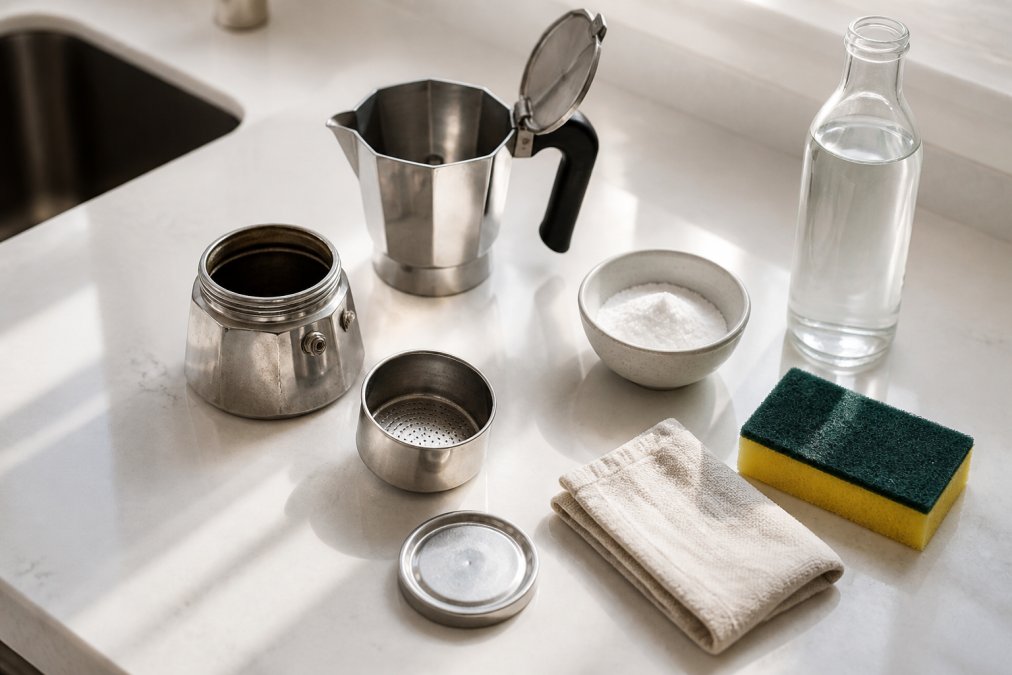
Stainless steel moka pots, particularly food-grade 304 stainless like the Fiamma & Ferro Linea Suprema, are more resistant to corrosion than aluminum and don't react with acidic cleaning agents. This gives you more flexibility with natural cleaners like citric acid and white vinegar. Keep abrasive scrubbers and harsh chemical cleaners away entirely, they damage the protective surface layer.

How to Clean Your Stainless Steel Moka Pot: Daily Routine
The most common mistake is over-cleaning. Soap after every brew and aggressive scrubbing strip the thin layer of coffee oils that builds up on interior walls and improves flavor over time. Daily maintenance should be gentle and fast.
Disassembly and Rinsing
After each brew, allow the moka pot to cool completely before disassembling to avoid burns and warping. Unscrew the upper and lower chambers, remove the funnel and filter plate, and lift out the silicone gasket. Rinse each component under warm running water and wipe away visible coffee grounds with your fingers or a soft cloth.
Avoid dish soap for routine cleaning. Many experienced users skip soap entirely for the interior, relying on hot water alone. If you use soap occasionally, apply only a tiny amount to the exterior and rinse thoroughly.
Drying to Prevent Moisture and Corrosion
Moisture trapped in threaded gaps, around the gasket seat, or inside the filter plate creates conditions for mineral deposits, corrosion, and off-flavors. After rinsing, dry every component individually with a soft cloth, paying special attention to the threaded connections, filter plate underside, chamber walls, and the gasket groove. Reassemble only when all parts are fully dry.
Deep Clean a Stainless Steel Moka Pot: Descaling and Mineral Deposits
Mineral buildup from your water supply accumulates on interior walls and the filter plate, creating visible white or gray crust that affects heat distribution and flavor. According to guidance from the NSF on home appliance sanitation, mineral scale from hard water is one of the most common maintenance issues in home coffee equipment, and regular descaling is the recommended solution.
Citric Acid and White Vinegar for Descaling
Citric acid is the most effective descaling agent for stainless steel coffee equipment, dissolving mineral deposits efficiently without residual odor.

Citric acid descaling method:
- Dissolve one to two teaspoons of food-grade citric acid powder in a full lower chamber of cold water.
- Reassemble the moka pot without coffee grounds in the funnel.
- Place on low heat and allow the solution to work through the system.
- Once the upper chamber fills, remove from heat and cool.
- Disassemble and rinse all components thoroughly under warm running water.
- Run one full brew cycle with plain water before making coffee again.
White vinegar works on the same principle using a 50/50 mixture of vinegar and water, though citric acid leaves no odor and is preferred by most users.
Baking Soda for Coffee Oil and Residue Buildup
Baking soda is a mild alkaline agent that breaks down coffee oils and organic residue without scratching stainless steel.
Baking soda cleaning method:
- Make a paste using baking soda and a small amount of warm water.
- Apply to interior walls using a soft cloth or non-abrasive sponge.
- Gently scrub in circular motions, focusing on dark staining or oily film.
- Rinse thoroughly until no baking soda residue remains.
- Dry completely before reassembly.
Use this method monthly or whenever you notice visible oily film. Do not combine baking soda and vinegar in the same session, the reaction neutralizes both agents.
How to Remove Coffee Stains from Stainless Steel
Coffee stains fall into two categories requiring different approaches.
Visual Identification: Oxidation vs. Coffee Oil Staining
Oxidation appears as dull, grayish, or iridescent discoloration near the base or threaded connection, caused by moisture exposure or harsh chemicals compromising the protective chromium oxide layer.
Coffee oil staining presents as dark brown or black film on interior walls and filter plate, from polymerized coffee oils accumulating over brew cycles.
Stain Type |
Appearance |
Cause |
Treatment |
|---|---|---|---|
Coffee oil buildup |
Dark brown/black, oily film |
Polymerized coffee oils |
Baking soda paste, gentle scrub |
Mineral deposits |
White/gray crust |
Hard water scale |
Citric acid or white vinegar solution |
Oxidation |
Dull gray or iridescent sheen |
Moisture, harsh chemicals |
Mild soap, thorough dry, prevention |
For oxidation, prevention is most effective: dry the pot completely after every wash and avoid abrasive scrubbers. Light surface oxidation can be addressed with a soft cloth dampened with white vinegar, followed by thorough rinsing and immediate drying.
Component-Specific Maintenance: Gasket, Filter Plate, and Coffee Stem
Each component has its own failure mode and maintenance requirement.

Caring for the Silicone Gasket
The silicone gasket seals the lower and upper chambers and takes the most mechanical stress. Inspect it every cleaning cycle for cracks, tears, deformation, stiffness, leaking, or persistent rubbery taste.
For routine cleaning, rinse under warm water and wipe with a soft cloth. Avoid extended soaks in acidic solutions. If the gasket has absorbed coffee oils and odor, a brief soak in mild baking soda solution followed by thorough rinsing is effective. Replace worn gaskets rather than continuing with a compromised seal. The Fiamma & Ferro Linea Suprema 12-Cup Silicone Gasket Set provides food-grade OEM replacement seals at fiammaferro.com.

Cleaning the Filter Plate and Coffee Stem
The filter plate's small perforations clog with compacted grounds and coffee oils, restricting flow and producing uneven extraction. After each brew, rinse under running water and use a soft-bristle brush to clear perforations. Weekly, soak for 10-15 minutes in citric acid or baking soda solution, then scrub gently and rinse thoroughly.
The coffee stem should receive the same treatment, with special attention to the threaded base where grounds and oils accumulate. If damaged, the Stainless Steel Replacement Funnel for the Linea Suprema is a precision-fit OEM component.
How Often to Clean Your Moka Pot
Cleaning frequency depends on brewing frequency and water type.
Cleaning Type |
Frequency |
Method |
|---|---|---|
Daily rinse and dry |
After every brew |
Warm water, soft cloth |
Baking soda deep clean |
Monthly |
Baking soda paste, soft scrub |
Descaling (citric acid) |
Every 1-3 months |
Citric acid solution, full brew cycle |
Gasket inspection |
Every 2-4 weeks |
Visual check, replace when worn |
Filter plate soak |
Weekly |
Citric acid or baking soda solution |
Water Quality and Cleaning Frequency
Hard water with high dissolved calcium and magnesium leaves mineral deposits significantly faster than soft water. If your tap water leaves white spots on glassware, you have hard water and should descale more frequently. According to the U.S. Geological Survey's water hardness data, much of the central and southwestern United States has moderately hard to very hard water, requiring descaling every four to six weeks.
Using filtered water is the most effective way to reduce mineral buildup and improve coffee flavor, since water quality directly affects extraction.
Best Cleaning Tools for Stovetop Espresso Makers
Recommended:
- Soft microfiber cloths for drying and wiping
- Non-abrasive sponge (soft side only)
- Small soft-bristle brush for perforations and threaded gaps
- Food-grade citric acid powder
- Baking soda
- White vinegar (distilled)
What to Avoid: Abrasive Scrubbers and Harsh Chemicals
Abrasive scrubbers, including the rough side of kitchen sponges, steel wool, and scouring pads, scratch stainless steel at a microscopic level, creating sites where moisture and oils accumulate and accelerating staining and corrosion. A single aggressive scrubbing session can undo months of careful maintenance.
Harsh chemical cleaners, including bleach-based products and strong alkaline degreasers, compromise the passive chromium oxide layer that gives stainless steel its corrosion resistance. According to the FDA's guidance on food-contact materials, food-contact surfaces should only be cleaned with agents specifically approved for that purpose. Stick to food-safe options: citric acid, baking soda, and white vinegar are all effective and safe.
The dishwasher is also unsuitable. Dishwasher detergents are highly alkaline and abrasive, high heat cycles warp gaskets and deform threaded connections, and forced water jets drive moisture into difficult-to-dry areas.
Post-Cleaning Seasoning: Why It Matters and How to Do It
Seasoning rebuilds the thin layer of coffee oils on interior surfaces after a deep clean. This layer, or "patina," acts as a natural flavor buffer between the metal and coffee. Without it, the first few brews after a deep clean often taste slightly metallic or flat.
Here's how to season after any deep cleaning:
- Reassemble the pot with all components dry and clean.
- Fill the funnel with your regular coffee grounds.
- Brew a full cycle as normal.
- Discard the brewed coffee.
- Rinse with warm water only, no soap or cleaning agents.
- Brew a second cycle and discard again.
- On the third brew, the coffee oils will have re-established a thin patina, and flavor should return to normal.
Cleaning removes harmful buildup; seasoning restores the flavor-protecting layer. They work together. For the Fiamma & Ferro Linea Suprema, the 304 stainless steel interior develops a stable patina quickly and holds it well between deep cleans. For more guidance on maintaining food-contact equipment safely, the USDA food safety resources on equipment sanitation provide useful reference standards.
Keeping a stainless steel moka pot in peak condition requires consistent daily habits and periodic deep cleaning with non-toxic agents. The Fiamma & Ferro Linea Suprema is built from food-grade 304 stainless steel with no aluminum and no coatings, making it more forgiving to maintain and more durable over time. When components wear, OEM replacement parts including silicone gasket sets and precision-fit funnels are available at fiammaferro.com, so the pot stays in service for years. Get started with proper care from day one and the Linea Suprema will reward you with consistently clean, full-bodied coffee for the long term.
Frequently Asked Questions
Can you put a stainless steel moka pot in the dishwasher?
Dishwashers are not recommended for stainless steel moka pots. The high heat and harsh detergents strip the natural coffee oil seasoning from the metal, which dulls flavor over time. Threaded gaps and the silicone gasket also trap water in a dishwasher cycle, promoting moisture buildup. Hand-washing with warm water and a soft cloth keeps the pot in better condition and preserves the brew quality you worked to build up.
Is it safe to use vinegar to clean a moka pot?
White vinegar is safe and effective for descaling a stainless steel moka pot. Mix equal parts white vinegar and water, fill the lower chamber, and run a brew cycle without coffee. Follow with two plain water cycles to rinse any vinegar residue fully. Avoid soaking the pot in undiluted vinegar for extended periods, as prolonged acid exposure can affect threaded areas. Citric acid dissolved in warm water is a gentler alternative for regular descaling.
How do I clean an oxidized moka pot?
Oxidation on a stainless steel moka pot typically appears as dull gray or brownish patches, distinct from the dark brown film left by coffee oils. For light oxidation, a paste of baking soda and water scrubbed gently with a soft cloth usually restores the surface. For heavier buildup, a citric acid soak — roughly one tablespoon per liter of warm water for 20 to 30 minutes — dissolves mineral deposits and surface oxidation without damaging the steel.
How often should you clean a moka pot?
Rinse the moka pot with warm water after every use and dry it completely before storing. A deeper clean using citric acid or baking soda should happen once a month under normal use. If your tap water is hard — meaning it carries high mineral content — descale every two to three weeks. A metallic taste in your coffee or visible white mineral deposits inside the lower chamber are reliable signs that a deep clean is overdue.