

Best Manual Coffee Grinder for Precision Brewing
Table of Contents
- What Precision Brewing Actually Demands From a Grinder
- Manual Coffee Grinder Burr Types: Conical, Flat, and Material Choices
- Grind Size Chart for Stovetop Espresso and Other Brew Methods
- How to Calibrate a Manual Coffee Grinder for Repeatable Results
- Ergonomics and Physical Effort: Who Can Actually Use a Manual Grinder
- Long-Term Maintenance, Spare Parts, and Burr Life
- What to Look For in a Manual Coffee Grinder: Comparison Table and Pros/Cons
- Objective Particle Size Analysis: Why Micron Consistency Matters
- Conclusion
- Frequently Asked Questions
Last Updated: September 12, 2026
What Precision Brewing Actually Demands From a Grinder
Precision brewing demands a grinder that produces a narrow particle distribution, holds its setting across sessions, and lets you adjust in small, repeatable increments. A manual coffee grinder that slips between adjustments or throws a wide spread of fines and boulders will undermine even a perfect recipe, which is why grind quality sits upstream of every other variable in the cup.

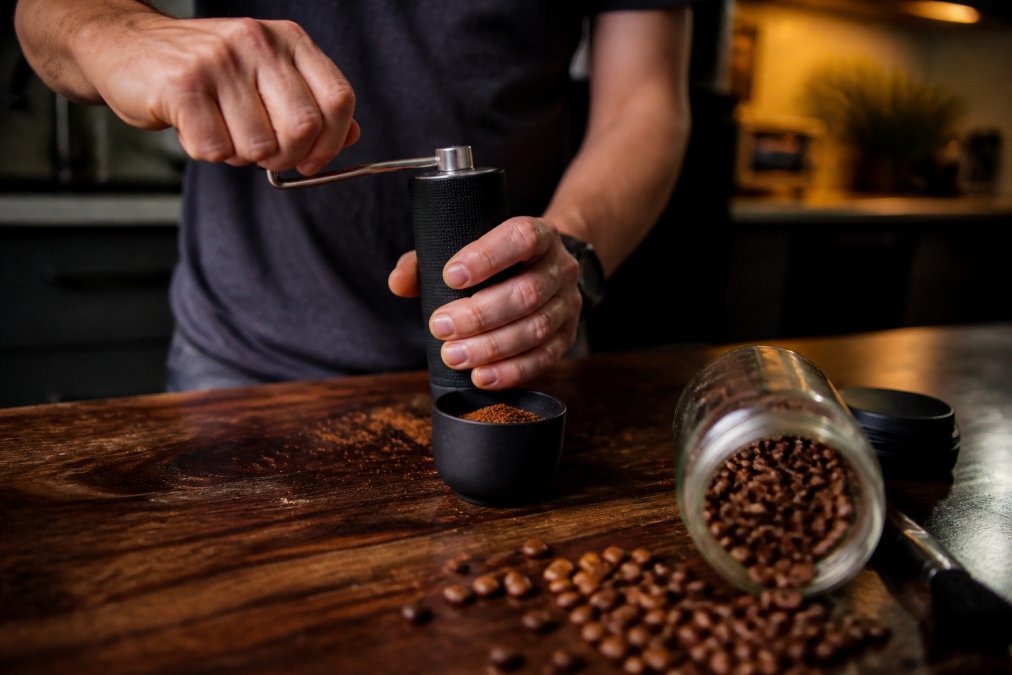
At fiammaferro.com, we build grinders for people who treat the morning brew as a deliberate process rather than a rushed one. The equipment matters less than the consistency it delivers. Three demands define that consistency:
- Uniformity: most particles land in the same size band, so water extracts them at the same rate
- Repeatability: the same setting produces the same result tomorrow as it did today
- Range: enough adjustment steps to move between espresso-fine and French-press-coarse without dead zones
- Stability: the burr stays aligned under load and does not drift mid-grind
Miss any one of these and you spend your mornings chasing variables instead of drinking coffee. The Specialty Coffee Association's brewing standards treat grind consistency as a foundation of repeatable extraction, not an optional refinement.
Manual Coffee Grinder Burr Types: Conical, Flat, and Material Choices
Manual coffee grinder burr types fall into two families: conical burrs, which crush beans between a cone and a ring, and flat burrs, which shear them between two parallel discs. Conical sets dominate hand grinders because they need less torque to turn, while flat burrs typically produce a tighter particle distribution at the cost of more effort per rotation.
Stainless Steel vs. Ceramic Burrs
Stainless steel burrs hold an edge longer, resist chipping, and handle the hard, lightly roasted beans that many home brewers prefer. Ceramic burrs stay sharp for a long time but crack under a dropped grinder or a stray rock in the bean bag. Hardened steel is the safer long-term bet, and titanium coatings add wear resistance without changing the cut geometry.
Burr Geometry and Particle Distribution
Burr geometry, meaning the angle, tooth pattern, and length of the cutting path, determines how narrow your particle distribution ends up. A well-designed conical set produces fewer fines and boulders than a cheap stamped burr, and that difference shows up directly in extraction yield. The NIST guide to particle size measurement explains why distribution, not average size, drives how a bed of coffee behaves under water.
Grind Size Chart for Stovetop Espresso and Other Brew Methods
A grind size chart for stovetop espresso gives you a starting point, not a final answer. Every grinder numbers its settings differently, so treat these as relative positions and dial in from there.
Brew Method |
Grind Setting |
Particle Size |
Adjustment Notes |
|---|---|---|---|
Stovetop espresso (moka pot) |
Fine, just shy of espresso |
Fine sand |
Coarser than pump espresso to avoid choking the basket |
Espresso |
Finest setting |
Powdered sugar |
Smallest steps, most sensitive to change |
Pour over |
Medium-fine |
Table salt |
Adjust one step at a time |
AeroPress |
Medium |
Table salt to coarse sand |
Forgiving across a two-step window |
French press |
Coarse |
Breadcrumbs |
Too fine and the plunger turns muddy |
The moka pot is the pickiest of the group. Grind too fine and the basket clogs, pressure builds, and the brew turns bitter and sputtering. Grind too coarse and water races through, leaving a thin, sour cup.
How to Calibrate a Manual Coffee Grinder for Repeatable Results
Calibrating a manual coffee grinder means finding its true zero point, marking a reference setting, and recording the number that produced your best cup. Without a recorded reference, every adjustment becomes guesswork.
Zero-Point Calibration and Dialing In
Zero-point calibration is the process of tightening the burrs until they just touch, then backing off to a known starting position. Here is the sequence:
- Empty the hopper and brush out any retained grounds
- Turn the adjustment ring clockwise until you feel the burrs contact, then stop
- Back off one full rotation to establish your working zero
- Grind a small dose at your target setting and inspect the particles
- Adjust one step at a time, noting each change, until the cup tastes balanced
- Record the final setting and the dose weight for next time
The dial-in process rewards patience. Change one variable per brew, and write down what you did. After a week you will have a personal reference chart that beats any published chart.
Ergonomics and Physical Effort: Who Can Actually Use a Manual Grinder
Ergonomics decide whether a manual grinder stays on your counter or ends up in a drawer. The variables that matter most are crank length, handle grip diameter, the torque required at fine settings, and whether the body can be braced against a counter or held between the knees.
Fine espresso settings demand noticeably more torque than coarse French-press settings, and that load lands on the wrist, forearm, and shoulder. For anyone with limited grip strength, arthritis, or a repetitive-strain history, a longer crank and a wider, textured handle make the difference between a comfortable grind and a painful one.
The Physics of Turning a Burr
Torque is force applied at a distance from the axis, so crank length is the single biggest lever you have over effort. A crank that is 20 percent longer reduces the force you must apply by roughly the same proportion for the same resistance at the burr. That is why a long-handled grinder can feel easy at a setting where a short-handled one stalls.
Two other factors compound the load:
- Burr diameter. A larger burr has more cutting edge in contact with the bean at any instant, which spreads the work but raises the peak force needed to start the turn.
- Bean density. Hard, lightly roasted beans resist the burr more than dark, brittle roasts, so the same grinder feels heavier on a light-roast Ethiopian than on a dark-roast blend.
Matching the Grinder to Your Hands
A few practical patterns hold across most hand grinders:
- Small hands or a weak grip. A narrower body that fits the palm, a wide textured handle, and a shorter crank you can turn with the wrist rather than the whole arm.
- Larger hands. A wider grip diameter reduces the finger curl needed to hold on, which lowers fatigue over a full dose.
- Arthritis or a repetitive-strain history. Prioritize a body you can brace against the counter or between the knees, so the stabilizing work comes from your torso instead of your wrist.
- Shared kitchens. A grinder that one person can turn comfortably at espresso-fine may be unusable for another, so test at the finest setting you actually brew, not at a coarse setting that flatters every grinder.
Grind Speed Is a Trade-Off, Not a Win
What most reviews miss is that grind speed and effort are trade-offs. A burr that cuts fast usually needs more force per rotation than a slower, more gradual set. Neither is better in the abstract; the right choice depends on how much resistance your hands can comfortably manage every morning. A grinder that finishes a dose in 30 seconds but leaves your forearm aching is worse for daily use than one that takes 45 seconds and feels effortless.
Long-Term Maintenance, Spare Parts, and Burr Life
Long-term ownership comes down to three things: how often you clean, whether replacement parts exist, and how long the burrs hold their edge. Hand grinders have few failure points, but the ones that do fail, a stripped adjustment thread or a worn burr, are fatal if no spares are available.
A practical maintenance routine looks like this:
- Brush the burr chamber weekly to clear retained grounds and oils
- Disassemble and deep-clean the burrs monthly
- Check the adjustment ring for play or drift every few months
- Inspect the burr edges annually for rounding or chips
- Confirm replacement burrs and gaskets are still in stock before you need them
Retention, the grounds left behind in the chamber after a grind, matters more than most owners realize. Stale retained grounds mix into the next dose and flatten the flavor. Cleaning frequency directly controls how much of yesterday's coffee ends up in today's cup.
What to Look For in a Manual Coffee Grinder: Comparison Table and Pros/Cons
The best manual coffee grinder for precision brewing balances burr quality, adjustment resolution, ergonomics, and serviceability. Here is how the main options compare against the criteria that actually affect the cup.
Priority |
What to Look For |
Why It Matters |
Trade-Off |
|---|---|---|---|
Grind consistency |
Hardened conical burrs, tight tolerances |
Narrow particle distribution |
Higher upfront cost |
Adjustment |
Stepless or high-step count |
Repeatable dial-in |
Finer control takes longer to learn |
Ergonomics |
Long crank, wide textured handle |
Less wrist strain at fine settings |
Bulkier body |
Durability |
Steel burrs, replaceable parts |
Years of service |
Needs periodic maintenance |
Portability |
Light body, compact footprint |
Travel and small kitchens |
Smaller hopper capacity |
The Fiamma & Ferro Titanium+ Professional-Grade Manual Coffee Grinder ($229.00) is our top pick for precision brewing. It pairs CNC-cut titanium-coated burrs with 180 grind settings and a designed burr life of more than 500 kilograms, backed by a 10-year burr performance warranty. The titanium coating adds wear resistance at the cutting edge, and the step count gives you the fine adjustment that espresso and moka pot brewing require.

Where it falls short: it is a dedicated home grinder, not a featherweight travel unit, and the 180-step range rewards a brewer willing to log settings rather than twist and hope. For anyone who wants a single grinder to cover espresso through French press, that range is the point.
The Fiamma & Ferro Espresso Ritual Bundle ($399.98) pairs the Titanium+ grinder with a stainless steel stovetop espresso maker for brewers building a complete moka pot setup. Grind fresh, brew immediately, and the two tools cover the workflow end to end.
Objective Particle Size Analysis: Why Micron Consistency Matters
Objective particle size analysis measures the actual spread of ground coffee in microns rather than relying on how it feels between your fingers. Two grinders can produce the same average particle size and behave completely differently, because one delivers a tight band and the other scatters fines and boulders across a wide range.
Fines, the dust-like particles, over-extract and turn bitter. Boulders, the oversized chunks, under-extract and taste sour. A grinder that produces both at once gives you a cup that is bitter and sour simultaneously, which is the telltale signature of poor particle distribution. Micron consistency, the tightness of that spread, is the single best predictor of whether a grinder can support precision brewing.
How Particle Size Is Actually Measured
The measurement methods come from materials science, not coffee. The ASTM standards for particle size analysis define the sieve and laser-diffraction techniques used across industries, and the same principles apply to a scoop of coffee.
- Sieve analysis. A stack of woven-wire sieves with progressively smaller openings sorts a sample by size. You shake a known weight of grounds through the stack, then weigh what lands on each screen. The result is a distribution by mass, reported as the percentage retained on each sieve.
- Laser diffraction. A beam of light passes through a dispersed sample, and the angle at which particles scatter the light indicates their size. This gives a full distribution curve in seconds and is the method most commercial labs use.
- Image analysis. A camera and software measure individual particles, which is useful for spotting shape differences that sieving and diffraction miss.
For a home brewer, sieve analysis is the practical option. A set of test sieves in the range that covers your brew method lets you reproduce the same measurement a lab would run.
Reading a Distribution Curve
A distribution curve plots particle size on one axis and the amount of coffee at each size on the other. The shape tells you more than any single number:
- A narrow, tall peak means most particles cluster near one size. This is what precision brewing wants.
- A wide, flat curve means the coffee is spread across many sizes, so some particles over-extract while others under-extract.
- A long tail toward the fines signals excessive dust, which usually shows up as bitterness and a muddy cup.
- A second bump at the coarse end signals boulders, which usually show up as sourness and a thin body.
A common pattern is that two grinders with identical average particle size produce very different curves, and the one with the tighter curve tastes cleaner and more balanced at the same recipe.
What This Means When You Choose a Grinder
This is where a technical approach beats a feature checklist. Instead of counting settings or admiring the finish, ask what the burr geometry does to the distribution. A well-designed conical set produces fewer fines and boulders than a cheap stamped burr, and that difference shows up directly in extraction yield. The NIST guide to particle size measurement explains why distribution, not average size, drives how a bed of coffee behaves under water.
A practical test you can run at home: grind a fixed dose at a fixed setting, sieve it, and weigh the fractions. Repeat the test after a month of use. If the fines fraction grows, the burr edge is dulling and the distribution is widening, which is your signal that a replacement burr is due.
Conclusion
The hard part of choosing a manual grinder is not finding one that turns; it is finding one that holds a setting, spreads particles tightly, and stays serviceable for years. Most buyers optimize for looks or price and end up fighting inconsistency every morning.
Fiamma & Ferro builds for the opposite priority. The Titanium+ Precision Manual Grinder brings CNC-cut titanium-coated burrs, 180 grind settings, a 500kg+ designed burr life, and a 10-year burr performance warranty to a single countertop tool. Pair it with our induction-ready stainless steel stovetop espresso maker and you have a complete, plastic-free brewing system built around repeatable results.
Get started with Fiamma & Ferro and brew richer, cleaner coffee with a grinder you can dial in and trust.
Frequently Asked Questions
Why is a manual grinder better for precision brewing?
Manual grinders give you direct control over particle size without the heat buildup that electric motors create. That heat can alter delicate coffee oils before you even brew. With a manual coffee grinder, you feel the resistance of the beans, which gives you tactile feedback on burr sharpness and bean density. The result is a more consistent grind, which means more even extraction and better flavor in your cup.
What features should I look for in a high-end manual coffee grinder?
Prioritize conical burrs made from hardened stainless steel or titanium-coated steel, stepless or high-step adjustment (180 settings or more), and a build that minimizes burr wobble. Check for zero-point calibration so you can return to a known reference. Look at hopper capacity, grip ergonomics, and whether replacement burrs are available. A grinder with a published burr life rating, like 500kg or more, signals the manufacturer expects long-term use.
How do I calibrate a manual coffee grinder for different brew methods?
Start by finding your grinder's zero point, where the burrs just touch. From there, count clicks or turns to reach each brew method. For stovetop espresso, you typically want a fine grind, around 200-300 microns, which is coarser than true espresso but finer than pour over. Use a grind size chart for stovetop espresso as your baseline, then adjust one step at a time based on taste. Sour means grind finer; bitter means grind coarser.
Are stainless steel burrs better than ceramic for manual grinders?
Stainless steel burrs hold a sharp edge longer and resist chipping, which makes them better for dense, light-roasted beans. Ceramic burrs stay cooler and resist corrosion, but they can crack if you drop the grinder or hit a stone. For precision brewing, stainless steel or titanium-coated steel is the more durable choice. The coating adds surface hardness without changing the burr geometry, so particle distribution stays consistent over years of use.