

Timemore vs 1zpresso Grinder Review: 2026 Comparison
Table of Contents
- Timemore vs 1zpresso: How These Two Brands Compare in 2026
- The Best Manual Coffee Grinder for Espresso: What Actually Matters
- Coffee Grind Size Chart for Moka Pots: Why It Differs From Espresso
- How to Calibrate a Manual Coffee Grinder for Consistent Results
- Price, Value, and Long-Term Ownership Costs
- Where a Third Option Fits: The Fiamma & Ferro Titanium+
- Conclusion
- Frequently Asked Questions
Last Updated: September 12, 2026
Timemore vs 1zpresso: How These Two Brands Compare in 2026
A Timemore vs 1zpresso grinder review comes down to one practical question: which hand grinder gives you more usable cups per dollar over five years of daily brewing? Both brands built their reputations on CNC-machined burrs and stepless-style adjustment. At fiammaferro.com, we test manual grinders against the same standard we apply to our own Titanium+ grinder: burr geometry, adjustment repeatability, and durability after hundreds of grinding cycles.
The short answer: Timemore favors lighter bodies and lower entry prices, while 1zpresso leans toward external adjustment and espresso-focused burr sets. Neither is automatically better.
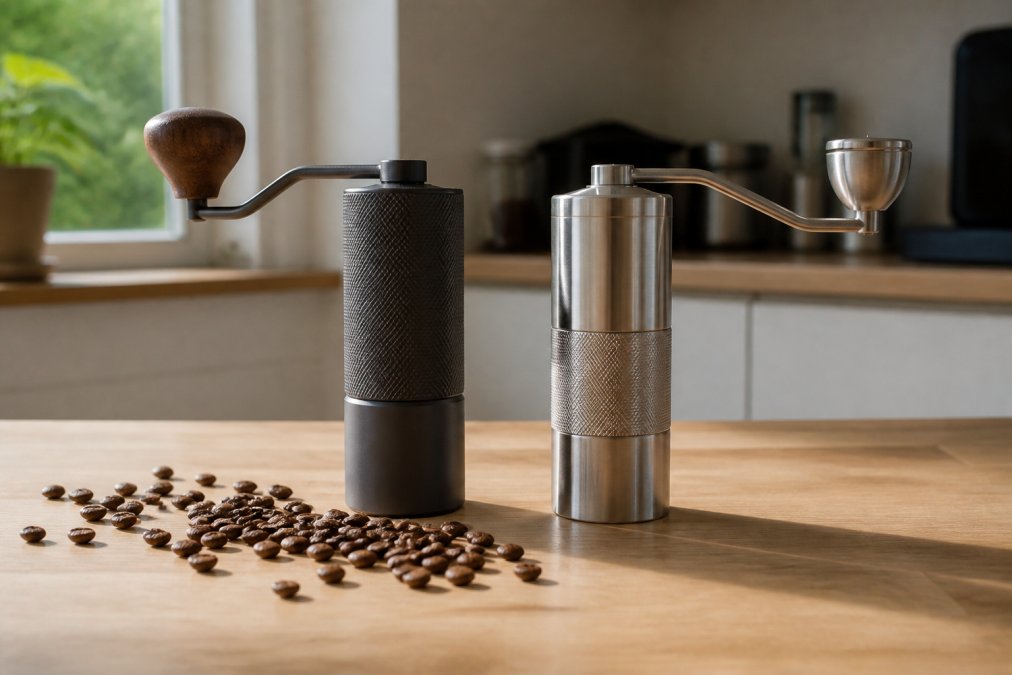
Burr Sets and Build Materials
Timemore's core models use hardened stainless steel burrs in aluminum or stainless bodies, keeping weight down. 1zpresso uses stainless steel burrs too, but pairs them with heavier machined bodies and, on several models, heptagonal or pentagonal burr geometry rather than a conventional conical profile.
That difference matters for flavor. Pentagonal and heptagonal burrs tend to produce a more uniform particle distribution at fine settings, which reduces astringency in espresso. Conventional conical burrs, like those in many Timemore models, favor clarity and body at medium grinds.
One thing most reviews skip: aluminum bodies feel lighter but transfer heat faster from your palm, subtly warming beans during a long grind. Stainless stays cooler but adds weight.
Grind Adjustment Systems
Adjustment is where these two brands diverge most. Timemore typically uses internal adjustment: you remove the catch cup and turn a dial under the burr. It works, but dialing in espresso requires repeated disassembly and small changes are hard to track.
1zpresso moved most of its lineup to external adjustment rings with numbered clicks. You can shift from moka pot to pour-over to espresso without opening the grinder, and you can log a setting and return to it exactly.
For anyone brewing the same way every morning, internal adjustment is fine. For anyone switching methods daily, external adjustment saves time and reduces waste.
| Feature | Timemore (typical) | 1zpresso (typical) |
|---|---|---|
| Adjustment | Internal dial | External numbered ring |
| Body material | Aluminum or stainless | Machined stainless |
| Burr profile | Conical | Conical, pentagonal, heptagonal |
| Espresso range | Narrower | Wider |
| Weight | Lighter | Heavier |
The Best Manual Coffee Grinder for Espresso: What Actually Matters
The best manual coffee grinder for espresso holds a repeatable fine setting under load, not the most clicks. Espresso exposes inconsistency faster than any other method because a small shift in particle size changes flow rate and extraction dramatically (PubMed).

Three factors decide whether a hand grinder works for espresso:
- Burr alignment, misaligned burrs produce a mix of fines and boulders, which channels water through the puck.
- Adjustment resolution, you need steps small enough to move extraction by a few seconds, not a few grams.
- Torque at fine settings, a grinder that stalls or flexes at espresso range will wear unevenly.
Cheaper grinders often advertise "espresso capable" while offering steps too coarse to dial in, the most common mistake buyers make.
Burr Geometry and Espresso Range
Conical burrs cut beans between a cone and a ring, producing a bimodal distribution that suits moka pots and French press. Flat and multi-faceted burrs cut more uniformly, suiting espresso.
1zpresso's heptagonal burrs sit closer to that flat-burr behavior, which is why the brand gets recommended for espresso more often. Timemore's conical burrs still work for espresso, but you have less room to fine-tune before the shot turns sour or bitter.
Taste Profile Calibration: Dialing Each Design to the Same Shot
This is the part most comparisons skip. Because the two brands use different burr geometry and adjustment mechanisms, the same click number does not mean the same particle size. Here is how to calibrate each design toward a balanced shot rather than chasing a shared number.
Start from a known reference. Pull one shot at a repeatable setting. Note the time from first drip to the end of the shot and the taste: fast and sour means under-extracted, slow and bitter means over-extracted.
On a 1zpresso with an external numbered ring:
- Move in single clicks; one click shifts extraction by a small but measurable amount at espresso range.
- Fast and sour: go one click finer. Slow and bitter: go one click coarser.
- Log the click number next to the bean, dose, and shot time, the numbered ring makes this repeatable across bags.
On a Timemore with an internal dial:
- Because you must remove the catch cup to adjust, change one increment at a time and reassemble fully before grinding.
- Count and record turns or detents from your zero point, not the last setting; internal dials drift in memory faster than numbered rings.
- Expect a narrower espresso window: where a 1zpresso gives several clicks around a good shot, a conical Timemore may give one or two before the cup swings sour or bitter.
Match the dose to the basket, not the grinder. A slightly larger dose slows the shot and masks grind inconsistency. If you cannot get a stable shot at a reasonable dose, the issue is usually distribution or alignment, not the burr set.
A note on retention and stale grounds. Both designs retain grounds in the burr chamber. On a Timemore, disassembly for adjustment lets you brush them out; on a 1zpresso, retained fines carry over between settings. Purge a few grams after a large jump, especially from coarse down to espresso.
Coffee Grind Size Chart for Moka Pots: Why It Differs From Espresso
A moka pot needs a grind coarser than espresso but finer than drip, roughly fine table salt (home.lamarzoccousa.com). Too fine clogs the basket and the pressure valve never opens cleanly; too coarse and water races through without extracting.
Here is a working coffee grind size chart for moka pots and nearby methods:
| Method | Grind Size | Visual Reference |
|---|---|---|
| Espresso | Fine | Powdered sugar |
| Moka pot | Medium-fine | Fine table salt |
| Pour-over | Medium | Coarse sand |
| AeroPress | Medium-fine | Fine table salt |
| French press | Coarse | Breadcrumbs |
The moka pot is where grinder choice shows up fastest. Because the brew relies on rising steam pressure rather than a pump, a slightly inconsistent grind tastes thin and sharp rather than syrupy.
Both Timemore and 1zpresso handle moka pot range comfortably. The difference is repeatability, not capability.
How to Calibrate a Manual Coffee Grinder for Consistent Results
Calibrating a manual grinder means finding your zero point, then working outward in known increments so every setting is reproducible. Do this once per grinder and recheck after any deep clean.
Here is how to calibrate a manual coffee grinder in five steps:
- Empty the hopper and brush the burrs. Residual grounds throw off your reference point.
- Close the adjustment until the burrs touch. Turn gently; you are listening for the first faint contact, not forcing metal on metal.
- Mark that position as zero. On a numbered ring, note the click count. On an internal dial, mark the housing with a small piece of tape.
- Back off to your working range. For moka pot, start several clicks coarser than zero. For espresso, start closer.
- Brew a test cup and adjust one increment at a time. Change only one variable per cup.
The mistake most people make is adjusting grind, dose, and water temperature at once. You learn nothing and waste beans.
Price, Value, and Long-Term Ownership Costs
Purchase price is only part of ownership cost. The real number includes burr replacement, spare parts availability, and how long the adjustment mechanism stays accurate.
Entry-level Timemore models cost less upfront; 1zpresso models cost more but often include external adjustment and wider burr options. Neither brand publishes a fixed burr replacement interval, so replace burrs based on cup quality, not the calendar.
What Actually Wears Out on a Hand Grinder
Most comparisons stop at the burrs. In practice, four components fail or degrade in this order:
- Burr cutting edges. They dull gradually; the first symptom is a wider spread of particle sizes at the same setting, tasting both sour and bitter at once.
- The adjustment mechanism. Threads, detents, and click rings wear, so a grinder that once held a setting may drift a click or two during a grind.
- Gaskets and O-rings. These seal the catch cup and seat the burr carrier; they dry out, crack, and let grounds escape or the cup loosen mid-grind.
- Handles, crank arms, and catch cups. These are the parts most likely to be dropped, stripped, or lost.
Gasket and Spare Parts Availability: The Gap Most Reviews Skip
Long-term ownership lives or dies on whether you can buy parts three and four above. Before buying any hand grinder, check three things:
- Does the maker sell replacement burrs individually? If burrs are only available as part of a new grinder, your five-year cost is effectively the price of a second grinder.
- Are gaskets and O-rings listed as separate line items? A gasket that costs a few dollars is the difference between a working grinder and a paperweight. If the maker does not list them, email support and ask before you buy.
- Are handles and catch cups sold separately? These are the parts most often damaged in daily use, and they are the easiest to source if the maker stocks them.
A practical test: search the maker's site for "replacement burr," "gasket," and "catch cup." If nothing returns, assume the grinder is disposable at the component level, however it is marketed.
Comparing Five-Year Ownership Cost
You do not need exact prices to compare two grinders fairly. Use this framework:
- Upfront price for the grinder as configured.
- Plus the cost of one burr replacement if you brew daily and the maker sells burrs separately.
- Plus the cost of a gasket and O-ring set if you plan to keep the grinder past a couple of years.
- Plus your time for adjustments. An internal dial that requires disassembly for every espresso change costs minutes per session; over five years of daily brewing, that is a real line item even if it never appears on a receipt.
The cheapest grinder is rarely the cheapest to own. Parts availability and burr replacement cost matter more than the sticker price over a five-year horizon.
Environmental Impact and the "Buy It for Life" Question
Sustainability in coffee gear is mostly about how long a tool stays out of a landfill, not about marketing claims. A grinder with replaceable burrs, gaskets, and handles can plausibly serve a decade; one without them is replaced the first time a cheap part fails. If longevity is your goal, prioritize makers who publish a parts list and stock the wear items. U.S. Federal Trade Commission guidance on environmental marketing claims is worth reading if sustainability factors into your decision, since "eco-friendly" claims on coffee gear are loosely regulated.
Where a Third Option Fits: The Fiamma & Ferro Titanium+
For buyers who want external-style precision without giving up material purity, the Fiamma & Ferro Titanium+ Professional-Grade Manual Coffee Grinder takes a different approach: CNC-cut titanium-coated burrs rated for a 500kg+ designed grind life, with 180 grind settings covering espresso, moka pot, pour-over, AeroPress, and French press.

The titanium coating matters for longevity: coated burrs resist the wear that gradually widens particle distribution over years of use. Fiamma & Ferro backs the burrs with a 10-year burr performance warranty, which is unusual in this category.
If you brew moka pot coffee, the Fiamma & Ferro Espresso Ritual Bundle pairs the Titanium+ grinder with a 12-cup stainless steel stovetop espresso maker, so grind and brewer are matched from day one. The grinder alone is available here at $229.00.
Where it falls short: it costs more than entry-level Timemore models and is heavier than an aluminum-bodied grinder. For buyers prioritizing plastic-free, aluminum-free construction and long-term parts support, that trade-off is the point.
Conclusion
Choosing between these two brands is a question about how you brew, not which wins on paper. Timemore suits lighter budgets and single-method routines; 1zpresso suits tinkerers who switch methods and want external adjustment.
If you want titanium-coated burrs, 180 settings, and a 10-year burr performance warranty in one tool, the Fiamma & Ferro Titanium+ Precision Manual Grinder is built for exactly that. Pair it with the Espresso Ritual Bundle to grind fresh and brew better from the first cup.
Frequently Asked Questions
Is 1zpresso better than Timemore for espresso?
1zpresso grinders generally offer finer adjustment steps and burr geometries tuned for espresso, which helps dial in a 25-30 second shot. Timemore models like the C3 Pro can pull espresso but have coarser adjustment increments, making fine-tuning harder. For dedicated espresso use, 1zpresso has the edge; for moka pot or pour-over, Timemore often performs just as well for less money.
Do Timemore grinders offer better value than 1zpresso?
On price alone, yes. Timemore grinders typically cost less while still using stainless steel burrs and aluminum bodies. The trade-off shows up in adjustment precision and burr longevity under heavy daily espresso use. If you brew moka pot or pour-over most mornings, a Timemore grinder covers your needs. If you chase espresso consistency, the extra spend on a 1zpresso often pays off.
How do burr sets compare between Timemore and 1zpresso?
Both brands use hardened stainless steel burrs, but 1zpresso machines often ship with heptagonal or K-series burrs designed for a wider sweet spot across brew methods. Timemore's S2C burrs emphasize clarity and speed. In practice, the difference shows up in mouthfeel and body: 1zpresso tends to deliver rounder shots, while Timemore leans brighter and more tea-like.
Which manual coffee grinder is best for beginners?
Beginners usually do best with a grinder that has clear numbered settings and forgiving adjustment. Timemore's C-series fits that profile: fewer clicks, simpler dialing, lower cost. 1zpresso's Q-series is also beginner-friendly but costs more. Start with the brew method you use most. If it is a moka pot, a mid-range Timemore paired with a stainless stovetop espresso maker covers the full ritual without overspending.
The hardest part of upgrading your coffee routine is not choosing a grinder, it is committing to one setting long enough to taste the difference. Fiamma & Ferro builds tools for that kind of patience: titanium-coated burrs rated for 500kg+ of grind life, 180-step adjustment for espresso through French press, and a 10-year burr performance warranty. Get started with Fiamma & Ferro and brew richer, cleaner coffee with equipment designed to last.