

Premium Coffee Tools for Home Baristas: The 2026 Edit
Table of Contents
- What Defines a Premium Coffee Tool?
- Quick Comparison: Top Premium Coffee Tools for Home Baristas
- Fiamma & Ferro Espresso Ritual Bundle: The Complete Setup
- Fiamma & Ferro Titanium+ Manual Coffee Grinder: Best Manual Coffee Grinder for Espresso
- Stainless Steel Moka Pot Benefits for Flavor and Durability
- Coffee Grind Size Guide for Home Brewing
- Physical Effort and Ergonomics: What to Expect
- Conclusion: Investing in Your Daily Ritual
- Frequently Asked Questions
Last Updated: September 9, 2026
The gap between a good cup of coffee and a truly exceptional one often comes down to the gear you use. For home baristas, the pursuit of that perfect shot or rich stovetop brew has driven a shift toward premium coffee tools for home baristas that prioritize precision, material quality, and longevity over convenience. Fiamma & Ferro builds tools with an engineer's eye for tolerance and a designer's respect for ritual.
Most guides treat "premium" as a synonym for "expensive," but that misses the point: a premium coffee tool offers repeatable results, material purity, and a design that will still look and perform well years from now.
What Defines a Premium Coffee Tool?
Premium coffee tools are defined by three non-negotiable pillars: precision engineering (consistent, repeatable results), material integrity (food-safe, durable materials like 304 stainless steel that do not leach flavors), and ergonomic design (comfortable and intuitive daily use).

These three factors determine whether a tool will elevate your coffee or become a drawer ornament.
Quick Comparison: Top Premium Coffee Tools for Home Baristas
For most home baristas, the two tools that move the needle most are the grinder and the brewer. Here is how the Fiamma & Ferro lineup stacks up.
Tool |
Price |
Best For |
Key Feature |
|---|---|---|---|
$399.98 |
Complete setup |
Grinder + brewer, saves $0 |
|
Titanium+ Manual Grinder |
$229.00 |
Precision grinding |
180 settings, 10-year burr warranty |
Linea Suprema Moka Pot |
$169.99 |
Stovetop espresso |
304 stainless steel, induction-ready |
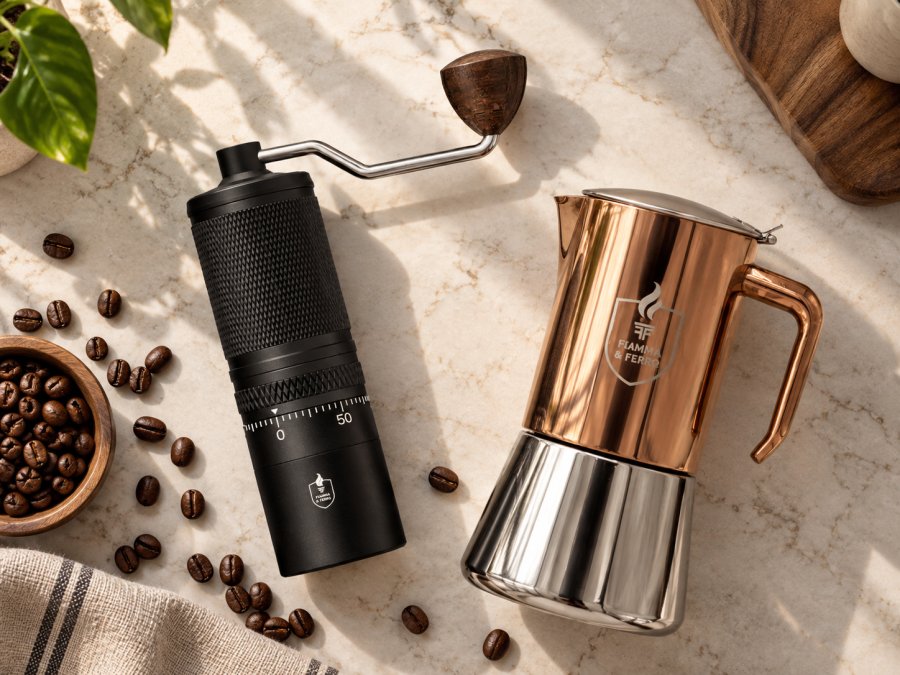
The bundle is a direct path to a full premium coffee tools for home baristas setup. If you already own a brewer you love, the Titanium+ grinder is a high-impact upgrade. The Linea Suprema moka pot is a centerpiece for those who want rich, full-bodied stovetop espresso without a bulky electric machine.

Fiamma & Ferro Espresso Ritual Bundle: The Complete Setup
The Espresso Ritual Bundle is our top pick for home baristas who want a cohesive, high-performance setup without hunting for compatible pieces. It combines the Titanium+ Professional-Grade Manual Coffee Grinder with the 12-Cup Stainless Steel Stovetop Espresso Maker, covering the two most important steps in brewing: grinding and extraction.

The grinder produces the consistent, fine grind the moka pot needs, while the stainless steel brewing chamber preserves the clean flavor profile that precision grinding creates.
Fiamma & Ferro Titanium+ Manual Coffee Grinder: Best Manual Coffee Grinder for Espresso
For those seeking a manual coffee grinder for espresso, the Titanium+ is engineered to handle the fine, precise settings that espresso demands. Its 180-step adjustment system allows you to dial in grind sizes from Turkish fine to French press coarse, with the micrometric control needed to fine-tune your shot extraction.
Many grinders produce a wide spread of particle sizes, leading to channeling and sour or bitter shots. The Titanium+ is built to minimize that variance, which can contribute to clarity and body in the cup.
Grind Consistency and Burr Longevity
The heart of any grinder is its burr set, and this is where the Titanium+ differentiates itself. The burrs are engineered for a designed grind life of 500kg+ of coffee beans, backed by a 10-year burr performance warranty.
Burr wear is the gradual loss of edge sharpness that leads to more fines and boulders over time. The titanium coating improves edge retention, meaning your grind consistency stays reliable cup after cup (peer-reviewed research).
Stainless Steel Moka Pot Benefits for Flavor and Durability
The stainless steel moka pot benefits extend well beyond aesthetics, directly impacting the flavor and safety of your brew. Traditional moka pots are often made from aluminum, which can impart a metallic taste and react with acidic coffee (the FDA). The Linea Suprema uses 304 stainless steel for all food-contact surfaces, ensuring that what you taste is the coffee, not the pot.
Stainless steel resists the dents, corrosion, and warping that can plague aluminum pots over time. The Linea Suprema's copper PVD finish adds surface durability while giving the pot a refined look, and it is induction-compatible.
Coffee Grind Size Guide for Home Brewing
A coffee grind size guide for home brewing is essential because each brew method extracts coffee differently and requires a specific particle size to avoid over- or under-extraction. But a simple chart of "espresso = fine, French press = coarse" is where most guides stop, and where they fail you. Grind size is a starting point, not a destination: it depends on the bean's roast level, origin, water temperature, and brew time.
Understanding Particle Distribution: Fines, Boulders, and the "Sweet Spot"
No grinder produces a perfectly uniform particle size. Even the best burr grinders produce a distribution ranging from fine dust (fines) to larger chunks (boulders). The ratio of these particles determines your extraction quality:
- Fines extract quickly and can lead to bitterness and astringency if over-represented.
- Boulders extract slowly and contribute sourness and a lack of body if under-extracted.
- The middle fraction (the "sweet spot") is what you are actually trying to optimize for a balanced cup.
For espresso, the goal is a narrow particle distribution, fewer fines and boulders, because the high pressure (9 bars) amplifies the effect of any inconsistency (peer-reviewed research). A wide distribution causes channeling, leading to a shot that is simultaneously sour and bitter. This is why burr geometry and alignment matter more than the number of settings on the dial.
The Role of Burr Alignment and Calibration
A grinder with 180 settings is only as good as its ability to maintain consistent alignment between the burrs at each setting. Over time, burrs can drift out of parallel alignment, causing one side to cut more coarsely than the other. This is invisible to the eye but detectable in the cup: your shots start pulling faster or slower for the same setting.
Premium grinders address this in two ways:
- Precision-machined burr carriers: The burrs are mounted on a carrier that is machined to tight tolerances (e.g., ±0.01mm), ensuring they remain parallel under load.
- External calibration mechanisms: Some grinders allow you to reset the zero point (the point where the burrs touch) to account for burr wear. This is critical for espresso, where a few microns of difference can change your shot time by several seconds.
Dialing In: A Practical Workflow for Espresso
For espresso, the grind size chart is just a starting point. Here is a practical workflow to dial in a new bag of beans:
- Start with a reference setting: For a medium roast, start at a setting that produces a grind similar to table salt. For a light roast, start one or two clicks finer, as light roasts are denser and extract more slowly.
- Pull a shot and measure: Use a scale to measure your yield. Aim for a 1:2 ratio (e.g., 18g in, 36g out) in 25-35 seconds.
- Adjust based on taste and flow: If the shot runs too fast (under 25 seconds) and tastes sour, grind finer. If it runs too slow (over 35 seconds) and tastes bitter, grind coarser. Make small adjustments, one or two clicks at a time, and taste again.
- Document your settings: Keep a log of the grind setting, bean origin, roast date, and shot time. This is the fastest way to build a mental map of how different beans respond to your grinder.
Roast Level and Grind Size: The Interaction
Light roasts are denser and less porous than dark roasts, so water extracts from them more slowly. To compensate, you generally need a finer grind for a light roast than for a dark roast using the same brew method, counterintuitive to many home baristas. For espresso, a light roast might require a grind setting 10-15% finer than a dark roast to achieve the same shot time.
A Practical Grind Size Reference
Here is a reference for the major brew methods, with the caveat that these are starting points, not absolute rules:
- Turkish coffee: Powdery fine, like flour. Requires the finest setting. The grind is so fine that it is closer to a powder than a granular solid.
- Espresso: Fine, like table salt. The consistency should be uniform, with no visible boulders. A fine, consistent grind is critical for pressure-based extraction.
- Moka pot: Medium-fine, like granulated sugar. Slightly coarser than espresso to prevent over-extraction on the stovetop, where the brew temperature is higher than espresso.
- Pour-over and AeroPress: Medium, like sand. Allows for a balanced extraction in the 2-4 minute range. For AeroPress, you can go finer than pour-over if you use a shorter steep time.
- French press: Coarse, like sea salt. The large particles prevent a muddy, bitter cup during the long steep (4+ minutes).
The Repeatability Factor
The Titanium+ grinder's 180 settings let you move between these ranges with precision, and once you find the sweet spot for your favorite bean and method, you can repeat it exactly. This repeatability is the foundation of great home brewing. A stepped grinder with 180 clicks gives you a tactile, audible reference for each setting, making it easier to return to a previous setting without looking. For most home baristas, a stepped grinder with fine increments is the more practical choice for daily use.
Physical Effort and Ergonomics: What to Expect
Manual grinding is a physical act, and the effort required varies significantly based on the grinder's design, the roast level, and the user's physical capabilities. For a home barista dialing in a light roast for espresso, the difference between a 30-second grind and a 90-second grind is the difference between a daily ritual and a daily chore.
Quantifying the Work: Turns, Torque, and Time
For a standard 18g espresso dose of a dense light roast, a typical premium manual grinder with 38-48mm burrs requires approximately 400 to 600 full rotations of the crank. At a sustainable pace of about 60-80 rotations per minute, that translates to 5-8 minutes of grinding. The more critical metric is torque, light roasts are denser and more brittle, requiring up to 30-40% more force per revolution.
Grinders with larger burrs (e.g., 48mm vs. 38mm) generally reduce grind time because each rotation cuts more beans, but they often require higher torque due to the larger contact area. The optimal design balances these factors: a burr set with a sharp, aggressive cutting geometry (rather than a crushing action) reduces the peak torque spike at the start of each rotation.
Ergonomics Beyond the Grip: Leverage and Body Mechanics
Ergonomic design is not just about a comfortable handle; it is about how the grinder's geometry interacts with your body. A narrow, cylindrical body forces you to rely on finger strength and wrist rotation, leading to fatigue. A wider body (e.g., 50-60mm diameter) allows you to wrap your palm around the grinder and use your larger forearm and shoulder muscles. Crank arm length also matters: a longer crank (e.g., 12-15cm) provides more leverage, reducing the force needed per turn.
A common pattern among high-end manual grinders is a folding or adjustable crank that lets you change the effective leverage. The Titanium+ uses a fixed-length crank optimized for a balance of speed and torque.
Accessibility and Physical Limitations: A Missed Consideration
Most premium grinder reviews are written by able-bodied enthusiasts and ignore a significant segment of the home barista community: those with arthritis, carpal tunnel syndrome, or general grip weakness. For these users, the standard "twist and crank" motion can be painful or impossible, regardless of the grinder's quality.
Key factors that reduce strain include:
- Low-friction bearings: Grinders with dual ball bearings or high-quality bronze bushings require significantly less force to turn than those with plastic bushings or metal-on-metal contact. The difference is noticeable on the first rotation, where static friction is highest.
- A textured, non-slip body: A smooth metal cylinder becomes slippery when your hands are slightly oily or sweaty, forcing you to grip harder. A knurled or rubberized surface allows a lighter, more relaxed grip.
- A stable base: If the grinder twists or walks on the counter, you are wasting energy stabilizing it. A wide, flat base with a rubber gasket prevents this.
- A low-profile crank: For users with limited wrist extension, a crank that sits close to the body of the grinder (low vertical profile) is easier to turn than one that angles upward.
The Heat and Noise Trade-off
One underappreciated advantage of manual grinding is the absence of heat generation. Electric grinders can heat the coffee grounds by 5-10°F (3-6°C) during a prolonged grind, accelerating the loss of volatile aromatic compounds. Similarly, a manual grinder produces a rhythmic, low-decibel crunch (around 60-70 dB), while an electric grinder can hit 85-95 dB, loud enough to disturb others early in the morning.
The Bottom Line on Effort
For a typical able-bodied user, grinding 18g of a medium-dark roast for espresso in a premium manual grinder takes 30-45 seconds and requires moderate, sustained effort. For a light roast, expect 60-90 seconds and noticeably higher torque. If you are unwilling to invest that physical effort on a daily basis, or if you have physical limitations that make it difficult, a manual grinder is not the right tool for you.
Conclusion: Investing in Your Daily Ritual
Building a premium coffee setup is not about accumulating gadgets; it is about choosing tools that respect the craft and your time. Fiamma & Ferro offers the Titanium+ grinder with its 180 settings and 10-year warranty, and the Linea Suprema moka pot, crafted from 304 stainless steel with a copper PVD finish.
The investment in premium coffee tools for home baristas is an investment in a daily moment of quality. Get started with Fiamma & Ferro and experience a coffee ritual defined by precision, purity, and lasting craftsmanship.
Frequently Asked Questions
Are manual grinders good for espresso?
Yes, premium manual grinders with stepless or fine-step adjustments are excellent for espresso. They offer the precision needed to dial in shots without the cost of high-end electric grinders. Look for models with conical burrs and 180 or more grind settings, like the Titanium+ grinder, to achieve the fine, consistent particle size that espresso extraction requires.
What is the difference between standard and premium coffee brewing tools?
The main differences are material quality, build precision, and design. Standard tools often use aluminum or plastic, which can affect flavor and durability. Premium tools use materials like 304 stainless steel, which is non-reactive and preserves coffee's true taste. They also feature better engineering, such as CNC-cut burrs and precise adjustment mechanisms, leading to more consistent results and a longer lifespan.
Do stainless steel moka pots provide a better brew than aluminum?
Many coffee enthusiasts find that stainless steel moka pots provide a cleaner, more consistent brew. Aluminum can impart a metallic taste, especially with acidic coffee, and it reacts with the coffee over time. Stainless steel is non-reactive, so it preserves the coffee's natural flavors and aromas. It is also more durable, induction-compatible, and easier to clean thoroughly.
What essential tools do I need to start brewing specialty coffee at home?
To start brewing specialty coffee, you need two foundational tools: a quality burr grinder and a reliable brewing device. A manual grinder with a wide grind range, such as the Titanium+ Precision Manual Coffee Grinder, allows you to adapt to various methods. For a rich, espresso-style brew without a machine, a stainless steel stovetop espresso maker is an excellent choice for a full-bodied cup.