

Is Manual Coffee Grinding Worth It? Honest 2026 Guide
Table of Contents
- What Manual Coffee Grinding Actually Costs You
- Manual vs Electric Coffee Grinder: The Real Trade-Offs
- Manual Grinder Grind Consistency: Burrs, Alignment, and Particle Size
- Best Manual Coffee Grinder for Moka Pot: What to Look For
- Long-Term Maintenance Costs and Environmental Impact
- Who Should Skip Manual Grinding
- Frequently Asked Questions
Last Updated: September 10, 2026
What Manual Coffee Grinding Actually Costs You
Manual coffee grinding suits anyone brewing stovetop espresso, pour-over, or French press at home who wants fresher coffee without the noise, footprint, and motor failure risk of an electric burr grinder, if you're willing to trade physical effort for control.

The difference comes down to three things: grind coarseness, cups per day, and burr durability.
Most guides frame this as "manual = better coffee, electric = convenience." That's too simple. A cheap manual grinder with wobbly burrs produces worse particle size distribution than a mid-range electric flat burr, while a well-machined manual with conical burrs can match electric grinders costing twice as much.
Manual vs Electric Coffee Grinder: The Real Trade-Offs
The manual vs electric coffee grinder decision comes down to what you value more: control and quiet, or speed and zero effort. Neither wins across the board, the gap depends on grams per day, grind fineness, and how long you plan to keep the grinder.
Electric grinders win on volume and speed: if you brew four cups back-to-back or host guests, a motor saves your wrist. The trade-off is mechanical, motors, gearboxes, and control boards are wear items, and a grinder used daily at espresso-fine settings can develop motor whine, stripped gears, or a failed power supply within a few years.
Manual grinders win on noise, portability, and long-term reliability: no motor to burn out, no cord, and a small cylinder you can tuck in a drawer. You supply the torque, but a well-machined hand grinder has exactly one wear item, the burr set, replaceable on most quality models.
| Factor | Manual Grinder | Electric Grinder |
|---|---|---|
| Noise | Nearly silent | 80-90 dB typical |
| Portability | Fits in a bag | Requires outlet |
| Grind time (18g) | 30-90 seconds | 5-15 seconds |
| Motor failure risk | None | Real over time |
| Counter footprint | Minimal | Moderate to large |
| Price for equal burr quality | Lower | Higher |
| Primary wear item | Burr set (replaceable) | Burrs, motor, switch, board |
| Typical service life | 10+ years with burr swaps | 3-7 years before a major failure |
| Electricity use | None | 100-300W while running |
A common mistake is buying a manual grinder expecting electric speed. What you get instead is a quieter ritual and a tool that, with care, can outlast several electric units, though cheap electric grinders often ship with the same wobbly burr carriages found in budget hand grinders.
The 5-Year Cost of Ownership
Sticker price is the least useful number here. What matters is what you spend to keep the grinder producing good coffee for five years.
For a manual grinder, you pay once, and the only likely replacement is the burr set. Quality titanium-coated or hardened-steel burrs are commonly rated for 500kg or more of beans, many years of daily use for a one- or two-cup household, often backed by multi-year burr warranties (sca.coffee).
For an electric grinder, the math is less predictable. Burrs wear on the same schedule, but you also carry motor, switch, and electronics risk, a replacement in year three or four can cost as much as the original grinder. Energy isn't the deciding cost; reliability is.
U.S. Department of Energy appliance energy use overview
Time-to-Grind: What 18g of Beans Really Takes
Grinding 18 grams by hand takes roughly 30 to 90 seconds depending on burr size, roast level, and grind setting. Light roasts are denser and slower; dark roasts crumble faster.
- Burr diameter: Larger conical burrs cut faster but need more torque per turn. A 48mm set typically finishes 18g of medium roast in 30-45 seconds; smaller 38mm burrs can push past 60 seconds.
- Grind setting: Espresso-fine takes two to three times as long as French press coarse for the same dose.
- Bean density: A light-roast Ethiopian natural can add 20-30 seconds versus a dark-roast blend.
- Technique: Steady, moderate-speed cranking beats frantic spinning, which makes beans bounce and re-cut without speeding output.
For a single moka pot or pour-over, that's a reasonable trade. For a household making six cups a day, the seconds add up, roughly 5 to 9 minutes of grinding daily at the slower end.
Ergonomics and Physical Accessibility
Ergonomics is the factor most reviews skip, and it determines whether you'll still be using a manual grinder six months in.
Hand grinding requires wrist and forearm torque, especially at espresso-fine settings. People with arthritis, carpal tunnel issues, or reduced grip strength often find it uncomfortable or impossible, "manual" doesn't mean "accessible." The torque needed to crack a light-roast bean at espresso setting is substantial, applied through a small handle that concentrates force on the wrist and fingers.
What helps:
- A stable, non-slip base so you're not fighting the counter.
- A handle long enough for leverage without awkward wrist angles.
- Grinding in short bursts rather than one continuous push.
- Choosing a coarser setting when your brew method allows it.
- Grinding while seated with the grinder braced against a stable surface, shifting load from the wrist to larger arm muscles.
If grip strength is a concern, an electric grinder isn't a compromise, it's the correct tool. No technique overcomes a torque requirement your hands can't comfortably meet, and forcing it risks injury.
Manual Grinder Grind Consistency: Burrs, Alignment, and Particle Size
Manual grinder grind consistency depends almost entirely on burr quality and alignment. Two grinders with identical burr material can perform very differently if one has shaft play and the other doesn't.
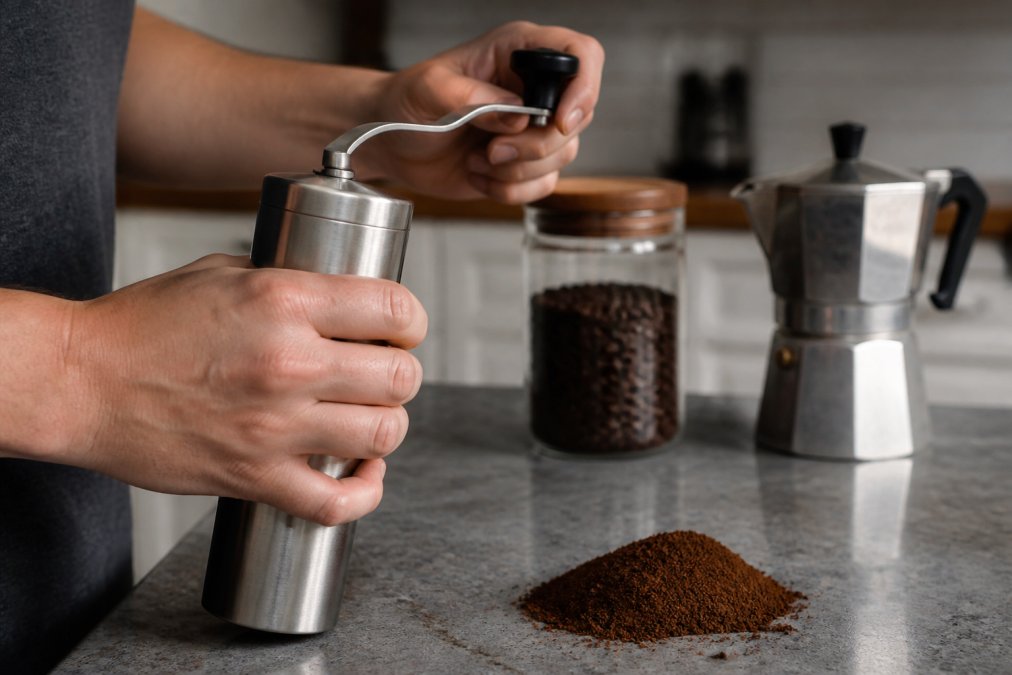
Conical burrs are the standard in hand grinders, crushing beans progressively between an inner and outer cone for a more even particle size distribution than blade grinders manage. But "conical burr" is a category, not a guarantee, machining tolerance, burr material, and shaft stability decide whether you get uniformity or a mix of fines and boulders.
Boulders (oversized particles) cause uneven extraction; fines (dust-like particles) over-extract and add bitterness. In espresso, that shows up as channeling and inconsistent shots; in pour-over, as a cup that tastes simultaneously weak and harsh.
What to check before buying:
- Burr material: Hardened steel or titanium-coated burrs hold an edge far longer than soft steel.
- Shaft stability: Any lateral play means inconsistent grind at every setting.
- Alignment: Burrs should meet evenly across their full surface, not just at one edge.
This is where a well-built grinder separates itself. The Fiamma & Ferro Titanium+ Precision Manual Coffee Grinder uses CNC-cut titanium-coated burrs with 180 grind settings and a designed burr life of 500kg+ of beans.

A quick alignment check: set the grinder to its finest setting and turn the handle. If you feel a rough, uneven scrape rather than smooth resistance, the burrs aren't aligned properly. This is worth testing before you commit to any manual grinder.
Stepped vs Stepless Adjustment and Dialing In
Stepped adjustment gives you fixed, repeatable grind settings; stepless lets you move infinitely between them. For most home brewers, stepped is easier to live with because you can return to a setting you liked. Stepless shines when dialing in espresso, but it's harder to record and repeat precisely. For moka pot and pour-over, stepped adjustment with a high number of positions (the 180 settings on the Fiamma & Ferro grinder, for instance) gives enough resolution without the fiddliness of stepless.
Best Manual Coffee Grinder for Moka Pot: What to Look For
The best manual coffee grinder for moka pot delivers a consistent medium-fine grind, holds its setting under load, and has burrs durable enough to stay sharp through years of daily use. Moka pot brewing is less forgiving than drip, so consistency matters more than speed.
What to prioritize:
- Grind range: Medium-fine as your base, but a wide range lets you experiment with pour-over and French press.
- Burr durability: Look for a stated burr life, not vague "long-lasting" steel claims.
- Adjustment precision: Enough steps to hit the same setting twice.
- Build quality: Stainless steel and machined parts resist wear and static better than plastic housings.
- Retention: A grinder that holds old grounds will stale your next cup.
If you're building a full stovetop setup, pairing a precision manual grinder with a stainless steel moka pot covers the two variables that matter most: fresh grind and even heat. The Fiamma & Ferro Espresso Ritual Bundle combines the Titanium+ grinder with a 12-cup stainless steel stovetop espresso maker for exactly this reason.
Long-Term Maintenance Costs and Environmental Impact
Long-term maintenance costs for a manual grinder are dramatically lower than for electric, and the reason is more specific than "no motor": a manual grinder has fewer failure points and a replaceable wear item, while an electric bundles a motor, switch, control board, and power supply into one unit where a single failure can end the tool's life.
What Actually Wears Out
On a manual grinder, the burr set is the only component that meaningfully degrades. Quality burrs are rated by throughput in kilograms of beans, and a well-made titanium-coated or hardened-steel set is typically rated for hundreds of kilograms, years of service for a household grinding 18g a day. When sharpness drops, replacement burrs are usually available as a standalone part, often under a multi-year warranty.
On an electric grinder, the burrs wear on a similar schedule, but you also carry:
- Motor brushes and bearings that wear with every use.
- Gearboxes that can strip, especially at espresso-fine settings.
- Switches and control boards that fail from heat, dust, and age.
- Proprietary parts that may go out of production before the grinder does.
A common pattern: an electric grinder works perfectly for three or four years, then develops a motor whine or dead switch. Repair labor often exceeds the unit's value, so it gets replaced. That replacement cost, not electricity, is the real long-term expense.
The Environmental Angle Most Guides Skip
The environmental case for manual grinding isn't primarily about electricity. A 150W electric grinder running 30 seconds a day uses only a few dollars of power per year, so energy savings alone won't justify the switch.
The real environmental difference is e-waste and product lifespan. Electric grinders contain motors, wiring, and circuit boards, a mix of metals and plastics that's difficult to recycle and often ends up in municipal waste when the unit fails. Manual grinders are mostly steel, aluminum, and wood, with no electronics, and their service life is limited mainly by burr wear. A manual grinder kept for a decade and refreshed with one burr set produces a fraction of the waste of three or four failed electric units over the same period.
U.S. Environmental Protection Agency electronics donation and recycling guidance
Maintenance Routine That Protects the Investment
Keeping a manual grinder running for years is mostly about avoiding the two things that kill burrs: moisture and grit.
- Brush, don't wash. Moisture rusts carbon steel and dulls cutting edges. Use the brush that ships with most grinders.
- Grind a small amount of dry rice or grinder-cleaning tablets occasionally if the manufacturer permits it, to lift oils and fines from the burr teeth.
- Disassemble only as far as the manual specifies. Removing burrs unnecessarily can knock them out of alignment.
- Store with the burrs dry and the hopper empty if you won't grind for a while.
Don't wash your manual grinder's burrs with water. Moisture causes rust and dulls the cutting edge. Brush them dry instead, and only disassemble as far as the manufacturer's instructions specify.
Over five years, the manual grinder's advantage isn't the electricity it saves, it's the replacements it avoids. One burr set versus one or two whole electric units is the real cost and waste difference.
Who Should Skip Manual Grinding
Manual grinding isn't for everyone, and pretending otherwise wastes your money. Skip it if any of these apply:
- You brew more than four cups a day. The time cost compounds fast.
- You have grip strength, wrist, or joint concerns. An electric grinder is the right choice, not a compromise.
- You want espresso-fine grind daily. Hand-grinding at espresso settings is the most physically demanding use case.
- You value one-touch convenience above all. Manual grinding is a ritual, not a shortcut.
- You're buying the cheapest option available. A poorly machined hand grinder produces worse results than a decent electric one.
For everyone else, particularly moka pot, pour-over, and French press brewers making one or two cups a day, a quality manual grinder is a genuinely better tool: quieter, more portable, easier to maintain, and in direct control of your grind.
The real challenge with manual coffee grinding isn't the grinding itself, it's finding a grinder built well enough to justify the effort. A wobbly, dull hand grinder makes the whole ritual feel like a chore. A precision one makes it the best two minutes of your morning. Fiamma & Ferro builds the Titanium+ Precision Manual Coffee Grinder with CNC-cut titanium-coated burrs, 180 grind settings, and a 10-year burr performance warranty. Pair it with the Espresso Ritual Bundle and you've covered grind and brew in one setup built to last. Get started with Fiamma & Ferro and brew richer, cleaner coffee every morning.
Frequently Asked Questions
Is a manual coffee grinder better than an electric one?
It depends on what you value. A quality manual grinder with conical burrs typically matches or beats a sub-$150 electric blade or entry burr grinder on grind consistency, because the burrs spin slower and generate less heat. Electric wins on speed and convenience for large batches. For 18-20g doses of moka pot or pour-over coffee, a manual grinder delivers comparable uniformity without the counter footprint or motor burnout risk.
Is it physically difficult to use a manual coffee grinder?
For light roasts ground fine, yes, it takes real effort. Light roast beans are denser, so grinding 18g for espresso can take 60-90 seconds of steady cranking and noticeable torque. Medium and dark roasts move faster and require less force. If you have wrist, shoulder, or grip issues, a grinder with a longer handle and stable body grip reduces strain. Otherwise, most people adapt within a week.
How does manual grinding affect the consistency of the coffee grounds?
Manual grinder grind consistency depends almost entirely on burr quality and alignment, not on the fact that it is hand-powered. CNC-cut conical burrs with tight tolerances produce uniform particle size distribution with minimal fines and boulders. Cheaper ceramic burr grinders often wobble, which creates inconsistent grounds and uneven espresso extraction or moka pot flow. Look for titanium-coated or hardened steel burrs and a stable shaft.
Are cheap manual coffee grinders worth the investment?
Usually not for serious brewing. Budget hand grinders under $50 often use ceramic burrs with loose tolerances, which leads to inconsistent grind size, slow grinding, and frequent replacement. A precision manual grinder with titanium-coated burrs and 180+ grind settings costs more upfront but lasts years, often with a multi-year burr warranty. If you brew daily, the cost per cup over five years is lower than replacing a cheap grinder every 12-18 months.