

Does Magnetic Stainless Steel Work on Induction?
Table of Contents
- The Short Answer: Magnetic Doesn't Always Mean Induction-Ready
- How Induction Cooktops Work
- Ferromagnetic Stainless Steel vs. Non-Magnetic Grades
- Why the Magnet Test Is Unreliable
- How to Test Stainless Steel for Induction Compatibility
- Understanding Induction Compatible Cookware Symbols
- Why Is My Stainless Steel Pan Not Working on Induction?
- False Positives and False Negatives: The Real Science
- Durability and Sustainability of Induction-Ready Cookware
- Frequently Asked Questions
Last Updated: September 19, 2026
The Short Answer: Magnetic Doesn't Always Mean Induction-Ready
Just because stainless steel is magnetic doesn't automatically mean it will work on induction cooktops, understanding whether does magnetic stainless steel work on induction requires looking beyond the magnet test. Whether does magnetic stainless steel work on induction depends on the specific grade of steel, its composition, and how well it couples with the electromagnetic field your cooktop generates. At fiammaferro.com, we engineer stovetop espresso makers from 304 stainless steel specifically for induction compatibility. The magnet test might tell you something is ferromagnetic, but it won't tell you whether that cookware will heat efficiently on your induction stove.

How Induction Cooktops Work
Induction cooktops use an electromagnetic coil beneath the cooking surface to create a rapidly changing electromagnetic field. When you place cookware on the cooktop, that field induces electrical currents, called eddy currents, directly within the pan's base. Those eddy currents generate heat through electrical resistance, warming your cookware from the inside out.
This process is remarkably efficient because the cooktop itself stays cool, the heat is generated in the cookware, not in the burner. For this to work, your cookware must have a ferromagnetic base that can interact with the electromagnetic field. The efficiency of energy transfer depends on the magnetic permeability of the base material, base thickness, pan diameter, and how well the cooktop's sensors detect the cookware.

Ferromagnetic Stainless Steel vs. Non-Magnetic Grades
Not all stainless steel is created equal. The key variable for induction compatibility is whether the steel is ferromagnetic, meaning it's attracted to magnets and can interact with electromagnetic fields.
Ferritic and Martensitic Stainless Steel
Ferritic stainless steel (grades like 430 and 409) and martensitic stainless steel (grades like 410 and 420) are both ferromagnetic and suitable for induction cooking, assuming the base is thick enough and well-constructed. However, ferritic grades have lower corrosion resistance than other stainless steel types and are more prone to rust over time.
Austenitic Stainless Steel and the Nickel Problem
Austenitic stainless steel, the most common grade for food-contact surfaces, includes the 300 series, with 304 and 316 being the most popular. These grades contain high levels of nickel and chromium, giving them superior corrosion resistance and thermal conductivity. The problem is that austenitic stainless steel is non-magnetic in its standard form.
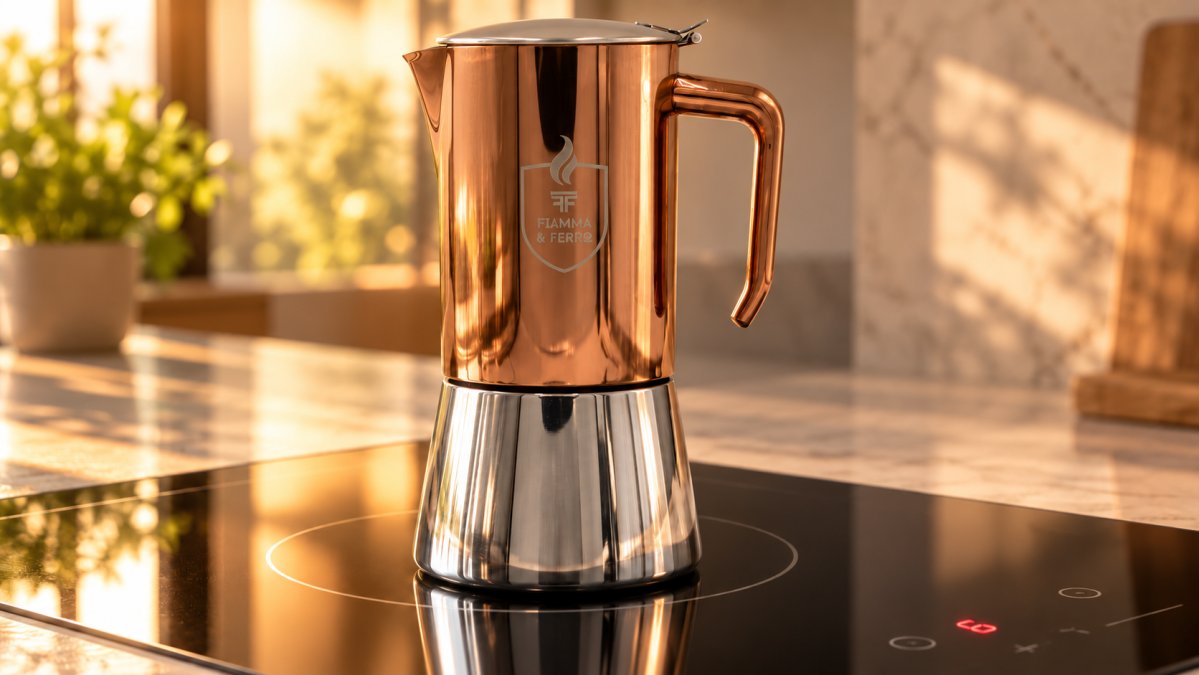
Many home cooks buy cookware made from 304 stainless steel because it's durable and food-safe, assuming it will work on induction. But standard 304 austenitic steel is not ferromagnetic, and the cookware sits inert on the cooktop. Premium cookware manufacturers, including fiammaferro.com, solve this by adding a ferromagnetic cladding or base layer beneath the food-contact surface. The Linea Suprema moka pot uses 304 stainless steel for its brewing chamber, ensuring no aluminum touches your coffee, while incorporating an induction-compatible ferromagnetic base.
Why the Magnet Test Is Unreliable
The magnet test is simple: hold a magnet to your cookware. If it sticks, you assume it's induction-ready. This binary thinking is the source of enormous frustration for consumers.
The magnet test tells you whether your cookware is ferromagnetic. It does NOT tell you whether it will work efficiently on induction. A pan can be ferromagnetic and still perform poorly due to inadequate base thickness, poor coupling efficiency, or insufficient contact with the cooktop surface. The magnet test conflates two different properties: ferromagnetism (the ability to be attracted to magnets) and induction compatibility (the ability to couple efficiently with an electromagnetic field and generate heat).
How to Test Stainless Steel for Induction Compatibility
If you want to know whether your stainless steel cookware will actually work on induction, try these more reliable methods.
The Cooktop Test. Place the cookware on your induction cooktop and turn it on. If the cooktop detects the pan and begins heating, it's induction-compatible. This is the only test that matters.
The Manufacturer's Specification. Check the product documentation or labeling. Reputable cookware makers clearly state whether their products are induction-compatible. Premium brands like fiammaferro.com provide detailed specifications about base construction and cooktop compatibility.
Visual Inspection of the Base. Examine the bottom of your cookware closely. Induction-compatible pans often have a visibly thicker, heavier base than non-induction cookware, with signs of multi-ply construction. A thin, flat base is a red flag.
Fiamma & Ferro Stainless Steel Stovetop →
The Weight Test. Lift the cookware. Induction-compatible cookware tends to be heavier due to thicker base construction and multi-ply cladding. A flimsy, lightweight pan is unlikely to have the engineering necessary for efficient induction heating.
Understanding Induction Compatible Cookware Symbols
Many cookware manufacturers mark induction-compatible products with a coil or spiral symbol, sometimes enclosed in a square. This symbol indicates the cookware has been tested and verified for induction compatibility. However, not all cookware displays this symbol, even if it's induction-ready. When shopping for stovetop espresso makers or other premium cookware, look for detailed product descriptions that specify induction compatibility.
Why Is My Stainless Steel Pan Not Working on Induction?
You've placed your stainless steel cookware on your induction cooktop, and nothing happens. Diagnosing the cause requires systematic troubleshooting.
Cooktop Error Codes and Sensor Detection Failures
Most induction cooktops display error codes when they cannot detect cookware or detect a problem with the pan-to-cooktop coupling:
- "E" or "Error" with no heating: The cooktop's sensor cannot detect ferromagnetic material, indicating the pan is non-magnetic, the base is too thin, or the pan diameter is below the cooktop's minimum (typically 4 inches).
- "Pan" or "Cookware" symbol flashing: The cooktop recognizes something is on the surface but cannot establish proper electromagnetic coupling, often due to a warped base or poor contact.
- Intermittent heating or cutoff after 1-2 minutes: The cooktop detects the pan initially but loses coupling during heating, usually indicating a warped base or inadequate thickness.
If your cooktop displays an error, start with these diagnostic steps:
Step 1: Verify Pan Diameter. Measure the bottom of your cookware. If it's smaller than 4 inches in diameter, most induction cooktops won't recognize it.
Step 2: Check for a Flat, Even Base. Place the pan on a flat surface and look for gaps. If you can slide a piece of paper under the base, the pan is warped and cannot be reliably used on induction.
Step 3: Test with a Known-Compatible Pan. Place a pan you know works on induction on the same cooktop zone. If it heats normally, the cooktop is functioning, and the problem is with your original pan.
Step 4: Inspect the Base Material and Thickness. Run a magnet over the base. A quality induction-ready base should be visibly thick (at least 3-4mm), possibly showing visible layers of different metals bonded together.
Base Thickness and Coupling Efficiency
The thickness of your cookware's base directly affects how well it couples with the electromagnetic field. A base thinner than 2mm often fails to couple reliably. Most premium induction cookware has a base thickness of 4-6mm, with multi-ply construction combining ferromagnetic stainless steel with aluminum or copper layers.
Pan Diameter and Cooktop Sensor Detection
Induction cooktops require cookware to be at least 4 inches in diameter for the sensors to detect it. Additionally, the cooktop's sensors must make good contact with the pan's base. If the base is warped or uneven, it may not sit flat on the cooktop surface, reducing sensor contact and preventing detection.
Multi-Ply Cladding and Heat Distribution Issues
Multi-ply construction, bonding multiple layers of different metals together, is standard in high-quality induction cookware. When these layers separate or delaminate, the cookware loses efficiency. Delamination is a sign of poor construction or age-related degradation. Well-made cookware resists delamination and maintains consistent performance over years of use.
Material Composition: Austenitic vs. Ferritic Stainless Steel
The grade of stainless steel used in the base affects both ferromagnetism and thermal conductivity. Standard 304 austenitic stainless steel is non-magnetic, so it cannot be used alone as an induction base. However, 430 ferritic stainless steel is ferromagnetic and is commonly used in induction cookware bases. Premium cookware manufacturers use 304 stainless steel for food-contact surfaces while incorporating a ferromagnetic 430 or 409 stainless steel base layer for induction compatibility.
Fiamma & Ferro Stainless Steel Stovetop →
False Positives and False Negatives: The Real Science
The magnet test creates two types of errors: false positives and false negatives.
False Positives: Magnetic but Not Induction-Ready
A false positive occurs when a pan passes the magnet test but doesn't work well on induction. The cookware is ferromagnetic, but the base is thin, poorly constructed, or made from low-quality ferromagnetic steel. A budget stainless steel cookware set might use 430 ferritic stainless steel for the base (ferromagnetic) but make the base only 1.5mm thick to reduce costs. When placed on an induction cooktop, the thin ferromagnetic layer generates weak eddy currents, and the cooktop may heat it slowly or display an error code.
False Negatives: Non-Magnetic but Induction-Ready
A false negative occurs when a pan fails the magnet test but actually works on induction. This happens with some premium cookware engineered with specialized ferromagnetic alloys or multi-ply bases that don't respond as strongly to a handheld magnet but still couple efficiently with induction cooktops.
The Physics: Eddy Currents and Magnetic Permeability
When an induction cooktop's electromagnetic field passes through ferromagnetic cookware, it induces eddy currents in the base. The strength of these eddy currents depends on the material's magnetic permeability and the thickness of the ferromagnetic layer. Standard 430 ferritic stainless steel has a magnetic permeability of approximately 500-800. A 4mm-thick layer will couple strongly; a 1.5mm-thick layer will couple more weakly.
Some premium alloys are engineered to have slightly lower magnetic permeability but higher electrical conductivity, resulting in more efficient eddy current generation at specific frequencies. These alloys may not respond as strongly to a handheld magnet but may actually couple more efficiently with an induction cooktop's electromagnetic field.
Practical Takeaway
If a pan passes the magnet test but doesn't heat on your induction cooktop, the problem is likely thin base construction, poor coupling efficiency, or a warped base. If a pan fails the magnet test but heats on your cooktop, it's likely engineered with a ferromagnetic layer optimized for induction coupling. The only reliable test is placing the pan on your cooktop and observing whether it heats.
Durability and Sustainability of Induction-Ready Cookware
Premium induction-ready cookware is built to last. The engineering required for true induction compatibility, thick bases, multi-ply construction, quality materials, also creates cookware that resists warping and maintains consistent performance. Stainless steel cookware, particularly 304 stainless steel with no aluminum or plastic components, is inherently durable and doesn't rust or leach chemicals into food.
From a sustainability perspective, durable cookware reduces waste. A well-engineered moka pot or stovetop espresso maker can last decades with basic care. The fiammaferro.com Linea Suprema moka pot is designed with longevity in mind, featuring 304 stainless steel construction, OEM replacement parts available for wear items, and a 2-year product warranty. When you choose induction-ready cookware engineered for performance and longevity, you're making a choice that benefits both your kitchen and the environment.
Choosing the right induction-compatible cookware requires understanding the science behind electromagnetic energy transfer and recognizing that the magnet test is just a starting point. The Fiamma & Ferro Stainless Steel Stovetop Espresso Maker is engineered from 304 stainless steel with an induction-ready base, designed for reliable performance on all cooktop types. With a 2-year warranty and OEM replacement parts available, it's built to deliver consistent brewing performance for years. Explore the Fiamma & Ferro Stainless Steel Stovetop Espresso Maker and experience premium induction brewing that combines engineering precision with Italian espresso tradition.
Frequently Asked Questions
Does magnetic stainless steel always work on induction cooktops?
Not always. While ferromagnetism is necessary for induction heating, magnetic attraction alone doesn't guarantee compatibility. Base thickness, construction quality, and cladding materials all affect whether a magnetic stainless steel pan will heat effectively. Some austenitic stainless steels with high nickel content may attract a magnet weakly but still work on induction. The magnet test is a starting point, not a definitive answer. Look for the induction-compatible symbol or test the pan directly on your cooktop for reliable confirmation.
How do I test stainless steel for induction compatibility?
The simplest method is the magnet test: hold a magnet to the bottom of the pan. If it sticks firmly, it's ferromagnetic. However, this isn't foolproof—some non-magnetic pans work on induction due to eddy currents in the base. The most reliable test is placing the pan directly on your induction cooktop and observing whether it heats. You can also look for the induction-compatible symbol on the pan's base or documentation. Premium cookware like the Fiamma & Ferro Linea Suprema moka pot includes induction compatibility as a tested specification.
What do induction compatible cookware symbols mean?
The induction-compatible symbol is a coil or spiral design, often shown on the bottom of cookware or in product documentation. This symbol indicates the manufacturer has tested and verified the pan's electromagnetic coupling efficiency and heat transfer performance on induction cooktops. It's a more reliable indicator than the magnet test alone. If a pan carries this symbol, it has been validated to work with induction cooktops. Not all ferromagnetic cookware displays this symbol, so its presence is a strong assurance of compatibility.
Why won't my stainless steel pan work on induction even though it's magnetic?
Several factors can prevent a magnetic stainless steel pan from heating on induction. Thin or poorly constructed bases reduce coupling efficiency—the pan must have adequate thickness and contact with the cooktop surface. Pan diameter matters too; cooktop sensors may not detect pans smaller than 4–5 inches. Multi-ply cladding with non-ferromagnetic layers can interfere with electromagnetic energy transfer. Warped bottoms prevent full contact with the cooktop. If your pan is magnetic but won't heat, check the base thickness, diameter, flatness, and whether any non-ferromagnetic materials in the construction are blocking the electromagnetic field.