

Equipamentos de café duráveis em aço inoxidável: o que realmente dura
Índice
- Por que os acessórios de café de aço inoxidável duram mais que os de alumínio
- A melhor cafeteira de espresso para fogão compatível com indução para uso diário
- O que procurar em equipamentos duráveis de café em aço inoxidável
- Como limpar os componentes de uma cafeteira de aço inoxidável
- Benefícios do design de cafeteira moka de aço inoxidável em comparação com o de alumínio
- Nossa escolha: Cafeteira de Espresso para Fogão Linea Suprema de 12 Xícaras
- Qual configuração de aço inoxidável combina com o seu ritual de café?
- Perguntas frequentes
Última atualização: 7 de setembro de 2026
Durante décadas, a escolha padrão para preparar espresso no fogão foi o alumínio, valorizado por sua condutividade térmica, mas propenso a amassados, corrosão e gosto metálico na xícara. Os acessórios de café duráveis de aço inoxidável resolvem esses problemas ao combinar o ritual do preparo manual com uma ciência dos materiais que resiste ao uso. Na fiammaferro.com, projetamos nossos equipamentos com aço inoxidável 304, e este guia explica por que essa escolha é importante para quem quer acessórios que durem décadas.

O alumínio reage com o café ácido e os detergentes alcalinos de lava-louças, causando corrosão localizada e um interior esbranquiçado. O aço inoxidável resiste a esse ataque químico e não entorta nem amassa com tanta facilidade. Se você ainda usa uma cafeteira de alumínio, inspecione a câmara interna: corrosão e descamação indicam que é hora de trocar.
Por que os acessórios de café de aço inoxidável duram mais que os de alumínio
As cafeteiras italianas de alumínio geralmente são feitas de ligas da série 3000, macias o suficiente para que uma queda de 2 pés possa entortar a borda, deformando a superfície de vedação e comprometendo a qualidade da extração. O aço inoxidável é definido por um teor mínimo de 10,5% de cromo; o grau 304 usado nas cafeteiras Fiamma & Ferro tem 18%, formando uma camada autorregenerativa de óxido de cromo que se recompõe quando riscada (britannica.com).

O café é levemente ácido (pH 4,5-5,5) e contém cloretos (pesquisa revisada por pares). O alumínio é anfotérico, dissolvendo-se em ácidos e bases, e é por isso que panelas antigas desenvolvem uma película esbranquiçada e o detergente de lava-louças causa oxidação rápida. O aço inoxidável 304 resiste muito melhor à corrosão por pites induzida por cloretos do que os aços da série 200, que frequentemente sofrem corrosão na linha d'água da câmara inferior.
Cada ciclo de preparo leva o metal da temperatura ambiente a aproximadamente 212°F. Ao longo de centenas de ciclos, o alumínio pode desenvolver corrosão intergranular causada por impurezas que criam microcélulas galvânicas; a camada de óxido de cromo do aço inoxidável evita isso. A taxa de expansão térmica do alumínio é aproximadamente o dobro da do aço inoxidável, o que pode fazer com que câmaras rosqueadas emperrem ou se soltem; a menor taxa do aço inoxidável mantém a junta dimensionalmente estável.
Uma cafeteira de alumínio lavada à mão pode durar de 3 a 5 anos antes que o interior fique áspero e o sabor se torne metálico. Uma cafeteira de aço inoxidável 304 não apresenta perda de material mensurável nas mesmas condições. É por isso que os equipamentos comerciais padronizam o uso de aço inoxidável 304 ou 316 em qualquer superfície que entre em contato com líquidos quentes.
A melhor cafeteira de espresso para fogão compatível com indução para uso diário
Uma cafeteira de espresso para fogão compatível com indução é a escolha certa para quem cozinha em cooktops modernos de vidro ou magnéticos. O alumínio não é magnético, portanto as cafeteiras moka tradicionais simplesmente não aquecem em fogões de indução sem uma placa adaptadora. Uma base de aço inoxidável com propriedades magnéticas, como o aço de grau 430 usado na Linea Suprema, fica diretamente sobre a bobina e aquece por igual.
O benefício prático é a estabilidade da temperatura. A indução fornece calor rápido e consistente à câmara inferior, o que ajuda a manter a faixa ideal de pressão para a extração. Você obtém mais corpo e preserva mais compostos aromáticos na xícara em comparação com uma cafeteira que tem dificuldade para atingir a temperatura de preparo em um queimador incompatível.

O que procurar em equipamentos duráveis de café em aço inoxidável
A maioria dos guias de compra para em "procure aço inoxidável 304 e uma junta de silicone". Esse conselho está correto, mas é incompleto. A longevidade é determinada por três fatores raramente visíveis no ponto de venda: a composição da liga das peças internas, a dureza Shore da junta e o compromisso do fabricante com a disponibilidade de peças de reposição.
Grau do material e construção: além do rótulo "304"
O padrão de referência é o aço 304 (18/8, com 18% de cromo e 8% de níquel), mas nem todo aço 304 é igual. A ASTM A240 permite variações que podem reduzir a resistência à corrosão nos pontos de solda. O aço 316 adiciona molibdênio para uma resistência superior a cloretos, mas o 304 é suficiente para a faixa de pH do café. A verificação crítica é o grau da câmara interna de preparo, do funil e do coletor superior, não da carcaça externa. Alguns fabricantes usam aço de grau 201 (manganês em vez de níquel) internamente; ele é magnético e mais propenso à corrosão por pites. Teste de campo: o 304 não é magnético em seu estado recozido, enquanto o 201 é levemente magnético.
Vedações à prova de vazamentos: a ciência da longevidade das juntas
A vedação é o único item sujeito a desgaste, e sua vida útil é determinada pelo composto elastomérico. Uma vedação de silicone mais macia (40-50 Shore A) veda melhor inicialmente, mas se deforma mais rápido; uma mais dura (60-70 Shore A) dura mais, mas exige mais torque. A escolha ideal para o uso diário é silicone de 50-60 Shore A com seção transversal circular. O silicone próprio para uso alimentício suporta até 400°F, muito acima da temperatura de operação de 212°F (a FDA). O modo de falha é a deformação permanente por compressão, não a degradação pelo calor; uma vedação de qualidade deve manter o formato por 12 a 18 meses. A borracha nitrílica mais barata (Buna-N) endurece e racha em até 6 meses.
O teste de durabilidade de 1 ano: o que realmente falha
Os pontos de falha mais comuns são os componentes secundários, não o metal. A rosca pode engripar se não for lubrificada com graxa de silicone própria para uso alimentício. O acabamento PVD de cafeteiras premium não descasca, mas pode ser riscado por produtos de limpeza abrasivos. O problema mais frequente é o acúmulo de incrustações minerais; como se trata de um problema de manutenção, a descalcificação com uma solução de vinagre branco e água na proporção de 1:3 a cada 4 a 6 semanas evita isso.
A reparabilidade como métrica de durabilidade
Uma cafeteira de aço inoxidável que não pode ser desmontada para substituir a vedação é um produto descartável com vida útil mais longa. A Linea Suprema foi projetada com base em peças de reposição OEM: a vedação, o funil e a câmara inferior estão disponíveis como SKUs separados. Ao avaliar qualquer utensílio para café de aço inoxidável, pergunte: Posso substituir a vedação sem ferramentas especiais? O funil é padrão ou proprietário? O fabricante publica um catálogo de peças de reposição? Se a resposta a qualquer uma dessas perguntas for não, o utensílio não foi projetado para a vida útil de 10 a 20 anos que o aço inoxidável torna possível.
Como limpar os componentes de uma cafeteira de aço inoxidável
Limpar uma cafeteira de aço inoxidável exige hábitos diferentes dos usados para cuidar do alumínio. Enxágue os componentes com água morna imediatamente após preparar o café e deixe-os secar ao ar. A superfície de aço inoxidável é resistente a manchas, portanto um simples enxágue geralmente remove os óleos do café.
Para uma limpeza mais profunda, use um detergente neutro e uma esponja macia. Evite esponjas abrasivas e palha de aço, que podem riscar a superfície polida e criar pequenas fissuras onde os resíduos se acumulam. Se notar acúmulo de minerais causado por água dura, deixe as câmaras de molho em uma solução de vinagre branco e água por cerca de 15 minutos e, em seguida, enxágue bem.
| Componente | Método de limpeza | Frequência | Erro comum |
|---|---|---|---|
| Câmara inferior | Enxaguar com água morna e deixar secar ao ar | Após cada uso | Exposição à lava-louças |
| Funil do filtro | Enxaguar com uma escova macia | Após cada uso | Arranhar com palha de aço |
| Coletor superior | Sabão neutro e esponja macia | Após cada uso | Deixar resíduos de café secarem |
| Vedação de silicone | Lavar à mão e verificar o desgaste | Semanalmente | Ferver para higienizar |
Benefícios do design de cafeteira moka de aço inoxidável em comparação com o de alumínio
Os benefícios do design de cafeteira moka de aço inoxidável em comparação com o de alumínio se resumem à pureza do sabor, durabilidade e compatibilidade com cooktops. As cafeteiras de alumínio são mais baratas e aquecem mais rápido, mas reagem com o café ácido, produzindo um gosto metálico. O aço inoxidável é inerte, preservando os sabores de origem do grão.
Cafeteiras de alumínio amassam facilmente e, quando a borda entorta, a vedação de pressão falha. O aço inoxidável resiste a impactos, sendo adequado para viagens e acampamentos. Para proprietários de cooktops de indução, o aço inoxidável é a única opção viável sem uma placa adaptadora.
Nossa escolha: Cafeteira de Espresso para Fogão Linea Suprema de 12 Xícaras
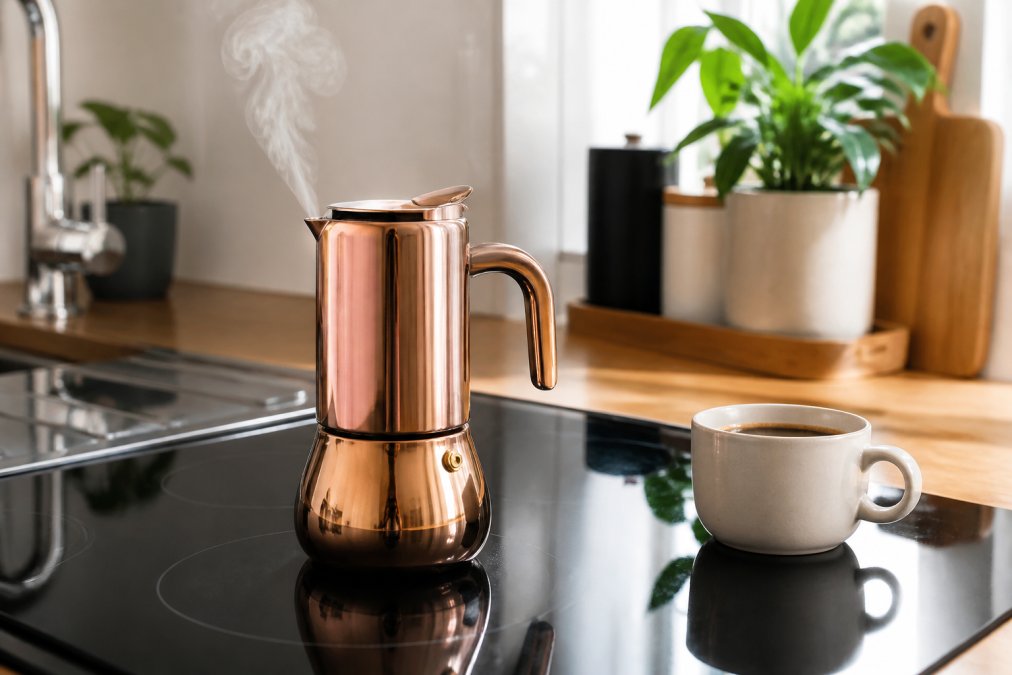
Para a maioria das famílias, a Cafeteira de Espresso para Fogão Fiamma & Ferro Linea Suprema de 12 Xícaras é a melhor cafeteira de espresso para fogão compatível com indução do mercado. Ela é fabricada inteiramente em aço inoxidável 304 nas superfícies que entram em contato com alimentos, sem câmara de preparo de alumínio e sem plástico em contato com o café. O acabamento em cobre PVD adiciona dureza à superfície, resistindo a riscos e desbotamento.
A capacidade de 20 onças serve até 12 xícaras de café pequeno. A base compatível com indução funciona em cooktops a gás, elétricos, de cerâmica, halógenos e de indução. A bolsa protetora de lona e o guia de preparo colorido tornam o conjunto um presente atencioso.
Por $169.99, a Linea Suprema está acima das cafeteiras de alumínio populares, mas o valor está na longevidade. Peças de reposição OEM estão disponíveis para mantê-la funcionando por décadas.
Qual configuração de aço inoxidável combina com o seu ritual de café?
Escolher os equipamentos de café de aço inoxidável certos depende do seu volume de preparo e de você querer adicionar a moagem fresca. Se você já tem um moedor de lâminas de qualidade e quer uma cafeteira durável e compatível com indução, a Linea Suprema sozinha atende às suas necessidades, produzindo um café encorpado no estilo espresso sem a manutenção ou o espaço na bancada exigidos por uma máquina de bancada.
Se você está migrando do café pré-moído, o Kit Ritual de Espresso Fiamma & Ferro combina a cafeteira de 12 xícaras com o Moedor Manual de Café de Precisão Titanium+. O kit custa $399.98 e adiciona 180 configurações de moagem, além de uma garantia de 10 anos para o desempenho das lâminas. A moagem fresca preserva compostos aromáticos voláteis, por isso a diferença na clareza da xícara é imediata.
Para quem já possui a Linea Suprema, manter peças OEM sobressalentes à mão é o investimento mais inteligente em longevidade. Uma câmara inferior de reposição por $80.00 e um funil de precisão de aço inoxidável por $29.99 garantem que uma peça caída nunca encerre a vida útil da sua cafeteira. Essa facilidade de reparo é o motivo pelo qual o aço inoxidável se tornou o padrão para o preparo sério de café em casa.
Escolher equipamentos de café duráveis de aço inoxidável é uma decisão sobre a integridade do material, não apenas sobre a estética. As cafeteiras de alumínio corroem, amassam e, com o tempo, afetam o sabor, enquanto uma cafeteira de aço inoxidável bem construída preserva o verdadeiro caráter do seu café e resiste a décadas de uso diário. A Fiamma & Ferro Linea Suprema oferece essa longevidade com construção em aço inoxidável 304, compatibilidade com indução e acabamento em PVD de cobre. Comece com a Linea Suprema e prepare um café com sabor tão puro no primeiro dia quanto anos depois.
Perguntas frequentes
O aço inoxidável afeta o sabor do café?
O aço inoxidável não altera os sabores como o alumínio pode fazer. A Linea Suprema usa aço inoxidável 304 em todas as superfícies que entram em contato com os alimentos, um material não reativo. Isso significa que seu café tem exatamente o sabor determinado pelos grãos e pelo método de preparo, sem notas metálicas ou amargas. Esse perfil neutro é o motivo pelo qual muitos consideram o aço inoxidável a melhor escolha para preservar os óleos e aromas naturais do café.
Os equipamentos de café de aço inoxidável são melhores que os de alumínio para cafeteiras moka?
Sim, pela durabilidade e pela pureza do sabor. O alumínio conduz o calor rapidamente, mas é macio, propenso a amassados e pode reagir com o café ácido, acrescentando um gosto metálico. O aço inoxidável resiste à corrosão, a amassados e à ferrugem. Uma cafeteira espresso de fogão de aço inoxidável compatível com indução também funciona em todos os cooktops, inclusive os de indução, ao contrário do alumínio.
Como limpar e manter equipamentos de café de aço inoxidável?
Enxágue as câmaras de preparo com água morna após cada uso e seque imediatamente. Evite esponjas abrasivas que risquem a superfície. Periodicamente, você pode limpar o interior com uma mistura de água e vinagre branco para remover o acúmulo de minerais e, depois, enxaguar bem. A Linea Suprema foi projetada com peças OEM substituíveis, como a câmara inferior e o funil, o que ajuda a prolongar a vida útil do equipamento.
Qual é o melhor equipamento de café durável de aço inoxidável para cooktops de indução?
Procure uma cafeteira espresso de fogão com base magnética, geralmente de aço inoxidável 430. A Fiamma & Ferro Linea Suprema foi projetada especificamente com uma base compatível com indução, por isso funciona em fogões a gás, elétricos, de vitrocerâmica e de indução. Seu corpo de aço inoxidável 304 e acabamento em PVD de cobre resistem ao desgaste diário, tornando-a uma opção durável e compatível com qualquer cooktop.