

Melhor moedor manual para espresso fino: guia de compra de 2026
Índice
- Por que um moedor manual para espresso faz sentido
- O que procurar em um moedor manual para espresso fino
- Análise do Moedor Manual de Nível Profissional Fiamma & Ferro Titanium+
- Moedor de Espresso Manual vs. Elétrico: Qual é o ideal para você?
- Como regular o espresso com um moedor manual
- Como manter seu moedor de café manual por anos de uso
- Qual moedor manual você deve escolher?
- Perguntas frequentes
Última atualização: 8 de setembro de 2026
Por que um moedor manual para espresso faz sentido
Um moedor manual para espresso fino é um dispositivo acionado por manivela, com mós de precisão projetadas para produzir partículas muito finas e uniformes, como exige a extração de espresso. Para quem leva o espresso a sério, o moedor é mais importante do que a máquina, e uma unidade manual de qualidade oferece consistência de nível de cafeteria sem ocupar o espaço na bancada nem produzir o ruído de um modelo elétrico.
O benefício mais evidente é o controle. Os moedores manuais com ajuste contínuo ou com incrementos pequenos permitem fazer mudanças microscópicas no tamanho das partículas, exatamente o que você precisa ao ajustar um novo pacote de grãos. Os moedores elétricos na mesma faixa de preço costumam usar ajustes escalonados que avançam em saltos grandes demais para um ajuste fino. A moagem manual também é silenciosa, portátil e ocupa uma fração do espaço.
A desvantagem é o esforço físico. Moer 18 gramas de torra clara para espresso pode levar de 60 a 90 segundos girando a manivela continuamente, dependendo do conjunto de mós e da sua técnica. A seguir, mostramos como escolher um moedor que minimize esse trabalho e maximize a qualidade da moagem.
O que procurar em um moedor manual para espresso fino
O melhor moedor manual para espresso fino equilibra quatro fatores: qualidade das mós, precisão do ajuste, velocidade de moagem e durabilidade da construção. Um erro comum é escolher com base apenas no material das mós, ignorando o mecanismo de ajuste, que determina se você realmente consegue encontrar o ponto ideal para a sua máquina de espresso.
Materiais das mós: revestidas de titânio vs. aço inoxidável vs. cerâmica
O material das mós afeta diretamente a consistência da moagem, a durabilidade e o esforço físico. As mós de aço inoxidável são as mais comuns em moedores de médio porte, oferecendo boa consistência e durabilidade razoável. As mós de cerâmica são mais baratas, mas tendem a produzir mais partículas finas e podem lascar com o tempo. As mós revestidas de titânio, como as do moedor Titanium+ Fiamma & Ferro, adicionam uma camada superficial endurecida que permanece afiada por muito mais tempo, reduzindo o torque e mantendo uma distribuição estreita do tamanho das partículas ao longo de anos de uso.

Mecanismos de ajuste: contínuo vs. escalonado
A precisão do ajuste é o que diferencia um moedor que funciona para espresso de um que apenas afirma funcionar. O ajuste contínuo usa um colar baseado em fricção que permite posicionar as mós em qualquer ponto, oferecendo variabilidade infinita para uma regulagem micrométrica. O ajuste escalonado passa por incrementos fixos com cliques, o que funciona bem para métodos filtrados, mas costuma ser grosseiro demais para espresso. O melhor moedor manual para espresso fino deve oferecer ajuste contínuo de verdade ou incrementos muito pequenos, normalmente de 15 a 30 mícrons por clique.
Análise do Moedor Manual de Nível Profissional Fiamma & Ferro Titanium+
Nossa principal recomendação para a maioria dos baristas domésticos é o Moedor de Café Manual de Nível Profissional Fiamma & Ferro Titanium+, com preço de US$ 229,00. Ele combina mós revestidas de titânio cortadas por CNC com 180 regulagens de moagem, oferecendo o controle micrométrico necessário para espresso e cobrindo toda a faixa, da cafeteira moka à prensa francesa. As mós foram projetadas para uma vida útil de moagem superior a 500 kg, o que, para um usuário doméstico que mói 30 gramas por dia, equivale a aproximadamente 45 anos de desempenho consistente, respaldado por uma garantia de 10 anos para o desempenho das mós.
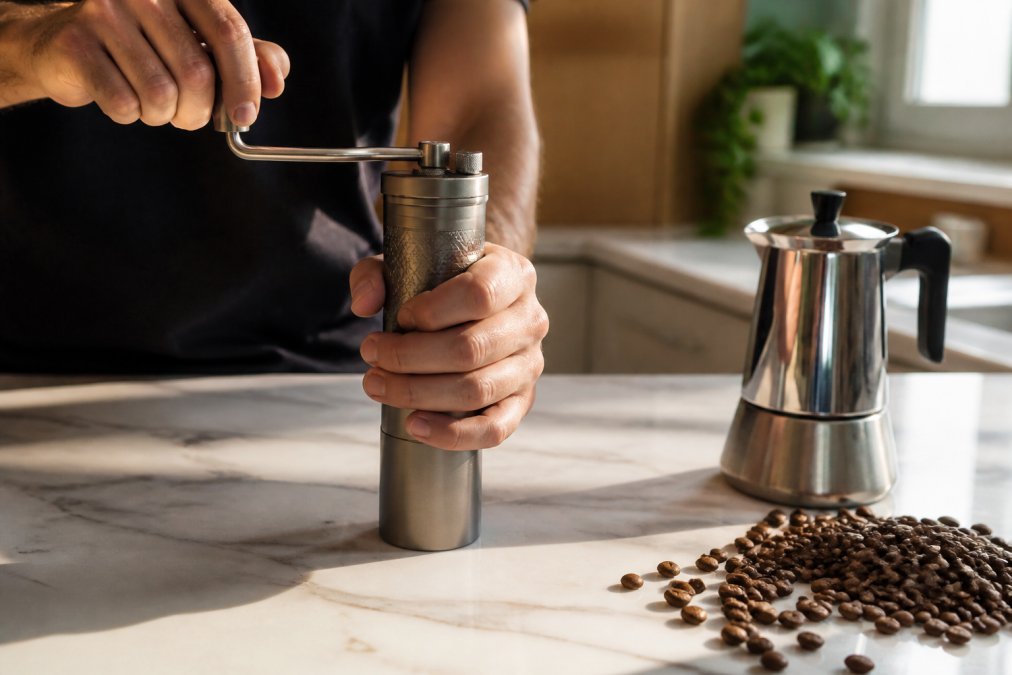
O que mais se destaca no uso diário é a velocidade de moagem e a retenção. O conjunto de mós maior e a geometria eficiente processam grãos de torra clara sem a lentidão que afeta moedores menores. A retenção permanece baixa, o que significa menos café velho acumulado nas mós entre as moagens. O corpo todo em metal acrescenta peso para maior estabilidade, e a manivela dobrável pode ser guardada com facilidade.
A única limitação honesta é a curva de aprendizado inicial. Para alcançar a faixa fina de espresso, é preciso girar o anel de ajuste por toda a sua rotação até a calibração do ponto zero, um processo que leva cerca de dois minutos na primeira vez. Depois de configurado, o seletor numerado torna as regulagens repetíveis muito fáceis. Combine-o com o Kit Ritual de Espresso por US$ 399,98 para completar a configuração com uma cafeteira italiana de aço inoxidável para 12 xícaras.

Moedor de Espresso Manual vs. Elétrico: Qual é o ideal para você?
Moedores manuais levam vantagem em preço, precisão e portabilidade, enquanto moedores elétricos ganham em praticidade e produtividade. Mas a decisão real depende de dois fatores que a maioria das avaliações ignora: o custo físico quantificado de moer manualmente torras claras e como o perfil de pressão da sua máquina de espresso interage com a consistência da moagem.
O problema do esforço físico que ninguém quantifica
A maioria das avaliações diz que moer manualmente "exige esforço", sem informar quanto. O esforço varia drasticamente conforme a geometria das mós, a densidade dos grãos e a regulagem da moagem. Para uma torra clara moída na fineza de espresso (cerca de 300-400 micrômetros), você está fragmentando grãos significativamente mais duros do que os de torras médias ou escuras. Um conjunto de mós de aço de 40 mm exige aproximadamente 1,2 a 1,5 voltas por grama de torra clara, o que significa que uma dose de 18 gramas requer de 22 a 27 rotações completas. A uma velocidade sustentável de 1,5 revolução por segundo, isso corresponde a 15 a 18 segundos de moagem contínua.
O torque é mais importante do que o número de voltas. Mós menores, com menos alavanca, travam com grãos densos, obrigando você a desacelerar ou aplicar pressão irregular, o que aumenta a quantidade de finos e arruína a distribuição das partículas. Mós maiores, geralmente de 48 mm ou mais, atravessam torras claras com menos resistência. Um moedor com mós de tamanho adequado e uma manivela de pelo menos 12 centímetros permite manter um ritmo constante, enquanto moedores subdimensionados obrigam a um ritmo de parar e recomeçar que produz extrações inconsistentes.
Para pessoas com artrite, limitações na força de preensão ou tensão nos punhos, essa distinção não é apenas teórica. Um moedor que exige alto torque em baixa velocidade sobrecarrega significativamente mais as articulações do que um que distribui o esforço por rotações mais suaves. Se esse for o seu caso, procure moedores com manivelas maiores, mecanismos com rolamentos de esferas que reduzam o atrito e conjuntos de mós projetados para maior eficiência.
Ajustando o desempenho do moedor à sua máquina de espresso
O segundo fator frequentemente negligenciado é como o perfil de pressão da sua máquina de espresso interage com a consistência da moagem. Máquinas acionadas por bomba, que mantêm aproximadamente 9 bar de pressão durante toda a extração, toleram pequenas inconsistências na moagem (pesquisa revisada por pares). Máquinas de alavanca dependem de uma pressão decrescente, então a uniformidade da moagem afeta diretamente a curva de fluxo. Um moedor que produz uma distribuição mais ampla de partículas fará com que máquinas de alavanca formem canais logo no início da extração, produzindo primeiras gotas ácidas e finais amargos.
Se você usa uma máquina acionada por bomba, pode aceitar um moedor com uma distribuição de partículas ligeiramente mais ampla, desde que o mecanismo de ajuste permita uma regulagem precisa. Se usa uma máquina manual de alavanca, priorize moedores com a distribuição de partículas mais uniforme possível. O Fiamma & Ferro Titanium+ , com suas mós revestidas de titânio e cortadas por CNC, produz uma distribuição de partículas notavelmente mais uniforme do que mós de cerâmica ou de aço inoxidável comum, e é por isso que tem bom desempenho nos dois tipos de máquina.
Característica |
Moedor manual |
Moedor elétrico |
|---|---|---|
Qualidade da moagem |
Alto, com controle micrométrico |
Alto, mas custa mais |
Esforço físico |
Necessário, 15-18 s por dose com mós de qualidade |
Mínima |
Ruído |
Silencioso |
Barulhento |
Espaço na bancada |
Mínima |
Significativa |
Retenção |
Baixa |
Mais alto |
Preço pela qualidade |
Acessível |
Premium |
Para a maioria dos entusiastas de cafés de origem única que preparam um ou dois espressos por dia, um moedor manual é a melhor opção para obter um espresso excepcional sem um grande investimento. Se você prepara espressos regularmente para várias pessoas ou tem limitações físicas que tornam doloroso girar a manivela por muito tempo, um moedor elétrico pode justificar o custo.
Como regular o espresso com um moedor manual
A regulagem é o processo de ajustar o tamanho da moagem para alcançar o tempo de extração e o equilíbrio de sabores corretos para os seus grãos e a sua máquina de espresso. O melhor moedor manual para espresso fino facilita esse processo por meio de ajustes precisos e reproduzíveis. O objetivo é obter um espresso extraído em aproximadamente 25 a 35 segundos, com sabor equilibrado, sem acidez excessiva nem amargor (sca.coffee).
Comece com uma dose consistente, normalmente 18 gramas para um espresso duplo, e cronometre a extração. Se o espresso sair rápido, em menos de 20 segundos, a moagem está grossa demais. Se pingar lentamente ou parar, a moagem está fina demais. Altere uma variável por vez, ajustando a moagem em um ou dois níveis, e mantenha a dose e a pressão de compactação constantes.
Calibração passo a passo para moagens finas
- Calibração do ponto zero: Gire o anel de ajuste no sentido horário até as mós apenas se tocarem e depois recue até seu ponto de referência inicial. Isso estabelece o zero.
- Defina sua referência: Para espresso, comece próximo da extremidade fina da faixa, normalmente de 15 a 25 níveis a partir do zero em um moedor de 180 níveis.
- Moa e dose: Pese os grãos, moa e distribua uniformemente no porta-filtro antes de compactar.
- Extraia e cronometre: Inicie o cronômetro no momento em que a água tocar o café. Anote o tempo de extração e observe as primeiras gotas.
- Prove e ajuste: Se a extração estiver azeda e rápida, moa mais fino em 2 a 3 níveis. Se estiver amarga e lenta, moa mais grosso. Repita até encontrar o ponto ideal.
A velocidade da moagem afeta a distribuição das partículas. Girar rápido demais pode criar mais finos, enquanto um ritmo lento e constante produz partículas mais uniformes. Busque manter de 1 a 2 rotações por segundo, e suas extrações ficarão mais repetíveis.
Como manter seu moedor de café manual por anos de uso
A manutenção regular é a diferença entre um moedor que funciona por décadas e um que se deteriora em um ano. Moedores manuais são mais simples de manter do que modelos elétricos, com menos peças sujeitas a falhas. Uma rotina de limpeza consistente leva cerca de cinco minutos por semana e evita que os óleos velhos do café fiquem rançosos.
O que realmente se desgasta após 6-12 meses de uso diário para espresso
A maioria das avaliações analisa os moedores assim que saem da caixa, mas o verdadeiro teste vem após seis a doze meses de uso diário para espresso. O ponto de falha mais comum não são as mós em si, mas o mecanismo de alinhamento. Toda vez que você ajusta a regulagem da moagem, move o suporte da mó interna contra um eixo roscado ou came. Após centenas de ajustes, esse mecanismo pode desenvolver folga, manifestada como um tamanho de moagem inconsistente na mesma posição do seletor.
Após cerca de 500-700 ciclos de ajuste, um moedor que antes produzia partículas uniformes na regulagem 18 agora produz uma mistura que se comporta como as regulagens 16 a 20. Isso não é desgaste das mós; é desgaste mecânico na trilha de ajuste. Moedores de alta qualidade usam roscas de aço temperado ou detentes com rolamentos de esferas que resistem a esse desgaste, enquanto moedores econômicos com componentes de plástico ou alumínio macio se deterioram muito mais rápido. Se suas extrações ficarem instáveis apesar de uma técnica consistente, verifique se há folga balançando suavemente o seletor para frente e para trás. Um movimento superior a um milímetro indica desgaste.
A perda de fio das lâminas é um problema separado, que aparece mais gradualmente. Lâminas revestidas de titânio, como as do Fiamma & Ferro Titanium+, mantêm o fio de corte por muito mais tempo do que as de aço inoxidável sem revestimento, porque o revestimento reduz o atrito e resiste à formação de microfissuras. Lâminas de aço sem revestimento normalmente apresentam uma queda de desempenho mensurável após 200-300 quilos de café, enquanto as lâminas revestidas de titânio frequentemente ultrapassam 500 quilos (home-barista.com). Para quem mói 30 gramas por dia em casa, as lâminas sem revestimento podem precisar ser substituídas a cada 18-24 meses, enquanto as revestidas de titânio podem durar cinco anos ou mais.
A rotina de limpeza que evita o desgaste prematuro
O hábito mais importante é escovar as lâminas após cada uso. Uma escova própria remove os resíduos de café retidos que, caso contrário, perderiam o frescor e contaminariam a próxima moagem. Uma vez por mês, desmonte o moedor para limpar as lâminas e o interior com uma escova seca, evitando totalmente a água, pois a umidade faz as lâminas de metal enferrujarem.
Como verificar se o seu moedor ainda está funcionando bem
A cada três meses, faça uma verificação simples da consistência. Moa uma dose na sua regulagem habitual para espresso e examine a distribuição das partículas sobre uma superfície escura. Lâminas novas produzem partículas de aparência uniforme, com o mínimo de pó. Lâminas desgastadas ou desalinhadas produzem pedaços grandes visíveis junto com pó fino. Se observar esse padrão, verifique primeiro o alinhamento, limpando e reposicionando o suporte das lâminas.
Uma segunda verificação envolve cronometrar a moagem. Um moedor que antes levava 15 segundos para uma dose de 18 gramas, mas agora leva 25 segundos na mesma regulagem, apresenta sinais de perda de fio das lâminas. Lâminas cegas esmagam em vez de cortar, exigindo mais força e produzindo mais partículas finas. Acompanhar mensalmente o tempo de moagem fornece uma métrica objetiva para saber quando é necessário fazer manutenção ou substituir o equipamento.
O desgaste a longo prazo aparece como lâminas cegas e uma moagem mais lenta. A maioria das lâminas de qualidade dura anos, mas as lâminas revestidas de titânio do Fiamma & Ferro Titanium+ são classificadas para mais de 500 kg de café, durando várias vezes mais que as típicas lâminas de aço inoxidável. Quando as lâminas perdem o fio, substituí-las se torna mais econômico do que comprar um moedor novo. A garantia de desempenho das lâminas por 10 anos do Titanium+ cobre essa eventualidade.
Qual moedor manual você deve escolher?
A escolha certa depende do seu volume de preparo, das suas necessidades físicas e do seu orçamento, mas, para a maioria dos entusiastas de espresso em casa, o Moedor de Café Manual Profissional Fiamma & Ferro Titanium+ é a escolha clara. Ele oferece o ajuste micrométrico e a qualidade das lâminas essenciais para um espresso fino, com uma construção e uma garantia projetadas para décadas de uso. Por $229.00, custa menos do que moedores elétricos com qualidade de moagem comparável.
Se você já tem uma cafeteira moka de aço inoxidável de qualidade ou uma cafeteira de espresso para fogão, o Kit Espresso Ritual por $399.98 combina o moedor com uma cafeteira de 12 xícaras para um conjunto completo e harmonioso. Para pessoas com limitações físicas significativas, um moedor elétrico pode ser a opção mais prática, apesar do custo mais alto.
Perguntas frequentes
Os moedores manuais são bons para espresso?
Sim, um moedor manual de qualidade com lâminas cônicas pode produzir uma moagem fina e consistente o suficiente para a extração de espresso. O essencial é ter regulagens precisas, de preferência sem etapas ou com incrementos pequenos, para controlar o tamanho da moagem. Os moedores manuais também evitam o acúmulo de calor que pode afetar o sabor e são mais silenciosos e portáteis do que os modelos elétricos.
Quão fina deve ser a moagem para espresso com um moedor manual?
Espresso exige uma moagem fina, com textura semelhante à de açúcar de confeiteiro ou areia fina. Comece com uma regulagem que permita pequenos ajustes e depois ajuste de acordo com o tempo da extração. Se a extração terminar rápido demais (menos de 25 segundos), moa mais fino. Se pingar lentamente ou entupir, moa mais grosso. As regulagens variam de um moedor para outro, então use a faixa indicada pelo fabricante como ponto de partida.
Qual é a diferença entre o ajuste de moagem sem etapas e com etapas?
O ajuste sem etapas usa uma rosca contínua ou um mecanismo de fricção, permitindo infinitos tamanhos de moagem entre os cliques. Isso oferece controle total para ajustar seu espresso com precisão. O ajuste com etapas passa por incrementos fixos, o que é mais simples, mas pode não chegar à regulagem perfeita para um determinado grão. Para espresso, moedores sem etapas ou com microetapas são preferidos, porque pequenas mudanças no tamanho da moagem afetam perceptivelmente a extração.
Quanto esforço é necessário para moer café para espresso manualmente?
Moa fino para espresso exige mais esforço físico do que moagens mais grossas, porque as lâminas trabalham mais. Torra clara é mais densa e leva mais tempo para moer do que torra escura. Um moedor com lâminas maiores e uma manivela confortável reduz o esforço a cada volta. Espere de 30 a 60 segundos de moagem para uma dose dupla, dependendo da torra e do design do seu moedor.