

Moka Pots Coffee: Complete Brewing Guide
Table of Contents
- What Moka Pots Are and How They Work
- Best Grind Size for Moka Pot Brewing
- Stovetop Espresso Maker Instructions
- Choosing the Right Moka Pot Size and Material
- Stovetop Espresso vs. Traditional Espresso Machines
- Water Chemistry and Its Impact on Extraction
- Induction vs. Gas vs. Electric Stovetops
- Troubleshooting Moka Pot Coffee Issues
- Maintenance, Cleaning, and Gasket Replacement
- Recipe Variations: Beyond Classic Moka Coffee
- Frequently Asked Questions
Last Updated: September 19, 2026
What Moka Pots Are and How They Work
Moka pots coffee is brewed using a stovetop coffee brewer that uses heat-driven vapor pressure to force hot water through ground coffee, producing a concentrated, espresso-style beverage without an electric machine. The device consists of three chambers: a lower water reservoir, a middle filter basket holding finely ground coffee, and an upper chamber where brewed coffee collects. As heat rises, pressure builds in the lower chamber, pushing water through the coffee grounds and into the upper chamber. The result is rich, full-bodied coffee with complex aromas that many home baristas prefer to standard drip methods.
The moka pot's elegance lies in its simplicity. No electricity, no complicated mechanics, no plastic components touching your coffee. The ritual itself becomes part of the appeal, watching the coffee rise into the upper chamber, listening for the characteristic hiss that signals completion. At fiammaferro.com, our Linea Suprema stovetop espresso maker is engineered with precision, drawing from timeless Italian coffee culture, and features stainless steel construction designed to preserve the true flavor of your beans.

The device emerged in Italy in the 1930s and remains the standard for home espresso brewing across Europe. Understanding how the three chambers work together, and how heat, pressure, and grind consistency interact, is fundamental to consistently excellent results.
Best Grind Size for Moka Pot Brewing
Why Grind Consistency Matters
The grind size you choose directly determines extraction rate, flow rate, and ultimately whether your coffee tastes bright or bitter. Too coarse, and water rushes through without extracting enough flavor, you get weak, thin coffee. Too fine, and the grounds compact, restricting flow so severely that pressure builds dangerously and the coffee over-extracts into harsh bitterness.
A medium-fine grind is the standard starting point for moka pots. This consistency allows water to contact the coffee evenly while maintaining enough resistance to build proper pressure. Consistency matters as much as size: if some particles are powder-fine while others are chunky, water will channel through the larger pieces, leaving finer particles under-extracted. Uneven extraction produces muddled, unbalanced flavor.
Most home grinders, especially blade grinders, produce inconsistent particle sizes. A burr grinder, particularly one with conical burrs like the Titanium+ Professional-Grade Manual Coffee Grinder from fiammaferro.com, cuts beans uniformly rather than shattering them. This uniform grind size is what separates repeatable, excellent moka pot coffee from hit-or-miss results.

Finding Your Ideal Grind Setting
Start with a medium-fine grind, roughly the texture of sand or fine sea salt. If your brewer has adjustment markings, begin at the middle setting and move finer from there. Brew a test batch and evaluate the result.
If the coffee tastes weak or comes through too quickly (under 5 minutes), grind finer. If it tastes bitter or harsh, or if the brewer hisses excessively before coffee appears, grind coarser. Small adjustments, moving your grinder dial by just one or two notches, often make the difference between mediocre and excellent.
Keep notes on your grind setting and brewing time. Different roast levels and bean origins may require slight adjustments. A light roast typically needs slightly coarser grinding than a dark roast, since lighter beans are denser and require more water contact time.
Stovetop Espresso Maker Instructions
Water and Coffee Ratios
The standard ratio for moka pots is 1 part coffee to 2 parts water by weight, though many brewers use a volume-based rule: fill the lower chamber with water up to the safety valve, then fill the filter basket with ground coffee leveled gently (not tamped).
For a 12-cup moka pot like the Fiamma & Ferro Stainless Steel Stovetop Espresso Maker, this means roughly 20 ounces of water and approximately 0.6 ounces (about 17 grams) of finely ground coffee. Adjust based on your taste preference: use slightly less coffee for a lighter cup, slightly more for a bolder one.
Water quality matters more than many home brewers realize. Hard water with high mineral content can leave scale buildup inside the chambers and muddy the coffee's flavor. Filtered or distilled water produces cleaner extraction and easier maintenance.
Step-by-Step Brewing Process
Fill the lower chamber. Unscrew the upper chamber and remove the filter basket. Fill the lower chamber with water just below the safety valve, not above it, as pressure needs room to build safely.
Add ground coffee. Place the filter basket back into the lower chamber and add your medium-fine ground coffee. Level it gently with your finger or a small spoon. Do not tamp. Tamping compacts the grounds excessively, restricting water flow and creating dangerous pressure buildup.
Assemble the brewer. Screw the upper chamber onto the lower chamber firmly but not with excessive force. Over-tightening can damage the gasket and make disassembly difficult.
Apply heat. Place the assembled moka pot on medium heat. For electric or ceramic stovetops, center it on the burner. For gas, use a flame diffuser if available to distribute heat evenly. For induction cooktops, ensure your moka pot has an induction-compatible base, stainless steel models like the Fiamma & Ferro Linea Suprema work seamlessly on induction.
Listen and watch. After 5-10 minutes, you'll hear a soft gurgling sound as coffee begins rising into the upper chamber. This is the signal that extraction is underway. Do not leave the brewer unattended.
Remove from heat. When you hear a steady hissing sound, distinct from the initial gurgling, remove the pot from heat immediately. This hiss indicates that air, not liquid, is entering the upper chamber, meaning the lower chamber is nearly empty. Leaving it on heat beyond this point risks burning the coffee and damaging the gasket.
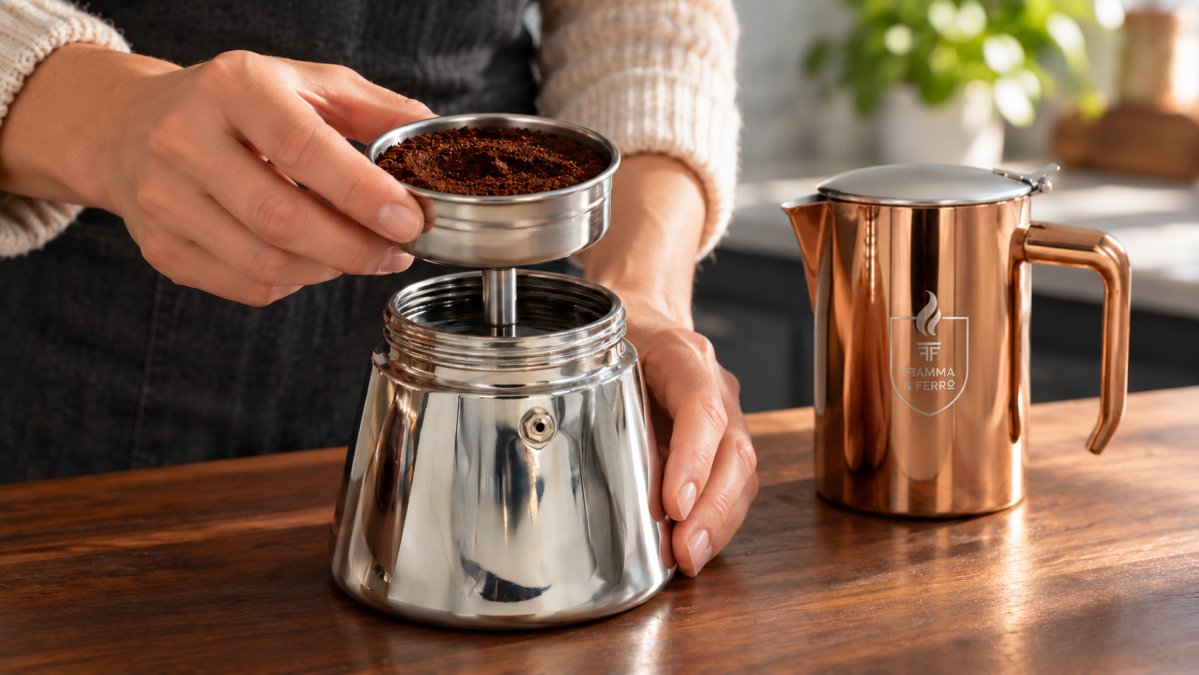
Pour and enjoy. Let the brewer cool for a moment, then carefully pour the concentrated coffee into your cup. The result should be dark, rich, and aromatic, true stovetop espresso.
Heat Management and Timing
Medium heat is the standard for most stovetops. High heat accelerates brewing but risks over-extraction and burning. Low heat extends brewing time excessively, allowing flavors to become muted and bitter. Medium heat typically produces excellent coffee in 7-10 minutes from the moment you place the pot on the burner.
Electric and ceramic stovetops heat more slowly and retain heat longer than gas. If you're using electric, you may need to reduce heat slightly once the pot is placed, or the residual heat will continue cooking the coffee even after you remove it.
Fiamma & Ferro Stainless Steel Stovetop →
Induction cooktops offer precise heat control. Start at medium (about 50% power) and adjust based on how quickly coffee rises. Induction's responsiveness means you can fine-tune heat in real time, a significant advantage over traditional stovetops.
Brewing time varies by altitude, water temperature, and grind fineness. At sea level with properly ground coffee and medium heat, expect 7-10 minutes. At higher altitudes, water boils at lower temperatures, so brewing may take longer and produce slightly less pressure.
Choosing the Right Moka Pot Size and Material
Capacity Options and Daily Brewing Needs
Moka pots come in 1-cup, 3-cup, 6-cup, 9-cup, and 12-cup sizes. These measurements refer to the volume of finished coffee, not water capacity. A 3-cup moka pot produces roughly 3 ounces of concentrated stovetop espresso.
Choose based on your daily consumption and household size. A single person who drinks one cup of moka coffee daily should choose a 3-cup or 6-cup model, brewing a 12-cup pot just for yourself wastes energy and produces coffee that cools before you finish it. Conversely, a household of three or four people benefits from a 9-cup or 12-cup pot to avoid multiple brewing cycles.
The Fiamma & Ferro Stainless Steel Stovetop Espresso Maker comes in a 12-cup capacity, ideal for households that brew moka coffee regularly or for anyone who wants to prepare multiple servings at once.
Stainless Steel vs. Aluminum: Why Material Matters
Aluminum has dominated the moka pot market for decades. It heats quickly, distributes heat evenly, and is inexpensive to manufacture. However, aluminum is reactive. Acidic coffee can interact with the metal, potentially leaching aluminum into your brew. Over time, aluminum also oxidizes and discolors.
Stainless steel, particularly food-grade 304 stainless steel, is non-reactive, durable, and maintains its appearance indefinitely. It heats slightly more slowly than aluminum but distributes heat more evenly once warmed. Stainless steel moka pots are heavier and more expensive, but they last decades with proper care. They also work reliably on induction cooktops, while most aluminum pots do not.
The Fiamma & Ferro Linea Suprema uses 304 stainless steel throughout the brewing chamber, eliminating aluminum entirely. This design choice prioritizes flavor purity and long-term durability. The copper PVD mirror finish adds visual elegance while maintaining the material's functional integrity.
Stovetop Espresso vs. Traditional Espresso Machines
Stovetop espresso makers and traditional espresso machines both produce concentrated coffee, but the methods differ significantly. A traditional espresso machine uses an electric pump to force water through grounds at precisely 9 bars of pressure, typically producing a shot in 25-30 seconds. The result is espresso with a thin layer of crema (foam) on top.
Moka pots rely on vapor pressure, the force created by heating water in a sealed chamber. This pressure builds more gradually and reaches lower maximum pressure (typically 1-2 bars) than pump-driven machines. Brewing takes 7-10 minutes instead of 30 seconds. The coffee produced is often called "stovetop espresso" because it's concentrated and bold, but it's technically not true espresso by the Italian definition.
The practical difference: traditional espresso machines produce a thinner, more delicate cup with visible crema. Moka pots produce a thicker, fuller-bodied coffee with deeper, more complex aromas. Neither is objectively superior, it depends on your taste preference and budget. An entry-level espresso machine costs hundreds of dollars and requires regular maintenance. A quality moka pot needs only basic cleaning.
For home baristas seeking rich, concentrated coffee without the expense and complexity of an espresso machine, moka pots coffee remains the gold standard. They've remained virtually unchanged for nearly a century because the design simply works.
Water Chemistry and Its Impact on Extraction
The mineral content in your water, primarily calcium and magnesium, affects how efficiently coffee extracts. Hard water with high mineral content actually improves extraction by slowing water flow slightly, allowing more complete flavor development. Soft water or distilled water flows too quickly, under-extracting and producing thin, sour coffee.
The ideal water for moka pot brewing has moderate hardness: enough minerals to support proper extraction, but not so much that scale accumulates inside the brewer. If your tap water is very hard, consider using filtered water that removes some minerals while retaining beneficial ones. If your water is very soft, a small pinch of mineral-rich salt can improve extraction, though this is rarely necessary in most regions.
Scale buildup inside the lower chamber and on the safety valve degrades performance over time. Hard water accelerates this buildup. Regular descaling with a mixture of equal parts white vinegar and water keeps the brewer functioning optimally. Fill the lower chamber with the vinegar solution, assemble the pot without coffee, and heat it until the solution rises into the upper chamber. Let it cool, disassemble, and rinse thoroughly with clean water.
Induction vs. Gas vs. Electric Stovetops
Gas stovetops heat moka pots quickly and allow precise, immediate heat adjustment. The flame provides even heat distribution if you use a flame diffuser. Gas is the traditional choice for stovetop espresso brewing and remains popular among coffee enthusiasts.
Electric coil and smooth-top electric stovetops heat more slowly and retain heat longer. Once you remove the pot from the burner, residual heat continues cooking the coffee briefly. This requires anticipation, remove the pot slightly before you'd normally do so to account for carryover heat. Electric stovetops work well with moka pots but demand more attention to timing.
Induction cooktops require ferromagnetic cookware, most stainless steel moka pots are induction-compatible, but aluminum pots are not. Induction offers exceptional heat control: it heats the pot directly rather than the burner surface, and power adjusts instantly. The Fiamma & Ferro Stainless Steel Stovetop Espresso Maker is fully induction-compatible, making it ideal for modern kitchens with induction cooktops.

Induction's precision is particularly valuable for moka pot brewing. You can start at medium-high heat to bring water to temperature quickly, then reduce to medium once the pot is placed, fine-tuning heat in real time as coffee rises. This level of control is difficult to achieve on gas or electric.
Troubleshooting Moka Pot Coffee Issues
Bitter or Over-Extracted Taste
Over-extraction is the most common problem with moka pots. It happens when coffee grounds contact hot water for too long, leaching excessive compounds that taste harsh and bitter.
The primary cause is grind size. If your coffee tastes bitter, grind coarser. Coarser grounds allow water to flow through faster, reducing contact time. Move your grinder setting up by 2-3 notches and brew another batch.
Fiamma & Ferro Stainless Steel Stovetop →
Secondary causes include excessive heat or leaving the pot on the burner too long. Reduce heat to medium if you're using high, and remove the pot immediately when you hear the hiss that signals the lower chamber is nearly empty. Leaving it on heat beyond this point burns the coffee and damages the gasket.
Using stale coffee also contributes to bitterness. Coffee begins losing aroma within minutes after grinding. Always grind immediately before brewing, and use beans roasted within the past 2-3 weeks.
Weak Coffee or Poor Flow
Weak coffee indicates under-extraction, the water passed through the grounds too quickly without extracting enough flavor. Grind finer to slow water flow and increase extraction time. Move your grinder setting down by 2-3 notches.
Poor flow can also result from a clogged safety valve or filter plate. If coffee barely trickles into the upper chamber despite fine grinding, disassemble the pot and inspect the safety valve (a small metal pin on the side of the lower chamber) and the filter plate (the perforated disc that holds the coffee basket). Clean these with a soft brush or cloth. Scale buildup from hard water is often the culprit.
Ensure you're using enough coffee. The filter basket should be filled level with the top, not heaped. Underfilled baskets allow water to channel around the grounds instead of through them.
Hissing, Sputtering, or Safety Valve Issues
Excessive hissing before coffee appears in the upper chamber usually indicates over-packed grounds or a grind that's too fine. This restricts water flow so severely that pressure builds rapidly and forces air through the safety valve as a safety release. Grind coarser and use a lighter hand when filling the basket, level the grounds gently without pressing down.
Sputtering or spitting from the upper chamber's outlet tube suggests that water, not just coffee, is reaching the upper chamber. This happens when the lower chamber empties completely while still on heat. Remove the pot immediately when you hear the hiss. If sputtering continues, the gasket may be worn and allowing steam to escape. Replacement gaskets are inexpensive and easy to install.
A safety valve that leaks water or coffee during brewing indicates either a worn gasket or mineral scale blocking the valve. Try descaling first. If the problem persists, replace the gasket. The Fiamma & Ferro Linea Suprema includes OEM replacement gasket rings and access to additional parts.
Maintenance, Cleaning, and Gasket Replacement
Clean your moka pot immediately after brewing while it's still warm. Disassemble all three chambers, remove the filter basket and gasket, and rinse each component with hot water. Use a soft brush to remove coffee residue from the filter plate and basket. Dry all parts thoroughly before reassembling or storing.
Never use a dishwasher. The high heat and harsh detergents can damage the gasket and degrade the finish on stainless steel.
Descale your moka pot monthly if you have hard water, or quarterly if your water is soft. Fill the lower chamber with equal parts white vinegar and water, assemble without coffee, and heat until the solution rises into the upper chamber. Let cool, disassemble, and rinse thoroughly several times with clean water to remove all vinegar smell.
The gasket, the rubber ring that seals the lower and upper chambers, wears over time and should be replaced annually if you brew daily, or every 2-3 years with lighter use. A worn gasket allows steam to escape, reducing pressure and producing weak coffee. Replacement is simple: unscrew the upper chamber, remove the old gasket, and press the new one into place. The Fiamma & Ferro Stainless Steel Stovetop Espresso Maker comes with replacement gaskets available separately.
Store your moka pot disassembled with the gasket removed. This allows air to circulate and prevents moisture buildup that can degrade the rubber over time.
Recipe Variations: Beyond Classic Moka Coffee
The concentrated coffee from a moka pot serves as a base for numerous drinks. Mix it with hot water in a 1:1 ratio to create an Americano-style coffee with less intensity than straight moka coffee. Add steamed milk to create a cappuccino or latte, the thick body of stovetop espresso produces excellent crema when combined with milk.
Iced moka coffee is exceptional on warm days. Brew normally, then pour the hot coffee over ice and add cold milk. The concentrated coffee remains flavorful even when diluted by melting ice. Some brewers add a touch of sweetener or vanilla syrup for variation.
Moka-based lattes with flavored syrups, hazelnut, vanilla, caramel, work beautifully because the full-bodied coffee stands up to sweet additions without becoming thin or overpowered.
Frequently Asked Questions
What grind size should I use for moka pots coffee?
Use a medium-fine grind, slightly coarser than espresso but finer than drip coffee. The grind should resemble table salt or fine sand. Consistency matters more than exact size—uneven particles extract unevenly, causing bitter or weak coffee. A precision manual grinder with adjustable settings helps dial in the exact grind your beans and stovetop require. Start with medium-fine and adjust finer if the coffee tastes weak, or coarser if it tastes bitter.
Why does my moka pot coffee taste bitter?
Bitter taste usually signals over-extraction, caused by too-fine grounds, excessive heat, or water that's too hot when assembly begins. Lower your heat to medium once the pot is assembled, and ensure you're using medium-fine—not espresso-fine—grounds. Using pre-heated water can also reduce bitterness by shortening total brew time. If your gasket is worn or leaking, pressure drops unevenly and can scorch the coffee. Replace the gasket if it shows cracks or hardening.
Can I use regular ground coffee in a moka pot?
Regular drip-grind coffee is too coarse for moka pots. It allows water to pass through too quickly, resulting in weak, watery coffee. Moka pots need medium-fine grounds to create the resistance and pressure that produces rich, concentrated coffee. If you're buying pre-ground coffee, look for bags labeled 'moka' or 'stovetop espresso.' For best results, grind whole beans fresh just before brewing using a manual grinder with precise adjustment.
Is moka pot coffee as strong as espresso?
Moka pot coffee is strong and concentrated but not true espresso. Espresso machines generate 9+ bars of pressure; moka pots produce roughly 1-2 bars through heat-driven vapor pressure. The result is full-bodied, bold coffee with complex aromas and crema-like appearance, but less intensity and body than machine espresso. Many coffee lovers prefer moka coffee for its smooth, balanced flavor and the ritual of stovetop brewing without the cost or maintenance of an espresso machine.