

Is Stainless Steel Coffee Equipment Worth It? 2026 Guide
Table of Contents
- Why Stainless Steel Coffee Equipment Commands a Premium
- Stainless Steel vs Aluminum Moka Pot: Which Material Wins?
- Non-Toxic Coffee Brewing Equipment: What's Really in Your Cup?
- Heat Retention and Brew Temperature Stability
- How to Clean Stainless Steel Coffee Equipment (Without Damaging It)
- Induction Compatibility and Kitchen Fit
- Does Stainless Steel Change the Taste of Your Coffee?
- Long-Term Value: Maintenance Costs, Durability, and Resale
- The Verdict: Is Stainless Steel Coffee Equipment Worth It for You?
- Frequently Asked Questions
Last Updated: September 16, 2026
Why Stainless Steel Coffee Equipment Commands a Premium
Stainless steel coffee equipment is worth it when you weigh material purity, thermal performance, and lifespan against the lower upfront cost of aluminum gear. At fiammaferro.com, we build our brewing tools from 304 stainless steel precisely because those three factors decide whether a moka pot lasts two years or twenty.

The premium is real. A stainless steel moka pot costs more than an aluminum one at checkout, and the gap widens with size and finish quality. What buyers often miss is that the premium buys you a different category of object: one that resists pitting, holds heat evenly, and never puts a reactive metal in contact with hot, acidic coffee.
Below, we break down the material science, the cleaning routine, and the long-term math so you can decide whether stainless steel coffee equipment earns a place on your counter.
The Real Cost of Buying Twice
Aluminum moka pots are inexpensive, and that is their main advantage. They are also soft, reactive, and prone to denting at the threads where the two halves meet. When those threads wear, the seal weakens and the pot starts sputtering instead of brewing.
Stainless steel resists that failure mode because the alloy is harder and more dimensionally stable under repeated heating and cooling cycles. A pot that still seals properly after years of daily use costs less per cup than a cheap pot replaced every other year.
Stainless Steel vs Aluminum Moka Pot: Which Material Wins?
Stainless steel wins on durability, corrosion resistance, and flavor neutrality; aluminum wins only on price and weight. For anyone brewing daily, the stainless option is the better long-term purchase.
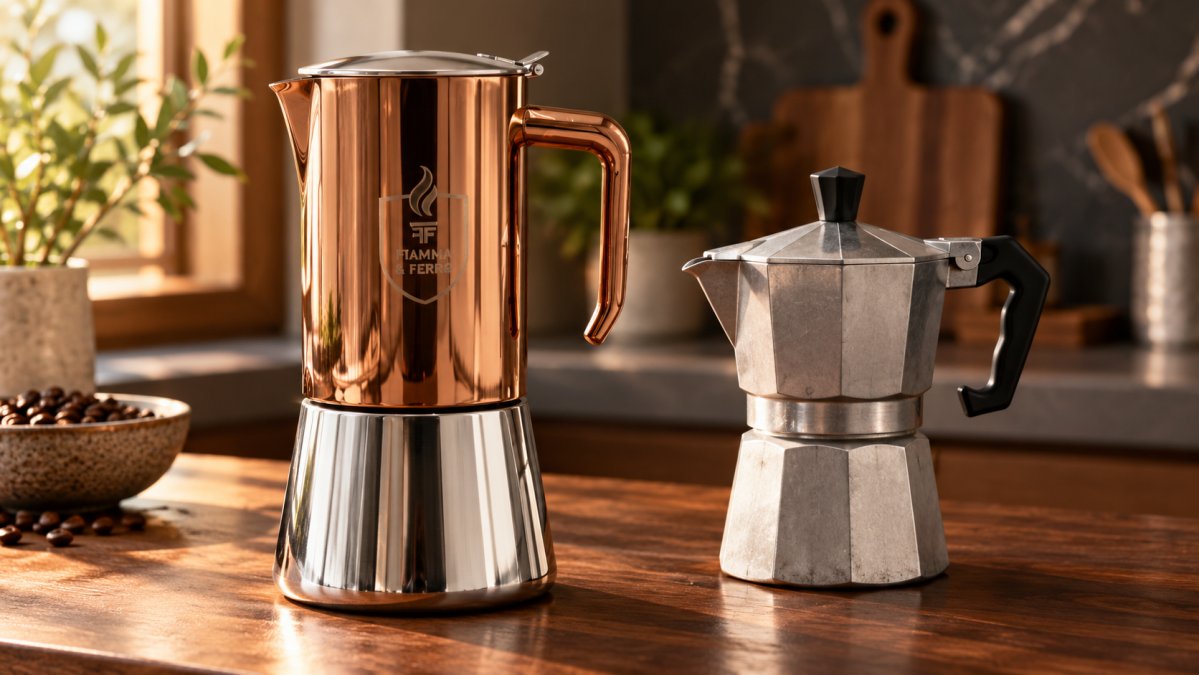
The difference comes down to how each metal behaves in a hot, wet, acidic environment. Aluminum is reactive. Coffee is mildly acidic. Put the two together repeatedly and the metal slowly oxidizes, which is why older aluminum pots develop a dull gray interior and a metallic edge in the cup.
Stainless steel sidesteps that problem. The chromium in the alloy forms a passive oxide layer that stops further corrosion, so the brewing surface stays inert. That is the whole point of choosing stainless steel coffee gear: the metal stops participating in the brew.
Corrosion Resistance and Material Grades
Not all stainless is equal. The grade number tells you what the alloy is built to do.
- 304 stainless steel: the standard food-grade alloy, roughly 18% chromium and 8% nickel, used for brewing chambers and food-contact surfaces
- 316 stainless steel: adds molybdenum for extra resistance to chlorides and salt, common in marine and medical applications
- 430 stainless steel: lower chromium, magnetic, often used for exterior cladding rather than brewing surfaces
For a moka pot, 304 is the correct choice. It handles coffee's acidity, resists staining, and holds up to daily thermal cycling. The FDA food-contact substance guidance treats stainless steel as an appropriate food-contact material, which is why it dominates commercial kitchens.
Non-Toxic Coffee Brewing Equipment: What's Really in Your Cup?
Non-toxic coffee brewing equipment means every surface that touches hot coffee is inert: no reactive metal, no plastic, no painted interior. Stainless steel, glass, and ceramic meet that bar. Aluminum and unlined plastic do not.
The concern with aluminum is leaching. Acidic liquids can pull trace amounts of metal from an uncoated aluminum surface, especially if the pot is scratched or has lost its oxide layer. Whether that matters at a given exposure level is debated, but the avoidance strategy is simple: choose a pot where the brewing chamber is stainless.
Plastic introduces a different set of questions. Many plastics contain additives, and heat accelerates migration into food and drink. A moka pot with a plastic handle is fine, since the handle never touches coffee. A moka pot with a plastic-lined brewing path is not, because that surface sits in contact with hot liquid for the full brew.
Our Linea Suprema moka pot was designed around this distinction. The brewing chamber is stainless steel, there is no aluminum in the water path, and no plastic components touch the coffee. The only non-metal part in the assembly is the silicone gasket, which is a sealing component rather than a brewing surface.
Heat Retention and Brew Temperature Stability
Stainless steel holds heat longer than aluminum once it reaches temperature, but the reason is counterintuitive: stainless is a poor conductor of heat. That low thermal conductivity is the feature, not the flaw. It slows the rate at which heat escapes the chamber walls, so the brew temperature stays in a narrower band during extraction.
Aluminum sits at the opposite end of the scale. It conducts heat roughly four times faster than stainless steel, which is why an aluminum pot reaches brewing temperature quickly. The same property works against it on the back end. Heat that enters fast also leaves fast, so the chamber cools the moment the burner cycles down, and the internal temperature swings through the extraction.
Copper and brass behave like aluminum, only more so. Copper is one of the best thermal conductors among common metals, which is why copper boilers in espresso machines respond to temperature changes almost instantly. That responsiveness is useful when a PID controller is actively managing the boiler. It is less useful in a stovetop moka pot, where there is no controller and the only thermal ballast is the mass of the metal itself.
Fiamma & Ferro Stainless Steel Stovetop →
That is the trade-off to understand before you buy:
- Fast conductor (aluminum, copper, brass): quick to heat, quick to lose heat, wider temperature swing during the brew
- Slow conductor (stainless steel): slower to heat, slower to lose heat, narrower temperature swing once it is at temperature
Moka brewing is pressure-driven, and pressure tracks temperature. Water in a sealed lower chamber builds pressure as it heats, and that pressure pushes the water up through the coffee bed. A pot that climbs steadily into the brewing range and holds there extracts evenly. A pot whose temperature spikes and drops pulls unevenly, which shows up in the cup as bitterness and thinness at the same time.
The practical lever is thermal mass. A heavier base and thicker walls store more heat, so the pot absorbs the small temperature dips that happen when cooler water first contacts the coffee. A stainless pot with real weight behind it takes slightly longer to reach brewing temperature on the stovetop, then holds that temperature through the full extraction. A thin-walled pot, regardless of material, has little mass to buffer with.
Surface finish plays a smaller role. A reflective exterior coating, such as a copper PVD layer, reduces radiant heat loss to the surrounding air, which is a marginal but measurable effect on a stovetop. It does not change the conductivity of the steel underneath.
One habit worth building: preheat your water before assembling the pot. Starting with hot water shortens the time the coffee grounds spend warming up, which reduces the scorched, harsh notes that come from a slow ramp. It also lets the metal reach brewing temperature faster, so the pot spends more of the brew in its stable band.
How to Clean Stainless Steel Coffee Equipment (Without Damaging It)
Cleaning stainless steel coffee equipment takes about two minutes a day and one deeper session a month. The daily routine is rinse, disassemble, and air dry. The monthly routine adds a descale.
Here is the full sequence:
- Let the pot cool completely before disassembling. Hot threads under pressure can gall or seize.
- Unscrew the top chamber and remove the filter basket and gasket.
- Rinse every part under warm running water. No soap needed for daily cleaning.
- Dry immediately with a soft cloth. Air drying leaves water spots on polished finishes.
- Once a month, run a descale cycle with a 1:1 mix of white vinegar and water through the brewing path.
- Rinse thoroughly after descaling, then brew one throwaway batch of water to clear any residue.
What most guides get wrong is the abrasive advice. Steel wool, scouring pads, and powdered cleansers scratch the passive oxide layer and dull the finish. Once scratched, stainless is more likely to stain and pit in those exact spots.
- Avoid steel wool and abrasive pads entirely
- Skip the dishwasher if your pot has a PVD finish
- Replace the silicone gasket when it hardens or flattens
- Never store the pot screwed shut, which compresses the gasket permanently
Gaskets are the wear item. A hardened gasket leaks pressure, which ruins extraction long before the metal shows any problem. Keeping a spare on hand is the single cheapest way to protect the pot's performance.
Induction Compatibility and Kitchen Fit
Induction compatibility depends on whether the base contains a magnetic layer, not on the body material. Many stainless moka pots work on induction; some do not. Check the base with a refrigerator magnet before you buy.
This is where a lot of buyers get burned. They assume "stainless steel" means "induction ready," then discover their new pot will not trigger the cooktop's magnetic sensor. The fix is a base engineered with a ferromagnetic layer, which is standard on induction-rated pots.
Our stovetop espresso maker is built for induction and also works on gas, electric, ceramic, and halogen. That flexibility matters if you ever move or upgrade your range. A pot that only works on one burner type is a pot you may have to replace.
Fit is the other half of the question. Induction burners have a defined ring, and the pot's base needs to sit fully inside it. A 12-cup pot with a wide base is a better match for a full-size induction zone than a small one that only covers part of the ring.
Does Stainless Steel Change the Taste of Your Coffee?
Stainless steel does not add flavor to coffee; it removes the metallic edge that reactive metals can introduce. In a side-by-side brew, the stainless cup typically tastes cleaner and slightly sweeter, with more defined origin notes.
That is not marketing language. It is the predictable result of an inert brewing surface. Aluminum can contribute a faint metallic sharpness, especially in older pots or ones with worn interiors. Stainless contributes nothing, so what you taste is the coffee.
The bigger flavor variables are grind and freshness, not the pot. Coffee starts losing aromatic compounds within minutes of grinding, which is why a manual grinder earns its place next to any moka pot. Our Titanium+ grinder uses CNC-cut conical burrs with a titanium coating engineered to hold their cutting edge, and the burr system is rated for 500 kg or more of beans.
Fresh-ground coffee into a stainless brewing chamber is the combination that produces the cleanest cup. The pot protects the flavor; the grinder creates it.
Fiamma & Ferro Stainless Steel Stovetop →
Long-Term Value: Maintenance Costs, Durability, and Resale
Long-term value comes down to three numbers: how often you replace the pot, how often you replace the wear parts, and what the pot is worth if you sell it. Stainless wins on all three, but the margin is smaller than the sticker price suggests once you account for the consumables.
Start with the wear parts. Every moka pot, stainless or aluminum, has a silicone or rubber gasket that seals the two chambers. That gasket is the single most frequently replaced component. A gasket hardens and flattens with heat cycling, and a hardened gasket leaks pressure, which ruins extraction long before the metal shows any problem. Budget one replacement per year for daily brewing, more if you brew twice a day. Gaskets are inexpensive, and keeping a spare on hand is the cheapest way to protect the pot's performance.
The filter basket is the second wear item. It is usually stainless even on aluminum pots, so it is not a differentiator, but it can deform if it is dropped or forced into place. A deformed basket lets grounds past the seal, which shows up as grit in the cup.
Descaling is the recurring cost most guides ignore. Hard water leaves mineral scale on the interior surfaces, and scale insulates the metal, which slows heat transfer and throws off the brew temperature. The fix is a periodic descale with a mild acid. White vinegar diluted with water is the low-cost option. Commercial descaling solutions work faster and are formulated to be gentle on stainless, but they cost more per treatment. Either way, the cost is small and predictable, and it applies to aluminum pots too, so it does not change the material comparison.
What does change the comparison is failure mode. Aluminum is soft, and the threads where the two halves meet are the weak point. Repeated heating and cooling cycles, plus the torque of screwing the pot shut, wear those threads. When they wear, the seal weakens and the pot starts sputtering instead of brewing. That is a terminal failure, not a maintenance item. Stainless steel resists it because the alloy is harder and more dimensionally stable under the same cycling.
Here is how the two materials compare across the full cost picture:
Factor |
Stainless Steel |
Aluminum |
|---|---|---|
Typical replacement cycle |
Many years with gasket changes |
Shorter, thread wear is common |
Gasket replacement |
Every 6-12 months |
Every 6-12 months |
Filter basket |
Stainless, durable |
Often stainless, can deform |
Descaling |
Periodic, mild acid |
Periodic, mild acid |
Corrosion risk |
Low, passive oxide layer |
Higher, reactive to acid |
Induction support |
Common with magnetic base |
Rare |
Resale value |
Holds value |
Minimal |
End-of-life |
Fully recyclable, higher scrap value |
Recyclable, lower scrap value |
Maintenance cost is mostly gaskets, and it is roughly equal between the two materials. The real difference is how long the body lasts. A stainless pot that still seals properly after years of daily use costs less per cup than a cheap pot replaced every other year, even though the stainless pot costs more upfront.
Recyclability closes the loop. Stainless steel is one of the most recycled materials in circulation, and scrap stainless retains meaningful value. Aluminum is also recyclable, but the thin, alloyed walls of a cheap moka pot are less attractive to recyclers than a solid stainless body. At end of life, the stainless pot is worth more to the waste stream and more to you.
The Verdict: Is Stainless Steel Coffee Equipment Worth It for You?
Is stainless steel coffee equipment worth it? For daily brewers, yes. The premium pays back through a longer service life, stable brew temperatures, and a brewing surface that never reacts with your coffee.
Skip it if you brew moka coffee a few times a year and want the lowest possible entry price. In that case, a basic aluminum pot is adequate, provided you keep it clean and replace it when the interior dulls.
For everyone else, the math favors stainless. Consider the Espresso Ritual Bundle if you want the full setup: the 12-cup Linea Suprema stovetop espresso maker paired with the Titanium+ manual grinder, priced at $399.98 together. If you already own a grinder, the EPA guidance on reducing waste through durable goods makes the case for buying one pot that lasts rather than three that do not. The stainless moka pot alone is $169.99, induction-ready, with OEM replacement gaskets available so the pot can outlive its wear parts.
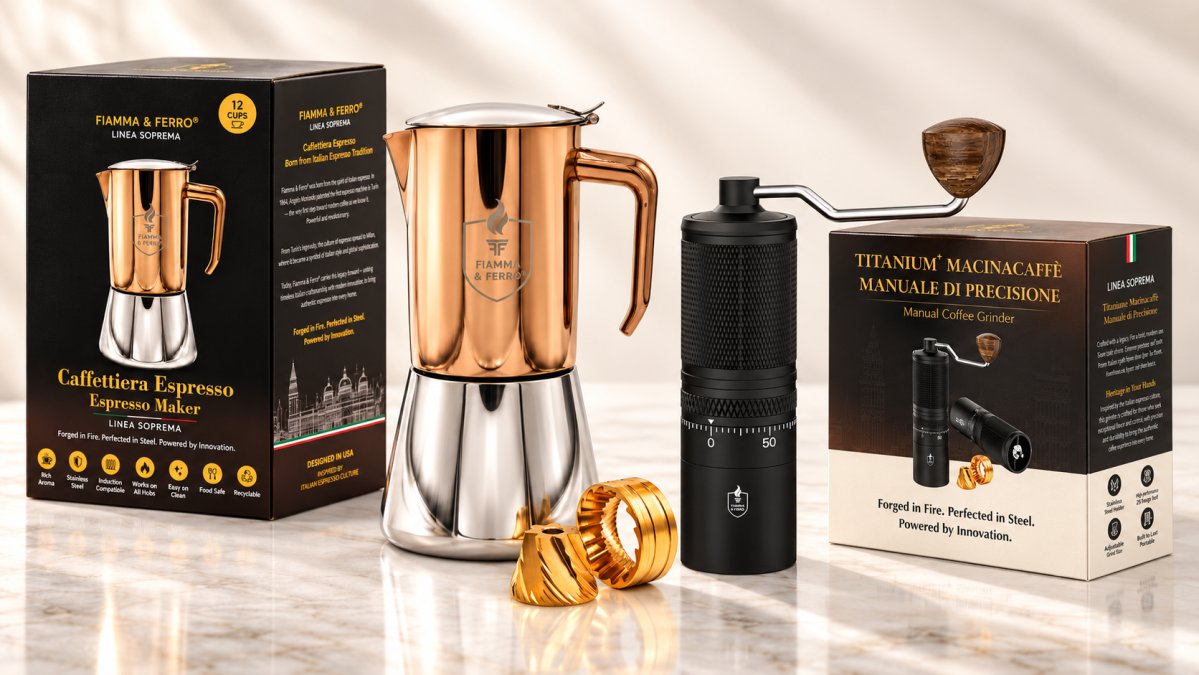
The challenge with stainless steel coffee equipment is not the purchase, it is committing to a brewing ritual that rewards patience and fresh grinding. fiammaferro.com builds for exactly that: 304 stainless steel construction with no aluminum brewing chamber and no plastic touching your coffee, an induction-ready base, and a copper PVD finish that looks as good on the counter as it performs on the stove. Pair the Linea Suprema moka pot with the Titanium+ grinder, backed by a 10-year burr performance warranty, and get started with fiammaferro.com to brew a cleaner, richer cup every morning.
Frequently Asked Questions
Is stainless steel coffee equipment better than aluminum?
Stainless steel coffee equipment offers better durability, corrosion resistance, and does not react with acidic coffee oils. Aluminum moka pots are lighter and cheaper but can pit over time and may impart a metallic taste if not seasoned properly. Stainless steel, especially grades like 304, resists rust and leaching, making it a safer, longer-lasting choice for daily brewing.
Does stainless steel affect the taste of coffee?
Stainless steel is non-reactive, so it will not alter the flavor of your coffee. Unlike aluminum, which can oxidize and leave a metallic aftertaste, stainless steel preserves the coffee's natural oils and aromatic compounds. This means you taste the beans, not the metal. For the cleanest cup, look for equipment with no plastic or aluminum in the brewing path.
How do I maintain stainless steel coffee brewing equipment?
Rinse with warm water after each use and dry immediately to prevent water spots. For scale buildup, descale monthly using a 1:1 white vinegar and water solution, then rinse thoroughly. Avoid abrasive scrubbers and dishwasher detergents with bleach, which can dull the finish.
Is stainless steel coffee gear compatible with induction cooktops?
Many stainless steel moka pots and stovetop espresso makers are induction-ready, but not all. Check the base: it must be magnetic and flat. Brands like Fiamma & Ferro design their stainless steel moka pots with an induction-compatible base that works on gas, electric, ceramic, halogen, and induction stovetops. If a magnet sticks firmly to the bottom, it will work on induction.