

Italian Coffee Pot Guide: Moka Pot Brewing in 2026
Table of Contents
- What Is an Italian Coffee Pot and Why It Still Wins in 2026
- How to Use a Stovetop Espresso Maker: Instructions That Actually Work
- Moka Pot Grind Size: The Single Biggest Flavor Variable
- Troubleshooting Moka Pot Coffee: Bitter, Weak, or Burnt
- Choosing the Right Size and Stove Compatibility
- Aluminum vs. Stainless Steel: What the Material Means for Flavor and Health
- Water Chemistry and Extraction: The Advanced Variables
- Cleaning, Descaling, and Repairability for a Longer-Lasting Pot
- Recipe Variations: Beyond the Classic Italian Coffee Pot
- Frequently Asked Questions
Last Updated: September 26, 2026
What Is an Italian Coffee Pot and Why It Still Wins in 2026
The Italian coffee pot, known in Italy as the caffettiera, is a stovetop brewer that pushes hot water up through ground coffee using steam pressure. No pump, no electronics, no capsules, and that simplicity keeps winning.
Walk into any kitchen in Naples or Milan and you will find one on the shelf. The octagonal design has barely changed in nearly a century, and that is the point. Fewer parts means fewer failure points. A well-made pot can outlast the stove it sits on.
Water boils in the lower chamber, steam builds pressure, and that pressure forces water through the coffee grounds in the filter basket. The result sits between drip coffee and true espresso, richer and more concentrated than a standard brew.
What most guides miss is that the pot is not the variable, your grind, water level, and heat source are. Get those three right and a $40 pot outperforms a careless $200 setup. Get them wrong and no equipment saves the cup.
How to Use a Stovetop Espresso Maker: Instructions That Actually Work
Using a stovetop espresso maker comes down to four moves: fill the base with water, add coffee to the basket, assemble and heat, then pour as soon as it finishes. Total time: five to seven minutes.
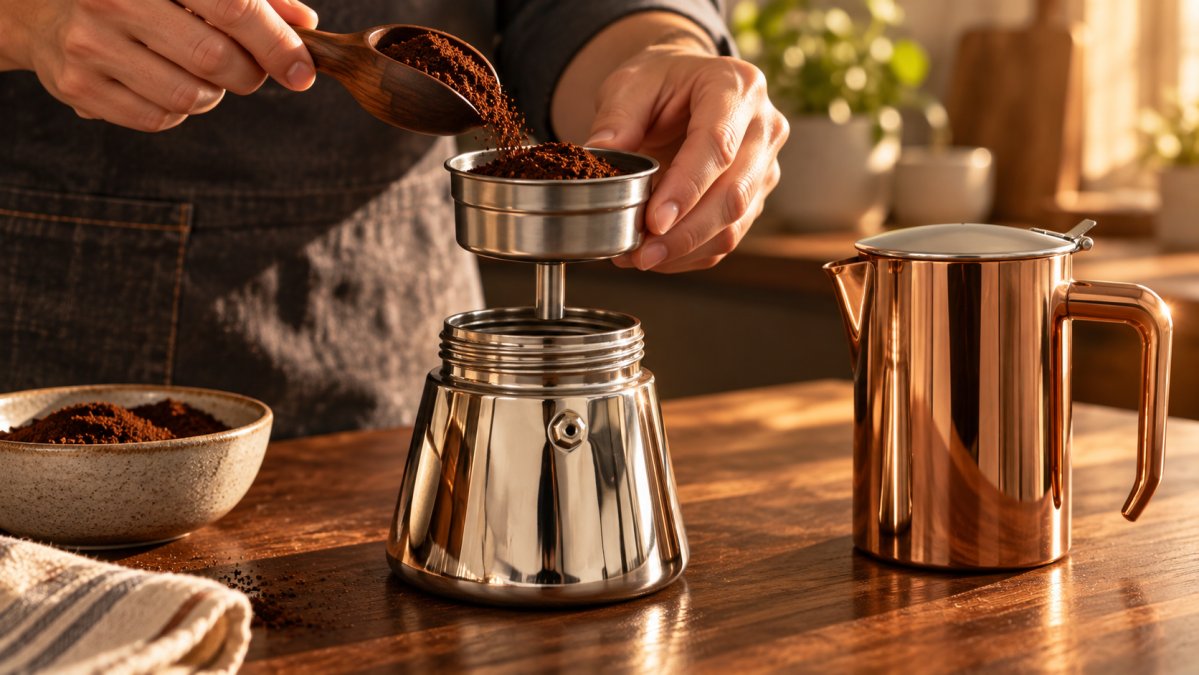
Most people ruin the cup in the first thirty seconds. Here is the sequence that works.
Step-by-Step Brewing: Fill, Add Coffee, Brew, Pour
- Fill the lower chamber with cold or room-temperature water to just below the safety valve. Never cover the valve.
- Add coffee to the filter basket and level it off with your finger. Do not tamp it down.
- Screw the top and base together firmly, using a cloth if the base is warm.
- Set the pot on medium heat. High heat scorches the grounds before the water even rises.
- Listen for the gurgle. When the flow turns pale and sputtering, pull the pot off the heat immediately.
- Stir the coffee in the upper chamber once, then pour.
A common mistake is walking away. The window between perfect extraction and burnt coffee is maybe twenty seconds. Stand there.
Moka Pot Grind Size: The Single Biggest Flavor Variable
Moka pot grind size should sit between fine espresso and standard drip, roughly the texture of table salt. Too fine and the brew turns bitter and clogged. Too coarse and water races through, leaving a weak, watery cup.
That advice is correct, but most guides skip why grind size dominates every other variable in a moka pot. The answer is pressure.
Why Grind Size Matters More Here Than in Drip or Espresso
A moka pot is a low-pressure brewer, typically developing 1 to 2 bar during a normal brew versus the 9 bar a pump espresso machine holds. That narrow band is the whole story.
In a pump machine, the pump forces water through the puck regardless of how the bed is packed. In a moka pot, the only thing pushing water through the coffee is steam pressure in the lower chamber, and the coffee bed is the resistance. Too tight and pressure climbs until it finds the path of least resistance, around the gasket or through a channel, giving you a sputtering, uneven brew. Too loose and water passes through before it dissolves the sugars and acids you want.
This is why grind size is not a preference in a moka pot, it is the flow-control mechanism. You are tuning the coffee bed's resistance to match the pressure the pot can generate.
The Practical Grind Window
Aim for a grind that clumps slightly when pinched but still falls apart. If your pot sputters and stalls, go coarser; if the coffee runs through in under a minute and tastes thin, go finer.
A few concrete signals to read during the brew:
- Steady, honey-colored stream from the upper spout: grind is in range.
- Dark, slow drips that never form a stream: grind is too fine, or the basket is overfilled.
- Pale, fast, watery flow that finishes in under 60 seconds: grind is too coarse.
- Sputtering and spitting before the upper chamber is half full: channeling, usually too fine a grind combined with too high heat.
Pre-ground supermarket coffee labeled "espresso" is usually too fine for a moka pot: it packs into the basket, restricts flow, and pushes brew temperature up until the coffee tastes scorched. If that is all you have, fill the basket slightly under level and use lower heat.
Why Fresh Grinding Changes the Cup
Coffee begins losing aroma within minutes of grinding, the volatile compounds carrying sweetness and fruit notes oxidize fast once the bean is broken open. Grinding immediately before brewing keeps them in the cup instead of the air.
A Specialty Coffee Association overview of grind and extraction notes that particle size consistency drives extraction uniformity, which is exactly what a moka pot needs. An uneven grind means some particles over-extract while others under-extract in the same brew, and in a low-pressure brewer, that inconsistency shows up faster than it would in a pump machine, because there is no pressure reserve to smooth it out.
A burr grinder produces a narrower particle distribution than a blade grinder, not that burrs grind "better," but that they grind more evenly, which is what a moka pot rewards.
The Fiamma & Ferro Titanium+ Precision Manual Grinder addresses this with 180 grind settings and titanium-coated burrs, so you can dial in a moka-specific setting and repeat it every morning. At $229, it costs more than most electric grinders, but the burr assembly is rated for 500kg+ of beans and carries a 10-year performance warranty. For daily brewers, that math works out.

Troubleshooting Moka Pot Coffee: Bitter, Weak, or Burnt
Troubleshooting moka pot coffee starts with identifying which of three failure modes you have: bitter, weak, or burnt. Each traces back to a different variable, and fixing the wrong one makes the cup worse.
Fiamma & Ferro Premium 12-Cup Stainless →
Problem |
Likely Cause |
Fix |
Impact |
|---|---|---|---|
Bitter, harsh |
Grind too fine |
Coarsen by 2-3 clicks |
Smoother, sweeter cup |
Weak, watery |
Grind too coarse |
Finen by 2-3 clicks |
Fuller body |
Burnt, ashy |
Heat too high |
Drop to medium-low |
Removes scorch |
Sputtering, stalls |
Basket overfilled |
Level, do not tamp |
Even flow |
Metallic taste |
Stale water or old gasket |
Fresh water, replace gasket |
Clean flavor |
Sour, thin |
Under-extracted |
Slower heat, finer grind |
Balanced acidity |
Bitter coffee usually means water took too long to pass through the grounds, pulling out harsh compounds along with the good ones. Go coarser.
Burnt coffee is a heat problem, not a coffee problem. Medium heat is the ceiling: on a high flame the metal heats faster than the water can absorb, and the grounds at the bottom of the basket scorch before extraction starts.
Weak coffee is the easiest fix. Your grind is too coarse, or you are not using enough coffee. Fill the basket level, every time.
Choosing the Right Size and Stove Compatibility
Size and stove compatibility are the two specs buyers most often get wrong, and both are easy to check before you buy. A moka pot that does not fit your cooktop is a paperweight.
Cup capacity is measured in Italian demitasse cups, roughly 50ml each. A 3-cup pot makes about 150ml, enough for one person; a 6-cup serves two; a 12-cup pot, like the Fiamma & Ferro Linea Suprema at 600ml, serves four to six or fills a thermos.

Buy for your typical largest batch, not your average. You can brew less than full, though extraction is slightly less consistent with a partial load.
Stove compatibility breaks down like this:
- Gas: Works with any moka pot, including bare aluminum and stainless steel.
- Electric coil and ceramic: Works with flat-bottom pots. Avoid heavily rounded bases.
- Induction: Requires a magnetic base. Aluminum pots will not work without a separate induction plate, which adds a layer of thermal resistance.
- Halogen: Same requirement as induction.
If you own an induction cooktop, buy an induction-ready pot from the start. The Linea Suprema is built from 304 stainless steel and works on induction, gas, electric, ceramic, and halogen without an adapter plate.
Aluminum vs. Stainless Steel: What the Material Means for Flavor and Health
Aluminum and stainless steel differ in three ways that matter: heat response, durability, and what touches your coffee. Aluminum heats faster and costs less; stainless resists pitting, holds up to descaling, and does not react with acidic coffee.
Aluminum is the traditional material and conducts heat quickly, which is why classic pots are made from it. The trade-off is reactivity: coffee is acidic, and aluminum can leach trace amounts into the brew over time, especially if the pot develops pits or scratches. It also cannot go in a dishwasher and discolors with use.
Stainless steel, particularly 304 or 18/10 grade, is non-reactive: it will not alter flavor and handles repeated descaling without corroding. It heats more slowly, so you adjust heat timing rather than technique.
For anyone brewing daily and thinking about the long term, stainless is the better buy. The Linea Suprema uses 304 stainless steel for all coffee-contact components, with zero aluminum contact and no plastic touching the brew. It is priced at $169.99 and includes a canvas storage bag, a full-color brewing and care guide, and access to replacement gaskets.
Water Chemistry and Extraction: The Advanced Variables
Water chemistry is the variable almost nobody adjusts, and it changes extraction more than most people expect. Coffee is roughly 98% water, so your tap matters.
Two measurements drive this: hardness and pH. Hard water carries dissolved calcium and magnesium that bind to coffee compounds and mute flavor; very soft water extracts aggressively and can produce a hollow, over-extracted cup. The target is moderate hardness with a neutral pH.
If your tap water tastes good, it will probably brew good coffee. If it tastes chalky or heavily chlorinated, filter it. A basic carbon filter pitcher handles most of the problem for a few dollars.
Temperature matters too. Water hits the grounds between 195°F and 205°F in a properly heated moka pot. Push past that and you extract bitter compounds; fall short and you get sour, underdeveloped coffee. Medium heat keeps you in range; high heat overshoots it.
The Water Quality Association's guidance on household water treatment is a useful starting point if you want to test your own supply before changing anything else.
Cleaning, Descaling, and Repairability for a Longer-Lasting Pot
Cleaning a moka pot takes ninety seconds if you do it right, and skipping it is what kills most pots early. Rinse every part in warm water after each use, dry thoroughly, and never leave coffee sitting in the upper chamber.
Here is what actually matters:
- Rinse, do not scrub. Abrasive pads scratch the interior and give coffee a place to cling.
- Skip the dishwasher. Detergent strips finishes and corrodes aluminum. Hand wash only.
- Dry fully before reassembly. Trapped moisture grows mold in the gasket seat.
- Descale monthly with a diluted vinegar or citric acid solution. Mineral scale blocks the filter and slows flow.
- Replace the gasket every six to twelve months. This is the single most common cause of a pot that suddenly brews badly.
That is the standard advice. What almost every guide skips is what happens after the gasket fails, and why the answer is almost never "buy a new pot."
The Two Wear Parts, and What They Actually Do
A moka pot has exactly two components designed to wear out: the gasket and the safety valve. Everything else, base, upper chamber, filter basket, handle, is meant to outlive the owner.
Fiamma & Ferro Premium 12-Cup Stainless →
The gasket is the silicone or rubber ring in the upper chamber that seals against the filter basket rim when the pot is screwed together. It keeps pressurized water from escaping around the outside of the basket instead of through the coffee. When it hardens, cracks, or flattens, steam leaks past it, pressure drops, and the brew turns weak and metallic-tasting even though nothing else changed, the number-one cause of "my pot suddenly stopped working."
The safety valve is the small spring-loaded fitting on the lower chamber. It is a pressure-relief device: if the outlet gets blocked (overfilled basket, too-fine grind, clogged filter), it vents steam rather than letting the base rupture. Valves rarely fail on their own but can seize from mineral scale or get damaged if dropped. A seized valve is a safety issue, not a flavor issue, replace it if it will not move freely.
A Realistic Replacement Schedule
- Gasket: every 6-12 months with daily use. Faster if you brew multiple times a day, use high heat, or leave the pot assembled while still damp.
- Safety valve: inspect annually; replace if stiff, corroded, or visibly scaled. Many owners never replace one in a decade.
- Filter basket: essentially never, unless it is physically bent or the holes are clogged beyond descaling.
Replacement gaskets cost a few dollars and take about a minute to swap: unscrew the upper chamber, lift the old gasket out with a butter knife or fingernail, press the new one in flat-side down, and reassemble. No tools required.
Why This Is the Real Sustainability Story
Most "eco-friendly coffee" content focuses on capsules versus loose grounds. That is only half the equation. The other half is the hardware.
A stovetop pot with a replaceable gasket and valve has an effectively indefinite service life: the metal does not degrade from normal use, and the only consumable is a rubber ring costing less than a café coffee. Compare that to a capsule machine, where the entire brewing head is a sealed assembly landfilled when the pump or thermoblock fails, usually in three to five years.
The arithmetic is straightforward: one pot, a handful of gaskets over a decade, and zero capsule waste versus a machine replacement cycle and thousands of discarded pods. Repairability is the sustainability.
What to Check Before You Buy
If long service life matters to you, verify two things before purchase:
- Replacement gaskets are sold separately by the manufacturer or a compatible third party. If you cannot find a gasket for your model, the pot is disposable by design.
- The safety valve is a serviceable part, not a pressed-in fitting. A replaceable valve means the pot can be maintained rather than retired.
The U.S. Consumer Product Safety Commission maintains recall and safety information worth checking if you buy used equipment, particularly for older aluminum pots where valve condition is unknown.
Fiamma & Ferro ships replacement gaskets for the Linea Suprema as standalone parts, so the pot you buy today is the pot you keep. That is the difference between a piece of equipment and a disposable appliance.
Recipe Variations: Beyond the Classic Italian Coffee Pot
Recipe variations let you get more from the same pot without buying anything new. The classic brew is the baseline, not the ceiling.
Caffè americano: Brew normally, then dilute with hot water at roughly a 1:1 ratio. Softer body, same flavor notes.
Affogato: Pour a hot shot directly over a scoop of vanilla gelato. The bitterness cuts the sweetness.
Moka mocha: Add a spoon of cocoa powder to the grounds before brewing, or stir chocolate syrup into the finished cup.
Iced moka: Brew strong, pour immediately over ice, and add a splash of milk. Brewing directly onto ice preserves the aromatics that a slow cool would lose.
Spiced moka: Add a pinch of cinnamon or cardamom to the coffee grounds. Keep it under a quarter teaspoon or the spice overwhelms the coffee.
Cuban-style cafecito: Brew a moka pot, then whip the first few drops of coffee with sugar until it forms a pale paste, and stir that back into the full cup.
The Espresso Ritual Bundle pairs the 12-cup Linea Suprema with the Titanium+ grinder at $324.98, which covers the fresh-grind variable and the brew variable in one purchase.

Frequently Asked Questions
Why does my Italian coffee pot taste bitter?
Bitterness in a moka pot usually comes from water that is too hot, a grind that is too fine, or leaving the pot on the heat after the upper chamber fills. Use preheated water just below boiling, a medium-fine grind, and remove the pot from the burner as soon as you hear the gurgling stop. If your pot has a burned or metallic taste, check the gasket for wear.
What is the best grind size for a moka pot?
Aim for a medium-fine grind, similar to fine table salt. It should clump slightly when pinched but not pack into a dense puck. Too fine and the pressure builds, producing bitter, burnt coffee; too coarse and the water rushes through, leaving a weak, sour cup. If you grind fresh, a manual grinder with 180-step adjustment lets you dial in the exact size for your pot.
Is a moka pot the same as an Italian espresso machine?
No. A moka pot, also called a caffettiera, brews at roughly 1 to 2 bars of pressure, while a true espresso machine pushes 9 bars. The result is a rich, full-bodied coffee that is stronger than drip but not a true espresso shot. In Italy, the moka pot is the everyday home brewer; the espresso machine belongs to the café. Both have their place, but they are different tools.
How do I prevent my moka pot coffee from burning?
Start with hot water in the base, not cold, so the coffee spends less time on the heat. Use a medium-low flame that does not wrap around the sides of the pot. Keep the lid open during brewing so you can hear and see when the upper chamber fills, then remove the pot immediately. If you use an induction cooktop, choose a pot rated for induction and use a lower power setting.