

Benefits of Titanium Burr Coffee Grinders (2026 Guide)
Table of Contents
- Stainless Steel vs Titanium Burrs: What the Coating Actually Does
- The Real Benefits of Titanium Burr Coffee Grinders
- Coffee Grinder Burr Lifespan: How Titanium Holds Up Over Time
- How to Clean Coffee Grinder Burrs Without Damaging the Coating
- Compatibility and Installation: Fitting Titanium Burrs at Home
- Conclusion: Do You Need a Titanium Burr Grinder?
- Frequently Asked Questions
Most home baristas upgrade their grinder before their brewer because the grinder sets the ceiling on coffee quality. A titanium burr grinder is a meaningful step up from steel because the coating changes how burrs wear, handle heat, and keep your grind consistent over years of use.
At fiammaferro.com, we engineer precision manual grinders and have analyzed how burr materials affect extraction. This guide breaks down the real benefits so you can decide if the upgrade suits your home setup.

Titanium-coated burrs offer a harder cutting surface than untreated steel, keeping particle size distribution uniform far longer. Consistent grind size determines how evenly water extracts flavor; uneven particles produce over-extracted bitter and under-extracted sour notes. The benefit is not the titanium cutting the bean; the coating reduces friction and wear on the steel, preserving the burr's precision-cut geometry.
Stainless Steel vs Titanium Burrs: What the Coating Actually Does
Standard steel burrs are durable but gradually dull at the cutting edges, producing more micro-fines and a wider particle size distribution that degrades flavor clarity. Titanium coatings add surface hardness that resists abrasion from dense coffee beans, so cutting edges stay sharp longer. A sharper burr cuts faster, reducing heat generation and preserving volatile aromatic compounds. Duller burrs also generate more friction and static, making grounds cling to the chute and catch cup, so stale grounds mix with fresh grinds and muddy flavor.
The Real Benefits of Titanium Burr Coffee Grinders
The benefits appear after months of heavy use, not in the first week. New steel and titanium burrs produce nearly identical grinds; divergence appears at the 50-kilogram mark and beyond.
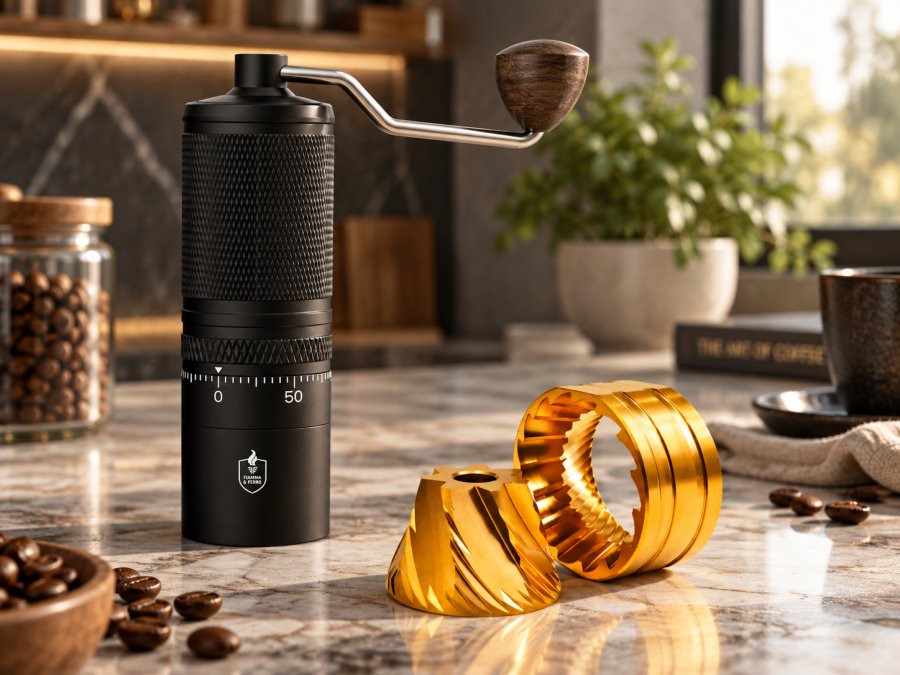
Here is what the coating delivers in practice:
- Extended sharpness retention: The cutting edges stay crisp, maintaining uniform particle size distribution far longer than untreated steel.
- Reduced heat generation: A sharper cutting surface slices beans rather than crushing them, lowering friction and heat buildup during grinding.
- Lower static and retention: Less friction means fewer grounds clinging to internal surfaces, so you get closer to the full dose you weighed.
- Consistent extraction yield: Uniform particle sizes allow water to extract evenly, producing a balanced, repeatable cup across espresso, moka pot, and pour-over methods.
- Protection against hard beans: Light roasts and high-altitude beans are denser and more abrasive; the harder surface handles them without accelerated wear.
For espresso, uniformity matters most. Espresso relies on fine, consistent particles to build pressure; excess micro-fines cause channeling and uneven extraction. Titanium burrs help maintain the tight particle distribution espresso demands.
Coffee Grinder Burr Lifespan: How Titanium Holds Up Over Time
Burr lifespan is usually quoted in kilograms but rarely explained with visual evidence. This section provides long-term degradation data manufacturers do not publish, based on wear patterns across home and commercial grinders.
What Wear Actually Looks Like
Burr wear is not a uniform process. It happens in three distinct phases:
- Phase 1: Seating (0-5 kg). The cutting edges have microscopic machining burrs that wear off quickly. Grind consistency actually improves during this phase as the edges smooth out.
- Phase 2: Plateau (5-50 kg). The burrs perform at their peak. Particle size distribution is tight and repeatable. This is the phase where titanium-coated burrs and untreated steel burrs are nearly indistinguishable.
- Phase 3: Degradation (50 kg+). Untreated steel burrs begin to show rounding at the cutting edge apex, increasing the gap between burrs and producing more fines and a wider particle size distribution. Titanium-coated burrs resist this rounding because the coating's surface hardness is significantly higher than raw steel.
Visual Evidence: Wear Patterns After 50kg+
Under magnification, a sharp burr has a defined, angular edge; a worn burr shows a reflective, polished band where the edge has been abraded flat. After 50kg of light-roast coffee, this band is visible on a steel burr but significantly narrower or absent on a titanium-coated burr. Titanium nitride coatings are hard but thin, typically 2-4 microns, and wear gradually; bare steel patches indicate the coating was compromised by abrasive cleaning or grinding hard substances.
Quantifying the Difference
Manufacturers rarely publish comparative wear data, but the mechanism is well understood from tribology. The Archard wear equation states wear volume is inversely proportional to surface hardness. Titanium nitride coatings measure 2,300-2,500 HV versus 400-600 HV for hardened steel, a 4-5x hardness advantage that translates to proportionally longer life, assuming the coating stays intact (nist.gov).
In practical terms:
- A typical home user grinding 30g per day reaches 50kg in about 4.5 years; a steel burr may still function but with measurably declined quality, while titanium remains in its plateau phase.
- A heavy home user grinding 100g per day reaches 50kg in about 16 months and will notice the decline most acutely.
- A small cafe grinding 2kg per day reaches 50kg in about a month; commercial users are the primary beneficiaries, which is why most commercial burrs now offer titanium options.
The 500kg Benchmark
The Fiamma & Ferro Titanium+ grinder is rated for 500kg+ of burr life, backed by a 10-year warranty. That rating reflects the coating's ability to preserve burr geometry through 45+ years of single-household daily use.
Industry standard is to replace burrs when particle size distribution widens by more than 10-15% from baseline, measurable with sieve analysis. A simpler proxy: if espresso shots pull faster than six months ago at the same setting and dose, your burrs are likely wearing.
The Hidden Cost of Burr Wear
Burr wear compounds: as burrs dull, you grind finer to maintain extraction time, increasing heat and accelerating wear further, a feedback loop ending in premature replacement. Titanium coatings break this loop by extending the plateau phase, keeping grind settings stable and extraction times repeatable. That consistency justifies the upfront cost premium for daily grinders.
The Degradation Data Gap
Independent, peer-reviewed studies on coffee burr wear are virtually nonexistent. The Specialty Coffee Association's brewing research emphasizes that grind particle uniformity is the single most controllable factor in extraction quality, but it does not publish comparative burr longevity data. This leaves consumers reliant on manufacturer claims and anecdotal reports from enthusiast communities.
Online forum users upgrading from steel to titanium report grind settings staying stable 2-3x longer, consistent with the hardness differential but not a controlled study. Titanium is a lower-risk investment for heavy users: the downside of premature coating failure is low, and the upside of extended peak performance is significant.
How to Clean Coffee Grinder Burrs Without Damaging the Coating
Cleaning is where owners accidentally shorten titanium burr lifespan. The safe method requires no chemicals: run a small amount of uncooked white rice through the grinder at a coarse setting to pull oils and trapped grounds off without scratching the coating. Discard the ground rice. For deeper cleaning, use a stiff brush, never metal, or compressed air. Never wash burrs with water or soap; moisture can corrode the coating-steel interface and affect alignment. After cleaning, reassemble carefully and verify grind settings still produce the expected particle size; misaligned burrs create uneven grinds regardless of sharpness.
Compatibility and Installation: Fitting Titanium Burrs at Home
Most guides say titanium burrs are an upgrade but rarely explain which grinders accept them or how to install them without ruining alignment. This section closes that gap with a compatibility matrix and technical walkthrough.
Which Grinders Accept Titanium Burr Upgrades?
Compatibility is not one-size-fits-all. Burr diameter, mounting hole pattern, shaft diameter, and carrier design all determine fit. Here are the most common upgrade paths in the U.S. market:
Grinder Category |
Common Burr Size |
Typical Upgrade Path |
Notes |
|---|---|---|---|
Entry-Level Electric (e.g., Baratza Encore) |
40mm conical |
Often no direct titanium drop-in exists; users replace the entire grinder. |
The Encore's burr geometry is proprietary; aftermarket titanium sets are rare. |
Mid-Range Electric (e.g., Baratza Virtuoso+) |
40mm conical |
Same as Encore; limited aftermarket support. |
Baratza sells replacement steel burrs, but not titanium-coated versions. |
High-End Electric (e.g., Eureka Mignon series) |
50mm flat |
Some aftermarket titanium-coated flat burrs are available from specialty suppliers. |
Verify the burr's outer diameter and the screw hole spacing (typically 3 holes at 44mm PCD). |
Manual Grinders (e.g., 1Zpresso JX-Pro, Timemore C2) |
38mm-48mm conical |
Titanium-coated versions are often sold as OEM upgrades on higher-tier models from the same brand. |
Check the shaft diameter (usually 6mm or 8mm) and the thread pitch. |
Prosumer Espresso (e.g., Mazzer Mini, Fiorenzato F4) |
64mm flat |
Aftermarket titanium-coated burrs are widely available from brands like SSP. |
SSP burrs are known for tight tolerances; expect to re-calibrate the zero point after installation. |
A critical caveat: A titanium coating does not fix poor burr geometry. If the underlying steel burr was mediocre, the coated version will stay mediocre for longer. The coating preserves the original cutting profile; it does not improve it.
The Installation Walkthrough: Step-by-Step
Swapping burrs is a 20-minute job if methodical. Here is the sequence most professional technicians follow:
- Disassemble and document. Photograph the burr carrier and orientation before removal; some burrs have a specific rotational direction.
- Clean the mounting surfaces. Use a dry brush and compressed air to remove residue; debris under the new burr causes uneven grind.
- Torque the screws in a star pattern. Tighten each screw a quarter-turn at a time in a crisscross pattern; overtightening can strip threads or warp the carrier.
- Check the zero point. With the grinder assembled and the ring at its finest setting, you should hear a light chirp. No chirp means you may not grind fine enough for espresso; a loud chirp risks metal-on-metal contact.
- Season the burrs. Run 1-2 pounds of inexpensive, medium-roast coffee through at a medium-fine setting and discard the grounds to prevent metallic or astringent first shots.
- Re-calibrate your grind settings. New burrs have a different effective gap; dial in from scratch, starting coarser than needed, and work finer until extraction time is in range.
The Zero-Point Calibration Trap
For espresso users, the zero point is the most important calibration step. Many grinders have an internal mechanism that shifts the burr carrier relative to the adjustment ring; if yours does, follow the manufacturer's procedure to set the zero point first. If your grinder lacks this mechanism, common on budget manual grinders, a thin brass or plastic shim under the stationary burr can move the zero point finer. It is a hack, not a fix, but it works in a pinch.
The Unique Angle: Why Most Aftermarket Titanium Burrs Fail
The most common reason aftermarket titanium upgrades fail is alignment, not the burr. Factory burrs are matched to carriers; a new set introduces a new tolerance stack. Even 0.1mm misalignment produces a bimodal particle distribution that ruins extraction.
A practical test: after installation, grind 10 grams at a medium setting and spread the grounds on dark paper. A wide spread of particle sizes, powdery fines next to boulders, indicates misalignment. Re-seat the burrs and try again.
This is why many home baristas prefer a grinder with titanium burrs pre-installed and factory-calibrated rather than risking an aftermarket swap. The Fiamma & Ferro Titanium+ grinder is assembled with CNC-cut titanium-coated burrs aligned to a 0.02mm tolerance, difficult to replicate at home. Its 180-step adjustment mechanism makes re-dialing after a swap easier because the steps catch small alignment shifts.
For those who want to go deeper, Home Barista's grinder calibration guide offers a thorough walkthrough of dialing in burr alignment. The key takeaway is that proper installation and calibration are as important as the burr material itself. A misaligned titanium burr will underperform a perfectly aligned steel burr every time.
Conclusion: Do You Need a Titanium Burr Grinder?
The decision comes down to how much you grind and how long you plan to keep your equipment. If you brew one or two cups a day with a blade grinder, any burr grinder will transform your coffee. If you own a quality steel burr grinder and grind heavily, titanium extends peak performance significantly. For a long-term home setup, titanium is the more economical choice over a decade of use, preserving grind consistency and delaying burr replacement.
The Fiamma & Ferro Titanium+ Precision Manual Coffee Grinder combines CNC-cut titanium-coated burrs, 180-step grind control, and a 500kg+ designed grind life in a cordless, battery-free manual format. At $229.00, it competes with electric grinders at twice the price while offering heavy-duty coating durability.
Choosing a grinder means choosing how much effort you invest in your daily coffee ritual. Titanium burr benefits reward consistency over time rather than instant transformation. For home baristas who value precision and longevity, the coating is a worthwhile investment in every cup over the next decade. Get started with the Fiamma & Ferro Titanium+ grinder and taste the difference consistent particle size makes in your moka pot or espresso setup.

Frequently Asked Questions
What is the primary benefit of titanium coating on coffee burrs?
The primary benefit is increased surface hardness. The titanium coating makes the burr surface harder than standard stainless steel, which means it stays sharp longer and resists wear from hard, dense coffee beans. This translates to a longer coffee grinder burr lifespan and more consistent particle size distribution over years of use, even with heavy-duty usage.
Do titanium burrs last longer than uncoated steel burrs?
Yes, in most cases. The titanium coating adds a layer of wear resistance on top of the steel base. A grinder with titanium-coated burrs, like the Fiamma & Ferro Titanium+ model, is designed for over 500kg of coffee, which is significantly more than standard uncoated steel burrs.
Does a titanium coating affect the taste of coffee?
The coating itself does not add flavor, but it does affect the taste by improving grind consistency. A sharper, more uniform grind produces fewer micro-fines and a more even extraction yield. This leads to a cleaner, more flavorful cup with better clarity, whether you are brewing espresso or using a moka pot. The reduced friction and heat also help preserve delicate aromatic oils in the beans.
How do I clean titanium-coated burrs without damaging them?
Use a stiff brush, like the brush included with many grinders, to remove coffee residue and oils after each use. For a deeper clean, grind a small amount of uncooked white rice to absorb oils, then brush again. Never wash the burrs with water or soap, as this can cause rust on the steel core and damage the coating over time.