

Stovetop Espresso Maker vs French Press Taste Difference
Table of Contents
- Why These Two Brewers Produce Such Different Cups
- The Stovetop Espresso Maker vs French Press Taste Difference in One Table
- How Pressure and Steeping Shape Body and Mouthfeel
- Moka Pot vs French Press Flavor Profile: Acidity, Sweetness, and Bitterness
- The Best Grind Size for Stovetop Espresso Makers and French Presses
- Non-Toxic Coffee Brewing Materials: What Touches Your Coffee Matters
- Which Brewer Highlights Single-Origin Coffee Better?
- Matching the Brewer to Your Daily Ritual
- Frequently Asked Questions
Last Updated: September 17, 2026
Why These Two Brewers Produce Such Different Cups
The stovetop espresso maker vs french press taste difference comes down to one variable: pressure. A moka pot pushes water through the coffee bed under roughly 1-2 bars of steam pressure, while a French press lets grounds steep in full immersion with no pressure at all. That single mechanical gap produces two entirely different drinks from the same beans.
At fiammaferro.com, we build stainless steel moka pots for people who care about material purity and repeatable results, so we think about this comparison constantly. The short version: a moka pot delivers a dense, syrupy shot with concentrated sweetness, while a French press yields a rounder, heavier-bodied cup where the coffee's aromatics sit closer to the surface.

If you have ever brewed the same beans both ways and wondered why one tasted sharp and the other tasted muddy, the answer is not your technique. It is the extraction method itself.
The Stovetop Espresso Maker vs French Press Taste Difference in One Table
Here is the fastest way to see how the stovetop espresso maker vs french press taste difference plays out across the variables that actually matter in the cup.
Factor |
Stovetop Espresso Maker |
French Press |
|---|---|---|
Extraction method |
Pressure-driven percolation |
Full immersion steeping |
Medium-fine |
Coarse |
|
Typical brew time |
4-6 minutes |
4 minutes steep + press |
Body |
Dense, syrupy |
Heavy but softer |
Clarity |
Higher, fewer fines |
Cloudy, sediment present |
Best flavor match |
Chocolate, caramel, nutty |
Floral, fruity, tea-like |
Cleanup |
Rinse and air dry |
Full disassembly and rinse |
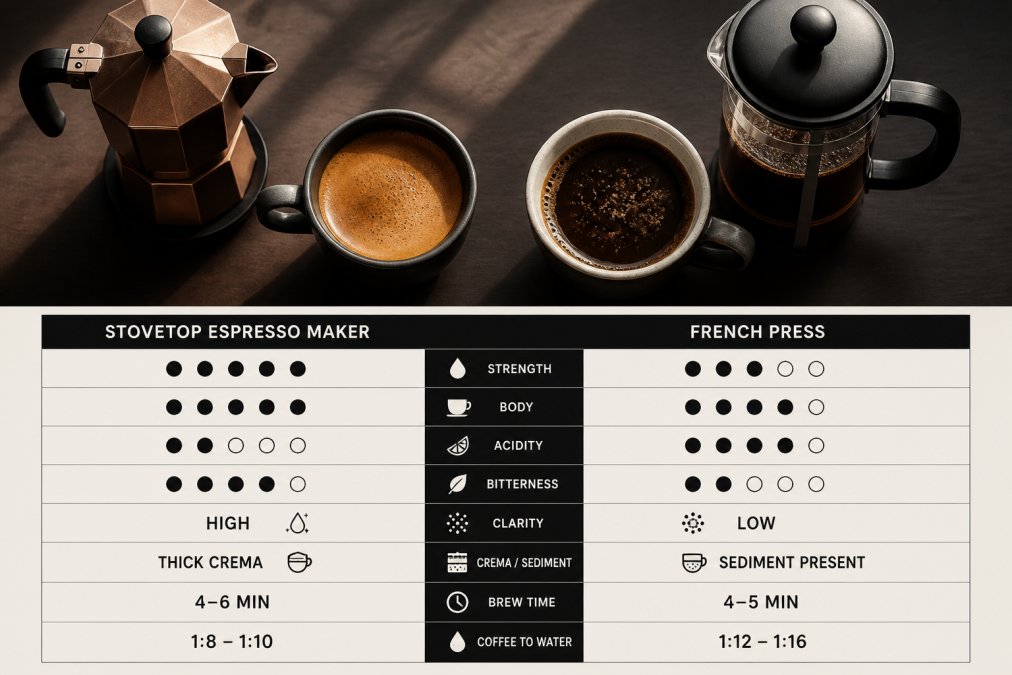
The table tells you the outcome. The next two sections explain why it happens.
How Pressure and Steeping Shape Body and Mouthfeel
Pressure and steeping are the two mechanisms behind every difference you taste. A moka pot forces hot water through a compacted bed of coffee, while a French press leaves grounds suspended in water and lets diffusion do the work.
What Pressure Does to the Cup
Pressure extracts fast and selectively. Water pushed through a medium-fine bed pulls oils and solubles out quickly, which is why moka coffee lands heavier on the tongue with a thicker texture. The tradeoff is that pressure also amplifies anything harsh in the roast, so a dark, over-roasted bean turns bitter fast in a moka pot.
What Full Immersion Does to the Cup
Full immersion extracts slowly and evenly. Grounds sit in water for four minutes, so the compounds that dissolve early (fruit acids, floral notes) have time to develop before the bitter compounds take over. The result is a softer, rounder cup with visible sediment that settles at the bottom of your mug.
Moka Pot vs French Press Flavor Profile: Acidity, Sweetness, and Bitterness
The moka pot vs french press flavor profile splits cleanly along three axes. Acidity reads brighter and more defined in a French press because slow steeping preserves delicate fruit acids. A moka pot mutes that brightness and converts it into sweetness and body.
Bitterness behaves the opposite way. Because pressure extracts aggressively, a moka pot punishes inconsistency. Grind too fine, heat too high, or leave it on the burner too long, and you get a sharp, ashy edge. A French press is far more forgiving; a slightly long steep mostly just adds weight.
Fiamma & Ferro Stainless Steel Stovetop →
Sweetness is where the moka pot wins. Concentrated extraction produces a syrupy, almost chocolate-like sweetness that most immersion brews cannot match. If you drink your coffee with milk, this is the profile you want underneath it.
- Choose the moka pot when you want intensity, sweetness, and a shot you can build a milk drink on
- Choose the French press when you want clarity, aroma, and a gentler cup that shows off a light roast
- Avoid the moka pot for very light, floral single-origins, which it tends to flatten
The Best Grind Size for Stovetop Espresso Makers and French Presses
Getting the best grind size for stovetop espresso makers and French presses right matters more than any other variable you control. The two brewers sit at opposite ends of the grind spectrum, and swapping them without adjusting your grinder is the single most common reason a cup tastes wrong.
Medium-Fine for the Moka Pot
Moka pots want a medium-fine grind, finer than drip but coarser than true espresso. The texture should feel like fine table salt. Level the basket gently and never tamp, because a compressed puck blocks the pressure path and forces water around the coffee instead of through it.
Coarse for the French Press
French presses want a coarse grind roughly the size of sea salt or raw sugar. Too fine and the grounds clog the mesh, slow the plunge, and leave grit in your cup. Too coarse and the water passes through without extracting enough, giving you a weak, hollow brew.
A consistent burr grinder matters more here than anywhere else, because blade grinders produce a mix of dust and boulders that no brewer can compensate for. The Specialty Coffee Association's brewing standards outline the extraction ranges these grind targets are built around.
Non-Toxic Coffee Brewing Materials: What Touches Your Coffee Matters
Non-toxic coffee brewing materials are the materials in direct contact with hot water and coffee during the brew. Heat and acidity together accelerate leaching, so the chamber, filter, and any plastic or coated parts in the path all matter.
This is the part most comparisons skip. Traditional moka pots are commonly made from aluminum, and many French presses use plastic or coated metal housings. Neither is automatically a problem, but if you are deliberately moving away from aluminum and plastic in your kitchen, the brewer's construction should be on your checklist alongside taste.
The Fiamma & Ferro Linea Suprema Stovetop Espresso Maker is built from 304 stainless steel with no aluminum brewing chamber and no plastic components touching the coffee. It is induction-ready, so it works on gas, electric, ceramic, halogen, and induction cooktops, and it ships with a protective canvas bag plus access to OEM replacement gaskets. At $169.99 for the 12-cup, 20 oz size, it is positioned for buyers who want the material spec to match the flavor result.
For French press drinkers, the same logic applies: look for a glass or stainless carafe with a stainless plunger and mesh, and check the lid assembly for plastic parts that sit against hot liquid.
Which Brewer Highlights Single-Origin Coffee Better?
The French press highlights single-origin coffee better in most cases. Full immersion preserves the delicate acidity, floral aromatics, and fruit-forward notes that define a good single-origin, and those are exactly the compounds aggressive pressure extraction tends to flatten.
Fiamma & Ferro Stainless Steel Stovetop →
That said, the answer depends on the origin. A bright, tea-like Ethiopian washed coffee shows its best side in a French press. A nutty, chocolate-forward Brazilian or a natural-process bean with heavy sweetness often tastes fuller and more complete through a moka pot, where concentration plays to its strengths.
If you drink single-origins black and want to taste the farm, the French press is the clearer window. If you want a single-origin to stand up against milk or to serve as the base of a morning ritual, the moka pot gives you more to work with.
Matching the Brewer to Your Daily Ritual
Matching the brewer to your daily ritual is less about which cup is objectively better and more about which one you will actually make every morning. The moka pot asks for attention: grind, fill, assemble, watch the heat. The French press asks for patience: grind, pour, wait four minutes, press.
Both reward consistency. A common mistake is buying premium beans and then grinding them days ahead of brewing. Coffee starts losing aromatic compounds within minutes of grinding, which is why the Fiamma & Ferro Espresso Ritual Bundle pairs the 12-cup moka pot with the Titanium+ Precision Manual Grinder, a CNC-cut conical burr grinder with a titanium coating and a 10-year burr performance warranty, at $399.98 for the set. Grinding immediately before brewing preserves the oils and aromatics that make either method worth the effort.

For deeper guidance on extraction variables, the National Coffee Association's brewing resources cover water temperature and ratio fundamentals that apply to both brewers. And if you want to understand how grind uniformity affects extraction at a technical level, UC Davis Coffee Center research is worth reading.
The real challenge is not choosing between these two brewers. It is finding equipment that matches your standards for materials, durability, and daily use, and then committing to one method long enough to learn it. Fiamma & Ferro builds stainless steel moka pots with 304 food-contact surfaces, no aluminum brewing chamber, no plastic parts touching your coffee, induction compatibility, and OEM replacement gaskets, so your brewer stays in service for years rather than seasons. Get started with Fiamma & Ferro and brew a cleaner, richer cup with equipment built to last.
Frequently Asked Questions
Does a stovetop espresso maker produce true espresso?
No. A stovetop espresso maker builds roughly 1 to 2 bar of pressure, while a pump espresso machine runs at about 9 bar. The result is a concentrated, syrupy coffee with moka-style character rather than a true 9-bar shot. That said, the stovetop espresso vs french press gap in intensity is still wide: the moka pot pushes water through a packed bed of medium-fine coffee, so you get far more dissolved solids and body per ounce than a French press ever delivers.
Why does French press coffee taste more textured than moka pot coffee?
A French press uses a metal mesh filter, so fine particles and coffee oils pass straight into your cup. That is what creates the heavy, silky, sometimes gritty texture people describe. A moka pot uses a metal filter basket too, but the pressure-driven flow and finer grind leave more sediment behind in the basket. If you want the moka pot's cleaner cup with more body than drip, a stainless steel model such as the Fiamma & Ferro 12-cup induction moka pot gives you that middle ground.
Which grind size works for each brewer?
The best grind size for stovetop espresso makers is medium-fine, close to table salt, leveled gently in the basket and never tamped. Too fine and the moka pot chokes or turns bitter; too coarse and the water races through under-extracted. A French press needs a coarse grind, roughly like sea salt or breadcrumbs, because a 4-minute steep with fine grounds clogs the mesh and leaves sludge. A grinder with marked adjustment steps lets you switch between both without guesswork.
Are there any coffee makers that don't use plastic?
Yes, and it matters for flavor as much as for material purity. Non-toxic coffee brewing materials means the hot water and coffee only contact stainless steel, glass, or ceramic. The Fiamma & Ferro Linea Suprema stovetop espresso maker uses 304 stainless steel food-contact surfaces with no aluminum brewing chamber and no plastic components touching the coffee, and its copper PVD finish is a coating rather than paint. A classic glass French press with a stainless plunger is the other plastic-free option.