

Coffee Maker for Induction Cooktop: 2026 How-To Guide
Table of Contents
- Why Induction Cooktops Need the Right Coffee Maker
- How to Use a Moka Pot on an Induction Stove
- Induction Cooktop Coffee Maker Adapter: When and How to Use One
- Stainless Steel vs. Aluminum: Material Matters for Induction
- Troubleshooting Induction Coffee Brewing Problems
- Grind Size and Water Chemistry for Better Induction Brewing
- Maintenance and Cleaning for Induction Coffee Makers
- Energy Efficiency: Induction vs. Traditional Stovetops
- Conclusion
- Frequently Asked Questions
Last Updated: September 17, 2026
Why Induction Cooktops Need the Right Coffee Maker
An induction cooktop generates heat through a magnetic field, not a flame or glowing coil, which means it only works with cookware that a magnet will stick to (Making the Switch to Induction Stoves or Cooktops). That single fact explains why so many stovetop coffee makers fail on induction: their bases simply aren't magnetic.
Here's the good news. Once you understand the compatibility rules, a coffee maker for induction cooktop use is one of the most rewarding ways to brew at home. You get fast, even heat, precise control, and a rich cup of stovetop espresso without a bulky machine.

This guide covers the full picture: how to brew, which materials work, how to troubleshoot when things go wrong, and how to keep your equipment running for years. Below, we'll walk through each step so you can brew with confidence on day one.
How to Use a Moka Pot on an Induction Stove
Using a moka pot on an induction stove follows the same basic method as any stovetop brewer, with one key difference: you must confirm the base is induction-ready before you start. If a magnet sticks firmly to the bottom, you're set.
Step-by-Step Brewing Instructions
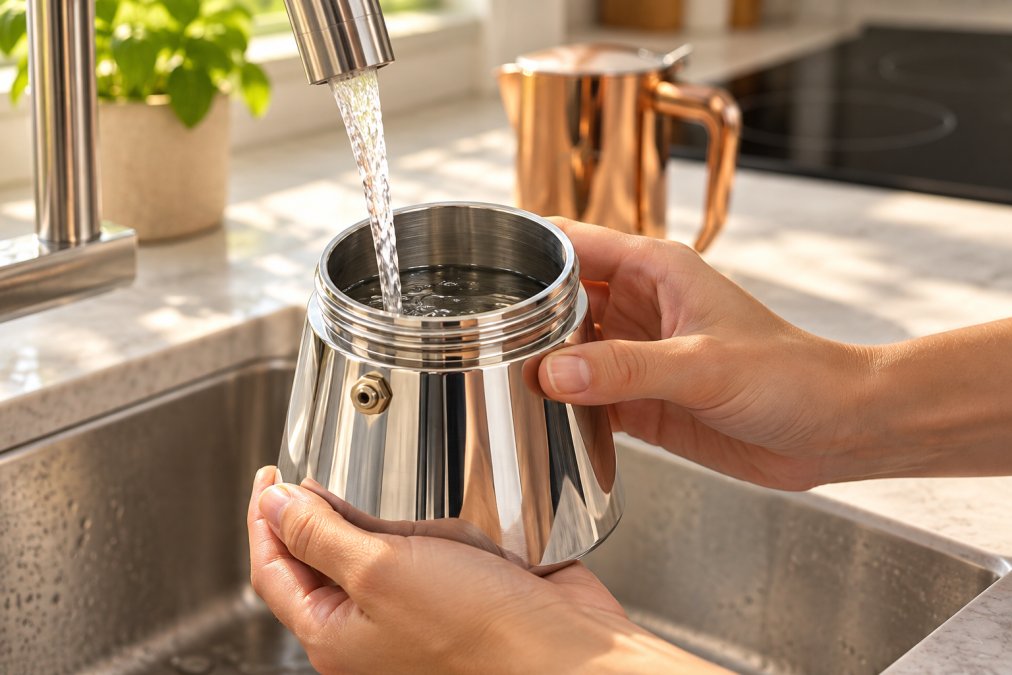
- Fill the lower chamber with cold water up to the safety valve. Never cover the valve.
- Add medium-fine coffee to the filter basket. Level it gently. Do not tamp.
- Screw the two chambers together firmly, but don't overtighten.
- Place the pot centered on the induction zone. The base diameter must match the ring size.
- Set medium heat and wait. Coffee rises into the upper chamber in a few minutes.
- Remove the pot as soon as it gurgles, then stir and pour.
Temperature Control and Optimal Heat Settings
Medium heat is the target on an induction cooktop. Higher heat intensity doesn't brew faster in a useful way; it scorches the grounds and pushes water through too quickly.
Induction responds instantly, so you can lower the setting the moment coffee starts flowing. That responsiveness is an advantage over gas, where heat lingers after you turn it down.
Induction Cooktop Coffee Maker Adapter: When and How to Use One
An induction adapter plate (also called a diffuser or interface disc) is a thin disc of ferromagnetic metal that sits between your cooktop and a non-magnetic pot. The cooktop's magnetic field induces currents in the disc, the disc heats up, and that heat transfers by conduction into the brewer resting on top. It is a workaround, not a conversion: the plate becomes the heating element, and your pot becomes a passive recipient of that heat.
When an Adapter Makes Sense
Use one only when you already own a brewer you love that isn't induction-ready, a vintage aluminum moka pot, a thin-gauge stainless pot with a non-magnetic base, or a ceramic-lined brewer. If you're buying new, skip the adapter and choose an induction-ready pot instead. Adapters add a layer of thermal lag between the cooktop and the coffee, which makes temperature control less precise and slows the brewing cycle.
What to Look For
- Ferromagnetic material. The plate itself must attract a magnet. Cast iron and many carbon-steel discs qualify; pure aluminum and copper do not.
- Diameter matched to the pot base. A plate smaller than the pot base creates a hot spot in the center. A plate larger than the induction ring wastes heat outside the field.
- Thickness. Thicker plates spread heat more evenly but respond more slowly. Thinner plates react faster but can develop hot spots under a narrow moka base.
- Flat, smooth surface. Warped or pitted plates make poor contact with both the cooktop and the pot, which is where uneven extraction starts.
- A raised rim or lip (optional). Some plates have a shallow lip that keeps a narrow pot from sliding off-center.
How to Use One Correctly
- Place the plate flat and centered on the induction zone. Confirm the zone's ring size matches the plate diameter.
- Preheat the plate on medium for a minute or two before setting the pot on it. This shortens the lag once brewing starts.
- Center the pot on the plate. If the pot base is narrower than the plate, keep it dead center.
- Expect a longer time-to-boil than a direct induction-ready pot, often noticeably longer, since heat has to conduct through an extra layer.
- Lower the heat the moment coffee starts rising. The plate holds residual heat, so backing off early prevents a scorched finish.
- Let the plate cool completely before handling or storing it.
Stainless Steel vs. Aluminum: Material Matters for Induction
Stainless steel is the better choice for induction brewing, and it isn't close. Aluminum isn't ferromagnetic, so a pure aluminum moka pot won't trigger the induction sensor at all. Stainless steel, by contrast, responds to the magnetic field directly and holds up to years of daily use.
There's a flavor argument too. Aluminum is a reactive metal, and many brewers prefer to keep it out of the brewing path entirely. A 304 stainless steel body with no aluminum brewing chamber and no plastic touching the coffee can contribute to a cleaner-tasting cup.
Thermal conductivity is where aluminum has a slight edge, since it spreads heat faster. Stainless steel compensates with better heat retention and far greater durability. For induction, durability and compatibility win.
Here's how the two stack up:
Fiamma & Ferro Stainless Steel Stovetop →
Factor |
Stainless Steel |
Aluminum |
|---|---|---|
Works on induction |
Yes, if ferromagnetic base |
No, unless coated or adapted |
Flavor neutrality |
High |
Reactive with acidic coffee |
Durability |
Excellent, resists dents |
Dents and warps more easily |
Heat distribution |
Even, slower to heat |
Fast, less even |
Maintenance |
Easy to clean, dishwasher-safe on some models |
Hand wash, can discolor |
Troubleshooting Induction Coffee Brewing Problems
Most induction brewing problems fall into two buckets: the cooktop doesn't recognize the pot, or the coffee comes out weak and slow. Both have straightforward fixes.
Cooktop Not Detecting the Pot
The base isn't magnetic, the pot is off-center, or the base is smaller than the induction ring. Test with a magnet first. If it sticks, reposition the pot so it sits dead center on the zone. If the base diameter is too small for your ring, the sensor may never engage.
Weak or Slow Extraction
Weak coffee usually means the grind is too coarse, the heat is too low, or the gasket is worn and steam is escaping. Check the grind first, then the heat setting, then inspect the gasket. A stiff or cracked gasket lets pressure leak, which stalls the brewing cycle.
Grind Size and Water Chemistry for Better Induction Brewing
Grind size and water quality shape your cup as much as the brewer does. For moka brewing, aim for a medium-fine grind, finer than drip but coarser than true espresso. Too fine and the pressure valve strains; too coarse and water races through without extracting flavor.
Water chemistry matters more than most guides admit. Coffee extracts best with water that has some mineral content, roughly in the range brewers use for filter coffee. Distilled or overly soft water pulls flat, hollow flavors, while very hard water can scale your brewer and mute the coffee aroma.
If your tap water tastes good, it will usually brew good coffee. If it tastes off, filtered water is a simple upgrade. Pair that with fresh-ground beans and the difference in the cup is noticeable.
Maintenance and Cleaning for Induction Coffee Makers
Moka pots last for years when you clean them properly, and most damage comes from neglect rather than wear. Rinse all parts in warm water after each brew and dry them fully before reassembling. Skip the abrasive scrubbers, which scratch stainless steel and dull the finish.

Every few weeks, take the brewer apart completely: filter basket, gasket, and the upper filter screen. Coffee oils build up in places you can't see during a normal rinse. A soft brush and warm water handle it.
Gasket replacement is the routine maintenance most owners forget. Silicone gaskets harden over time, and a stiff ring stops sealing properly. Replacing it is inexpensive and takes a minute. Buying OEM replacement parts ensures a proper fit, which matters for both pressure and safety.

- Rinse and dry after every brew
- Deep clean the basket and screen monthly
- Replace the gasket when it stiffens or cracks
- Store the pot unassembled so the gasket relaxes
Energy Efficiency: Induction vs. Traditional Stovetops
Most guides on induction brewing stop at "induction is efficient" and move on. That's the gap worth filling, because the efficiency claim is only useful if you understand where the energy actually goes and how to measure your own setup.
Where the Heat Goes
Induction works by inducing eddy currents in the ferromagnetic base of the cookware itself. The pot is the heating element. That means almost none of the energy is spent warming the air between the burner and the pot.
Gas and electric coil cooktops work differently. Gas burns a flame in open air, and a meaningful share of that heat escapes around the sides of the pot rather than into it. Electric coil and radiant glass-top elements heat a metal element or glass surface first, then rely on contact and radiation to move that heat into the cookware, with losses at every step. Induction skips those intermediate steps entirely.
Fiamma & Ferro Stainless Steel Stovetop →
What That Means for Moka Brewing
For a stovetop brewer, the practical effects are:
- Faster time-to-boil. The base heats directly, so the water in the lower chamber reaches brewing temperature sooner.
- Less waste heat in the kitchen. No open flame and no glowing coil means the surrounding air stays cooler, which matters in a small kitchen during summer.
- Tighter control. Because the cooktop responds almost instantly when you change the setting, you can cut heat the moment coffee starts rising instead of waiting for a coil to cool down.
- Lower standby loss. There's no hot element left radiating after you turn the burner off.
How to Compare Your Own Setup
A simple test: brew the same moka pot on the same setting twice, once on induction and once on your old cooktop, and time from cold water to first coffee rising. The induction run is typically shorter, and the difference is the clearest evidence you'll get without instrumentation.
The Trade-Off
Induction's efficiency only applies when the pot is compatible. A non-magnetic brewer on an induction zone draws nothing at all, the cooktop simply won't engage. That's why base material matters so much: the efficiency advantage is real, but it's conditional on the ferromagnetic base doing its job.
U.S. Department of Energy guidance on induction cooking efficiency
Conclusion
Getting the material right is important for induction brewing. Choose a brewer with a ferromagnetic stainless steel base, match it to your cooktop zone, and the rest is technique.
Fiamma & Ferro builds equipment for exactly this. The Linea Suprema 12-Cup Stovetop Espresso Maker uses a 304 stainless steel body with no aluminum brewing chamber and no plastic touching your coffee, and its induction-ready base works on gas, electric, ceramic, halogen, and induction cooktops. Pair it with the Titanium+ Precision Manual Grinder for fresh medium-fine grounds, and consider keeping an OEM replacement gasket on hand.
Get started with Fiamma & Ferro to brew stovetop espresso on your induction cooktop.
Frequently Asked Questions
Can I use a standard moka pot on an induction cooktop?
Only if the moka pot has a ferromagnetic base. Most traditional aluminum moka pots will not work because aluminum is not magnetic. Check the bottom with a magnet: if it sticks, the pot is induction-ready. Stainless steel models with a magnetic base, like the Fiamma & Ferro Linea Suprema, work on induction, gas, electric, ceramic, and halogen cooktops.
Do I need an induction adapter plate for my moka pot?
An induction adapter plate is only necessary if your moka pot is not induction-compatible. The adapter sits between the cooktop and the pot, transferring heat through conduction. However, it slows heating and reduces energy efficiency. If you brew on induction regularly, buying an induction-ready stainless steel moka pot is a better long-term choice than relying on an adapter.
Why is my induction cooktop not detecting my coffee maker?
The most common reason is that the base is not ferromagnetic. Induction cooktops generate a magnetic field that only reacts with magnetic materials like stainless steel with an iron core. If the base diameter is too small for the cooktop's induction sensor, the cooktop may also fail to detect it. Try centering the pot on the smallest burner zone and confirm the base is magnetic.
How does induction heating affect coffee extraction?
Induction heating transfers energy directly to the pot's base, so the water reaches brewing temperature quickly and evenly. This consistent heat distribution helps maintain steady pressure during the brewing cycle, which supports a more even extraction, provided you use a medium-fine grind and avoid overheating.